


10 Best SMS OTP Service Providers in 2026


Published: Apr 30, 2026

SMS one-time passwords (OTP) are one of the most popular authentication options for online platforms. Fintech services, SaaS platforms, marketplaces, and gaming platforms are some of the many services using SMS one-time passwords for user verification and protection against fraudulent activities.
Selecting the best SMS OTP service provider is no longer as easy as it used to be a few years ago, with delivery reliability being location-dependent, price structures of providers being vastly different, and many platforms using multi-channel authentication rather than relying on a single method such as SMS OTPs alone.
A low-performing OTP service provider may result in delays, failed login attempts, and higher costs for OTP messages, as well as support requests.
Within this guide, we will discuss how to evaluate SMS one-time password service providers in 2026, what aspects of such services are of the greatest importance for successful authentication, and what platforms are being used for user verification and authentication purposes.
How We Evaluated the Best SMS OTP Service Providers
Choosing an SMS OTP provider involves much more than comparing message rates. Authentication performance depends on factors such as deliverability, fraud prevention, routing quality, global coverage, and developer experience. To help businesses evaluate providers more effectively, we assessed each platform using the following criteria:
- Global coverage: The number of countries, carrier connections, and mobile networks supported for OTP delivery.
- Verification channels: Availability of SMS OTP as well as alternative verification methods such as WhatsApp OTP, Viber OTP, voice OTP, email OTP, and flash call verification.
- Route quality: The provider's ability to deliver authentication messages quickly and reliably through high-quality carrier routes and optimized messaging infrastructure.
- Security controls: Features such as rate limiting, traffic monitoring, SMS pumping protection, device intelligence, anomaly detection, and verification abuse prevention.
- Developer experience: Quality of API documentation, SDK availability, implementation guides, sandbox environments, webhooks, and overall ease of integration.
- Analytics and reporting: Visibility into OTP delivery rates, verification success rates, message status updates, authentication activity, and performance trends.
- Pricing transparency: Clarity around message rates, verification fees, sender registration costs, setup charges, and other pricing considerations.
- Scalability and enterprise readiness: The provider's ability to support growing authentication volumes, global expansion, multi-channel verification workflows, and high-availability requirements.
Top SMS OTP Service Providers in 2026
Businesses looking for reliable OTP authentication platforms often evaluate several providers before choosing one. Below are some of the most commonly used SMS OTP service providers in 2026.
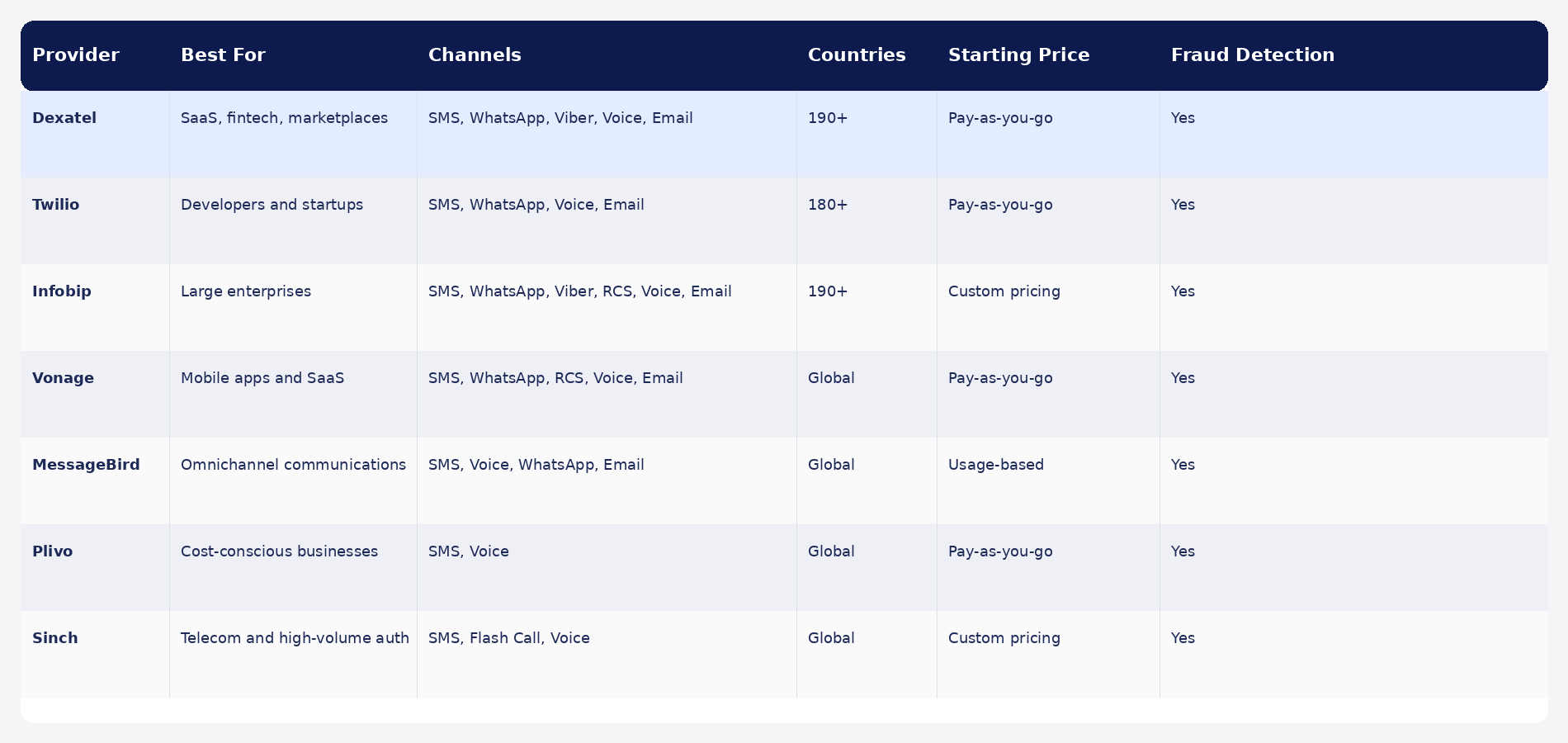
These platforms provide APIs and infrastructure that allow businesses to send one-time passwords for secure user authentication across global markets.
Why Businesses Need Reliable SMS OTP Providers
The verification of users is an essential element of digital security. Users need to be verified when they create an account, log in, or make transactions with a business.
The popularity of using the SMS OTP method is due to the fact that it is supported by all phones and does not require the user to download any other application or program to receive the verification code.
The delivery of the OTP is also not guaranteed, and if the user does not receive the verification code within a few seconds, they may ask for the code to be resent, or they may leave the process altogether.
This is a problem for many growing SaaS, fintech, and online marketplaces, as it may cause several issues for the business, such as:
- Failure of user verification
- Increase in customer support requests for login issues
- Increase in the costs of messages sent for user verification
- Increase in fraud and abuse of the platform
Therefore, it is essential for a business to choose a good and reliable SMS OTP service provider, as they will be able to provide the best services for user verification.
Authenticate Users With Dexatel SMS OTP
Deliver verification codes quickly and reliably through a global messaging infrastructure built for authentication workflows. Dexatel helps businesses automate SMS OTP delivery, improve verification success rates, and protect user accounts across registration, login, password recovery, and transaction approval processes.
Secure your users with SMS OTP
Deliver one-time passwords instantly via SMS — fast, globally supported, and easy to integrate. Start your 30-day free trial today.
Key Points When Choosing an SMS OTP Service
Not all OTP services are the same in terms of reliability, global coverage, and overall infrastructure. Before selecting a service provider, there are several key points to check, which will affect the overall reliability and cost of the service.
Delivery Speed and Reliability
OTP messages must arrive in a matter of seconds. Delaying the delivery of these messages will cause users to attempt resending the OTP or abandon the login process altogether. A reliable service provider should have excellent global routing and direct connections with the mobile network operators wherever possible. Using a large number of third-party aggregators will cause delays and increase the overall failure rate of the OTP service. If your company has international operations, it is a good idea to check the delivery in your target markets first.
Global Coverage
The user verification systems need to operate in various countries and with various carriers. While there are many SMS OTP service providers that operate effectively in North America and Europe, there are instances when the services fail to operate effectively in other places, e.g., Africa, Southeast Asia, or the Middle East. When selecting SMS OTP service providers, it is essential to evaluate their coverage and routing capabilities across the globe. The more the number of carriers they have, the better the delivery of their services.
API Quality and Developer Experience
Most platforms will include the OTP verification as part of the login process of the app. As a result, the quality of the provider's API is very important.
A good quality SMS OTP service provider should:
- Have a well-documented API
- Have SDKs available for popular programming languages
- Have a simple integration process, especially for authentication-related work
- Have a reliable way of tracking the status of the message
The API quality and the overall experience of the provider are also important.
Fraud Detection and SMS Pumping Protection
SMS pumping fraud (also known as artificial traffic inflation) occurs when attackers generate large volumes of OTP requests to phone numbers they control, creating messaging costs without legitimate user activity. At scale, these attacks can significantly increase authentication spend and distort verification metrics. When evaluating providers, look beyond basic reporting and assess whether they offer proactive fraud controls such as traffic monitoring, rate limiting, behavioral analysis, phone number intelligence, anomaly detection, and pre-send risk assessment capabilities that can identify suspicious verification attempts before messages are sent. Understanding how providers handle messaging abuse and A2P traffic violations is becoming increasingly important for businesses with large authentication volumes.
Multi-Channel Verification Support
While SMS is still being used, it has become a trend to use multiple channels to make it more reliable.
If SMS is not being delivered or is taking a while, another method can be used, such as:
- WhatsApp One-Time Password
- Voice One-Time Password
- Sending via Email
- Using apps like Viber, Telegram, etc.
This makes it much more likely to succeed, especially when used across a global platform.
Pricing Transparency
The pricing transparency for SMS OTP is variable between providers. Some platforms charge simple pay-per-use pricing, while others charge additional fees for renting numbers or messaging.
Businesses should consider:
- The sms rates per region
- Any additional fees charged by the platform
- The pricing of other verification methods
- Discounts offered based on the volume
The pricing model is essential, especially for platforms that anticipate increased user verification traffic in the future.
OTP Conversion Rate and Verification Success
Delivery rate only measures whether a message reached a device. It does not reveal whether the user successfully completed verification. A more meaningful metric is the OTP conversion rate, typically calculated as the percentage of verification requests that result in a successful authentication. Factors such as delivery speed, user experience, carrier filtering, fallback logic, message formatting, and regional network conditions can all affect conversion rates even when delivery rates appear high. When evaluating providers, ask whether they can report verification success rates by country, carrier, channel, and authentication flow. These insights often provide a more accurate picture of authentication performance than delivery metrics alone and can help identify opportunities to improve onboarding, reduce abandonment, and increase successful user verification.
Top SMS OTP Providers
Dexatel
Delivery and reliability
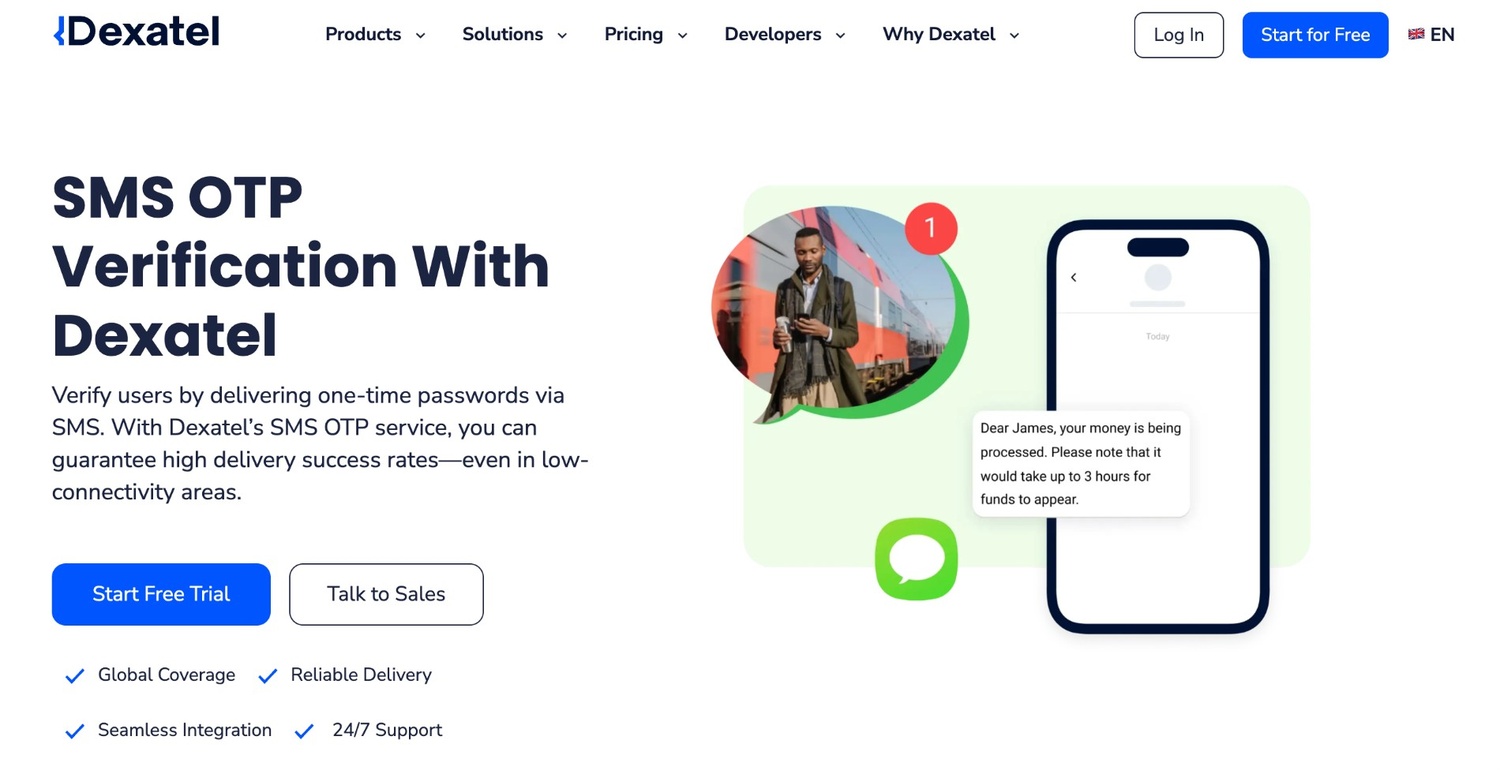
Dexatel presents itself as a “Business Messaging Platform” supporting SMS, WhatsApp, Viber, voice, and more, with the product “Verify” being part of the platform. Its messaging is not just limited to OTPs and is likely appealing to businesses that think in terms of authentication and failure strategies.
Global coverage
Dexatel is built for global communications, and the product structure indicates a solution designed for international use rather than being domestically focused. For businesses with international reach, this is likely a significant factor in the overall product decision.
API quality and developer experience
Dexatel has built APIs for the product suite, including “Verify,” “Lookup,” and messaging. From the purchaser’s point of view, the main strength is that verification is integrated with the overall communications platform and is not separated from the rest of the product suite.
Fraud prevention
Public WhatsApp pricing materials discuss how Number Lookup can be used to verify if a phone number is active on WhatsApp, indicating a focus on traffic quality. Although different from OTP anti-fraud, it suggests a viable solution to eliminate unnecessary expenditure.
Multi-channel verification
This is Dexatel’s strongest feature. They offer multi-channel verification via SMS, WhatsApp, Viber, etc. Viber OTP materials discuss how smart SMS fallback can be achieved. This is useful for businesses that require better success rates for authentication attempts by selecting the best channel for a given region, as opposed to defaulting to SMS.
Pricing
Dexatel discusses how transparent WhatsApp pricing is in their public materials. They also have separate pricing pages for different channels. The Viber OTP page discusses how Viber OTP can be used to reduce authentication expenditure compared to traditional SMS. It also discusses how smart SMS fallback can be achieved. This is useful for businesses that require better management of authentication expenditure in different regions.
Best fit
Dexatel is ideal for global businesses looking for multi-channel OTP delivery with configurable fallback across supported messaging channels, alongside Voice OTP and Flash Call verification options.
Twilio
Delivery and reliability
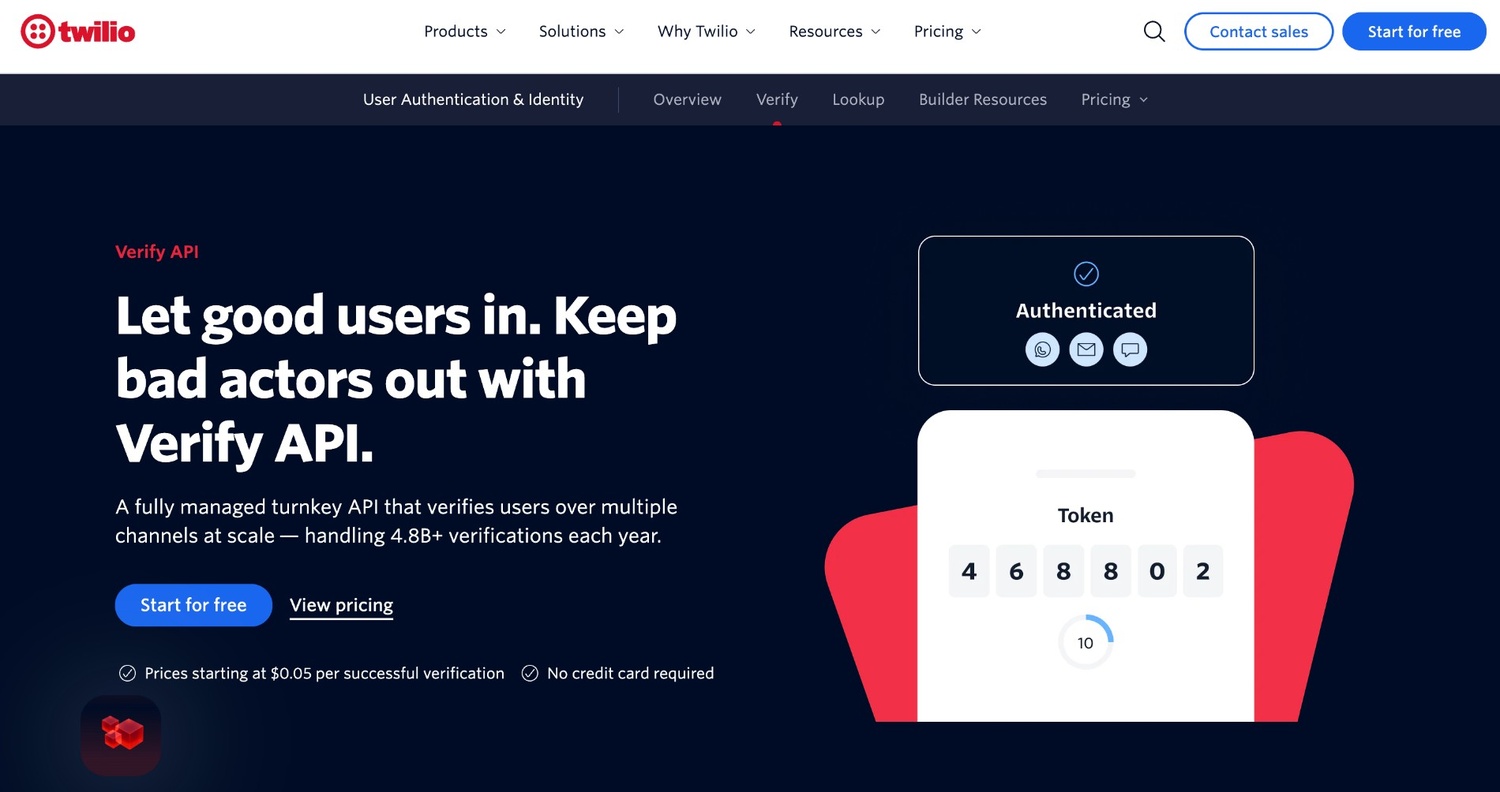
Twilio is an established player in the authentication market because of its reliable messaging service. It is an option that many consider if they need a provider that has been around for a while, has good documentation, and is well-supported. Verify is an authentication-as-a-service product that is designed for authentication. It has various verification capabilities that can be done in one API. This makes it suitable for companies that need more than just sending messages.
Global coverage
Twilio is suitable for companies that need an international solution. It has Verify, an authentication solution that is suitable for the global market. This is suitable for companies that need to cover many countries. It is better if you need consistent service in many places rather than an in-country solution.
API quality and developer experience
Twilio is good at this. They offer official SDKs, documentation, and a developer experience that is usually easy to use. This is suitable for companies that value an easy setup experience.
Fraud prevention
Twilio has documentation on how WhatsApp Verify can prevent fraud. It is suitable for companies that value fraud prevention in their authentication service. Verify is designed as an authentication service rather than just an SMS service.
Multi-channel verification
Twilio supports SMS, WhatsApp, voice, email, Silent Network Authentication, and many other methods of verification within Verify. This makes it suitable for companies that use fallback methods.
Pricing
Twilio has an easy-to-understand pricing structure. However, it is not the cheapest option. Verify pricing is based on the cost of each successful verification. It is based on the channel used. There is a cost per verification that is charged for SMS, WhatsApp, voice, and email. For WhatsApp, there is an additional cost per message that is charged on top of the cost charged by Meta.
Best fit
Twilio is a good choice for developer-driven teams, for startups that need fast integration, and for businesses that already use Twilio for other communication-related work. Twilio excels when integration is more important than the lowest-cost routing.
Infobip
Delivery and reliability
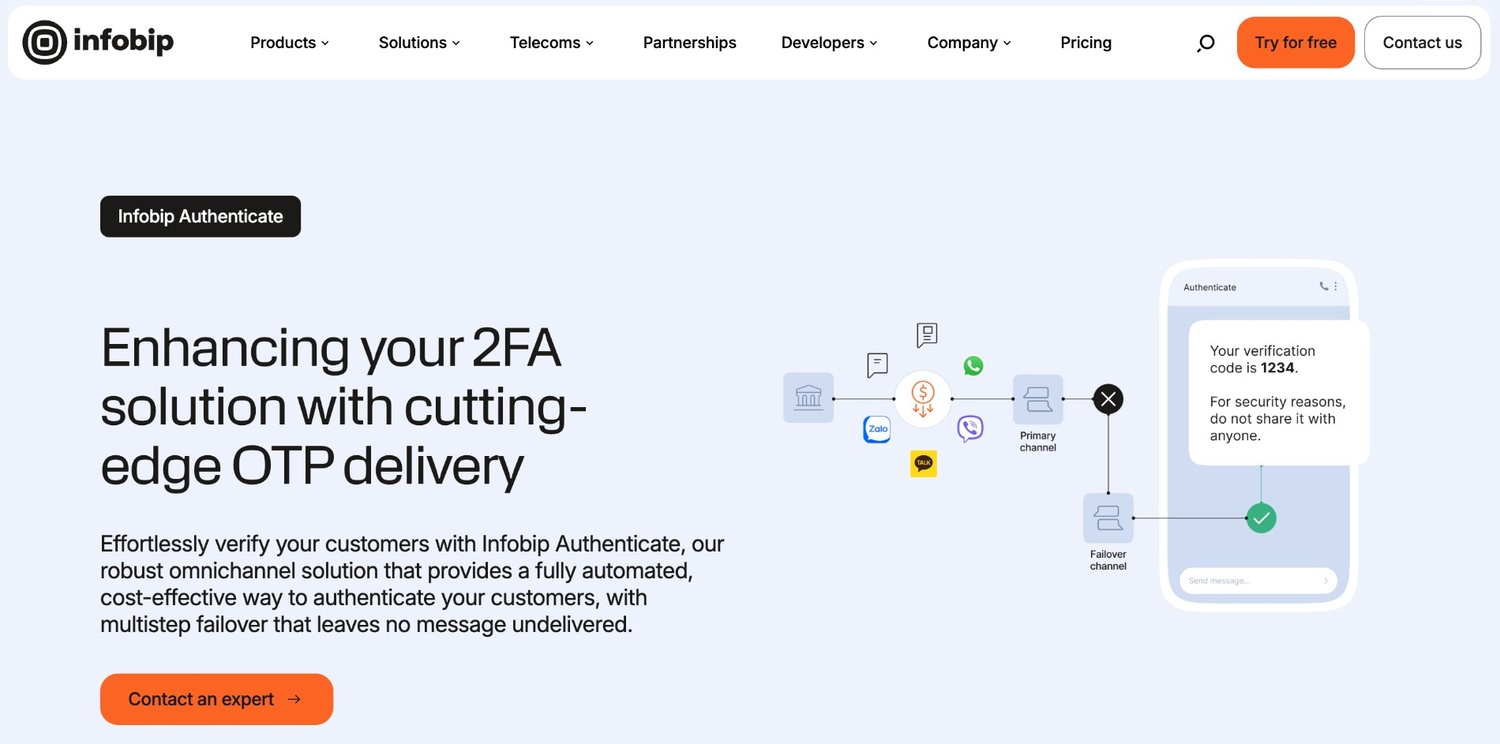
Infobip is a company that specializes in providing communications services. Its authentication service is designed to provide a simpler experience through a single integration. It is not simply an SMS service but provides a full authentication infrastructure that can be used by larger businesses.
Global coverage
This service is of interest to many businesses that have a global reach and need a service that can provide the same level of global delivery that Infobip offers. Larger businesses will tend to use Infobip as they have a presence in many countries and will use a single service provider in many of these countries, rather than using different providers in different countries.
API quality and developer experience
The company provides authentication and channel integrations through a single API. Infobip is a company that seems to be more focused on the enterprise than other brands that we have reviewed. This is likely because Infobip is focused on providing a service that can be used by larger businesses.
Fraud prevention
The authentication messages that Infobip provides are focused on providing a secure identity verification service. This makes the service suitable for businesses that need authentication as part of a larger communications setup.
Multi-channel verification
This is one of the major advantages of the Infobip authentication service. It provides authentication through multiple channels, including SMS, WhatsApp, RCS, Viber, and many other services. This makes the service much more suitable for businesses that need authentication through multiple channels.
Pricing
The company provides a service that is focused on the enterprise and is less focused on providing transparent pricing that can be easily understood by businesses. It is usually better suited for businesses that are ready for the negotiation and contract process that Infobip provides. This is based on the way the service is presented and the way that the company sells the service.
Best fit
This service is best suited for larger businesses and enterprises that have a global reach.
Vonage
Delivery and reliability
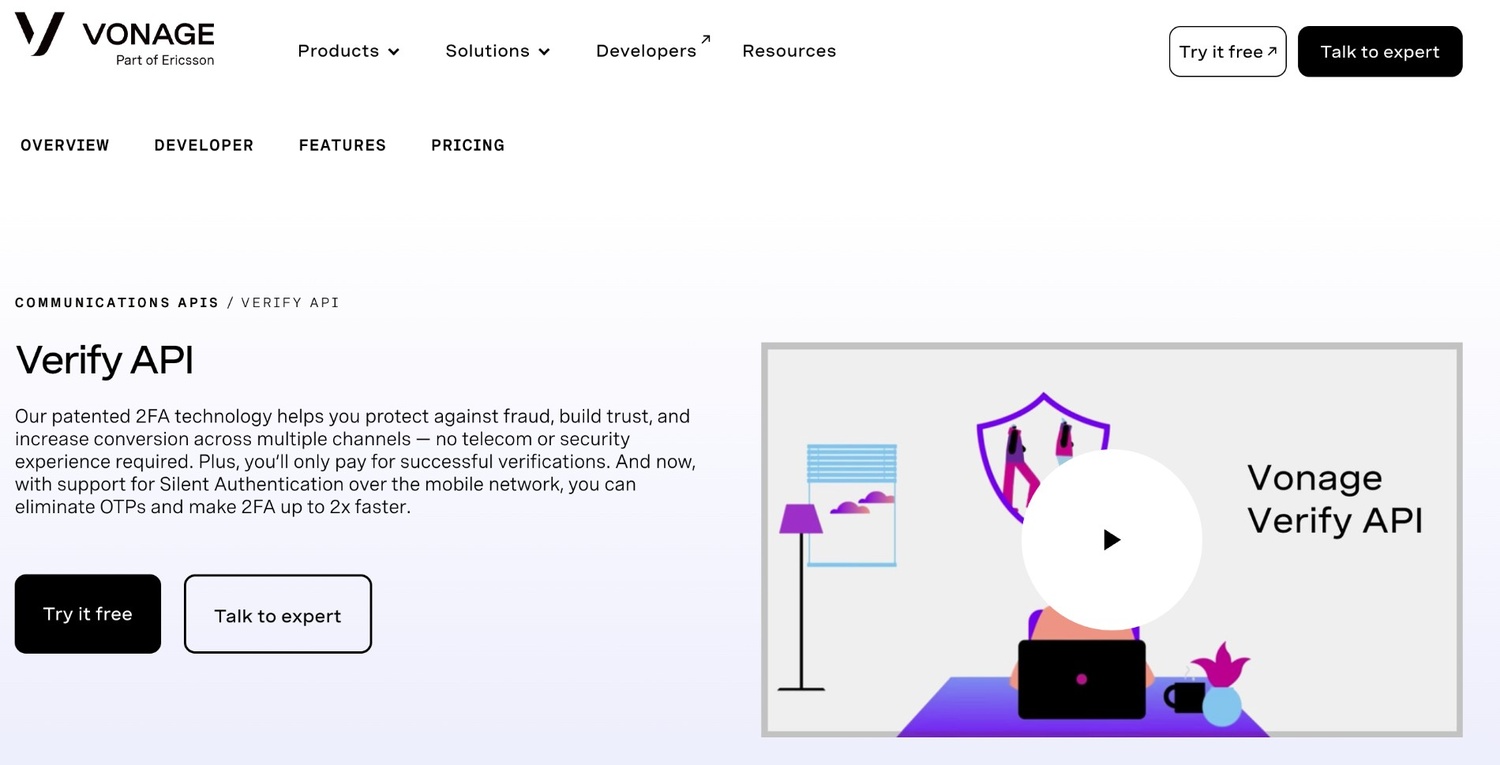
Vonage’s Verify API is what they use for authentication. It’s a complete verification tool that’s not just a simple SMS delivery solution. It’s a tool that’s meant for global usage with inherent authentication steps. This is good for businesses that want a complete solution for verification.
Global coverage
Verify is meant for customers who operate in a country or several countries. This makes it good for local as well as international businesses.
API quality and developer experience
Vonage is good for businesses that do a lot of API-based work. Their communication APIs are quite extensive. Verify is a part of that overall solution set. For a developer, the advantage is that authentication can be used alongside SMS, messaging, voice, etc.
Fraud prevention
Vonage highlights that Verify comes with inherent anti-fraud measures. This is good for businesses that experience a lot of fraud.
Multi-channel verification
Vonage is good for multi-channel verification. They highlight that Verify supports SMS, RCS, WhatsApp, voice, email, Silent Authentication, as well as failover.
Pricing
They highlight that you can pay only for successful conversions. Alternatively, you can opt for a flat rate for frequent logins.
Best for
Vonage is good for SaaS platforms, mobile applications, and businesses that want a flexible solution for verification with multi-channel support.
Bird
Delivery and reliability
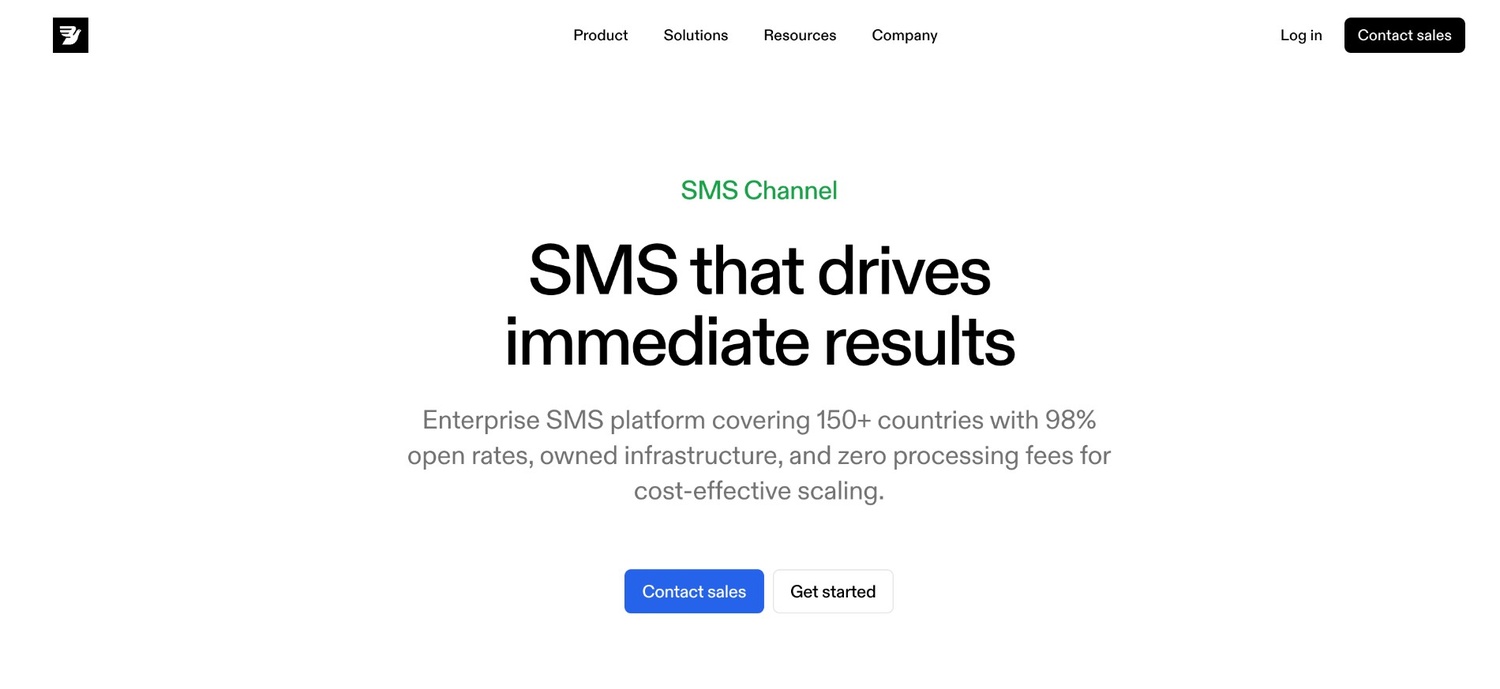
Bird’s Verify API is designed to handle token creation and delivery as a managed process. This can help businesses avoid implementing a lot of OTP code.
Global coverage
MessageBird is a well-known CPaaS provider that is often mentioned when discussing global communication APIs. It’s usually mentioned alongside Twilio, Vonage, and Sinch when a business requires a lot of communication options. Their Verify docs don’t really discuss OTP coverage.
API quality and developer experience
MessageBird is an API-centric solution that includes Verify docs, a quickstart guide, an API documentation section, and even a section for free test credits to give the solution a spin. This makes it relatively easy for a development team to give the concept a spin.
Fraud prevention
Their Verify solution is designed for managed verification flows. Compared to other providers in the space, MessageBird’s Verify docs don’t seem to highlight fraud prevention as much. This doesn’t mean it’s not a strong solution for fraud prevention; it’s just not something that’s really highlighted.
Multi-channel verification
According to the official MessageBird docs for their Verify solution, it’s mainly for verifying a phone number via SMS or verifying an email address. This is supplemented by other APIs that allow for WhatsApp and voice communications. While it does allow for multi-channel communication within the MessageBird platform, it’s not really highlighted as a multi-channel solution for the Verify product.
Pricing
Pricing information for the authentication solution isn’t really highlighted within the documentation like it is for other providers that offer a Verify solution. This can make it a bit more difficult to compare pricing for the solution when doing initial research. This is based on the documentation that’s accessible.
Best fit
MessageBird is a good option for companies that want a recognized CPaaS platform, API-driven implementation, and the ability to combine verification with broader messaging use cases over time.
Plivo
Delivery and reliability
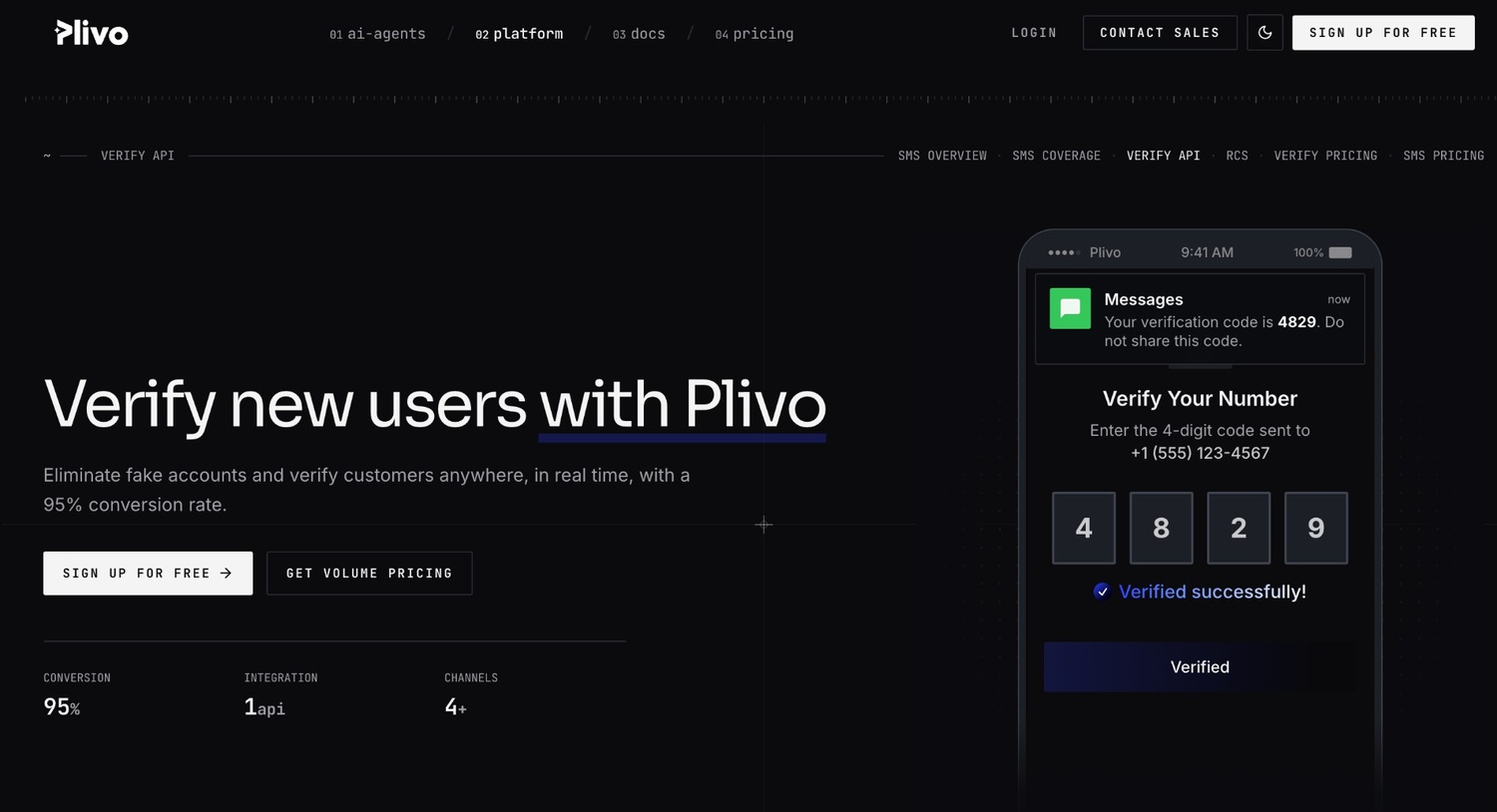
Plivo positions its Verify API as a secure, efficient solution for SMS and voice OTPs. The company’s status page indicates that its Verify API is an active product. For teams looking for a simple verification solution without bloat, Plivo might be an attractive option.
Global delivery
Plivo’s verification materials highlight its focus on international communication. The company’s verification materials do not highlight specific authentication metrics by country. This is a common consideration for teams looking to purchase international communication infrastructure.
API quality and developer experience
Plivo is considered easy to use, with its Verify API positioned as easy to integrate. This is a strong selling point for teams looking for a better developer experience without having to pay Twilio’s prices.
Fraud prevention
Plivo’s strong selling point is its fraud prevention capabilities. The company’s Twilio alternative page indicates that its Verify API offers SMS pumping fraud prevention. Additionally, there is no charge per authentication, only charges for SMS and voice. This is a strong selling point for businesses looking to prevent fraud.
Multi-channel verification
Plivo’s Verify API is focused on SMS and voice OTP, providing strong fallback options. The company’s verification solution is not as strong as others that offer WhatsApp, Email, RCS, and app-based authentication as part of a single verification process.
Pricing
Plivo’s strong selling point is its cost transparency. The company offers no verification fees, only charging customers for SMS & Voice. This is a strong selling point for teams looking for a simple verification solution without hidden fees.
Best fit
Plivo is best suited for startups, SaaS teams, & product-led organizations looking for SMS & Voice One Time Passwords with a strong focus on cost efficiency & fraud prevention.
Sinch
Delivery and reliability
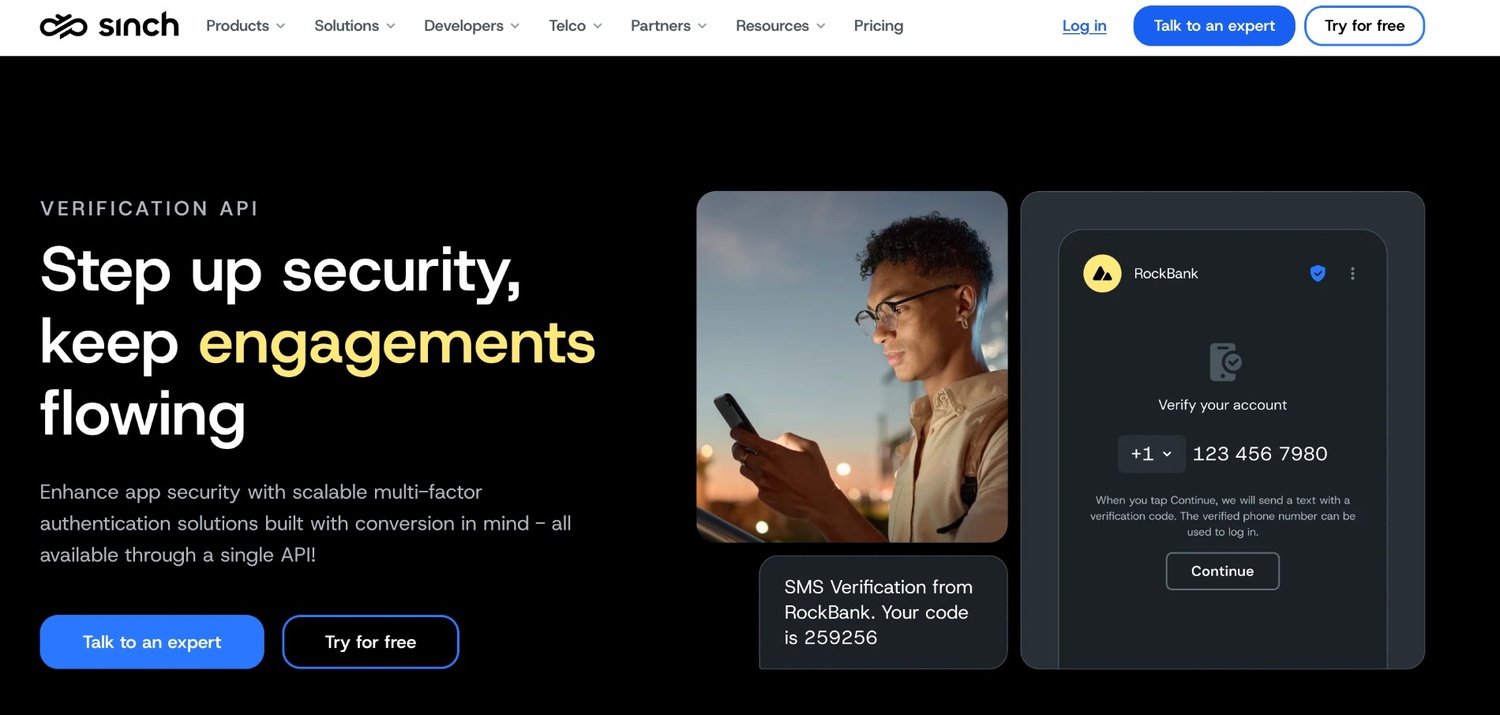
Sinch is a serious player in the communications space, providing verification as part of a broader programmable communications stack. The Verification API supports multiple verification methods, and its broader messaging focus is around scale and reliability.
Global reach
Sinch’s solution is designed with a global presence in mind, focusing on use cases where verification is needed across many different markets. Even though specific OTP details aren’t highlighted in many of these sources, it’s clear that their solution is designed for businesses with these types of needs.
API quality and developer experience
Sinch offers RESTful APIs, as well as Android, iOS, and JavaScript SDKs, for verification. This makes it well-suited for mobile applications looking to integrate verification into their overall product, as opposed to simply relying on backend SMS integrations.
Fraud prevention
Sinch’s verification solution offers multiple verification methods, including SMS, flash call, voice call, and data verification. This reduces reliance on a single method, making it a more robust solution. The materials presented aren’t as focused on “anti-fraud” as some of its competitors, but it does offer multiple verification methods, which is better.
Multi-channel verification
Sinch excels in terms of verification method variety. Their Verification API supports SMS, FlashCall, voice call, and data verification, with SDK documentation supporting these as well, including SMS, flash call, callouts, as well as mobile data verification. This is particularly useful for mobile applications, as alternative verification methods can increase completion rates.
Pricing
Transparent pricing information for verification services is not available in these sources, so it’s recommended that you contact sales or a representative for specific pricing information. This is common among infrastructure companies, but it does mean that self-service comparison is not as easy.
Best fit
Sinch is well-suited for enterprises, as well as businesses focused on telecommunications, looking for more than just simple SMS OTP.
Best SMS OTP Provider Comparison Table
The table below summarizes the key characteristics of the SMS OTP providers reviewed in this guide. It highlights global coverage, authentication channels, developer experience, and typical use cases.
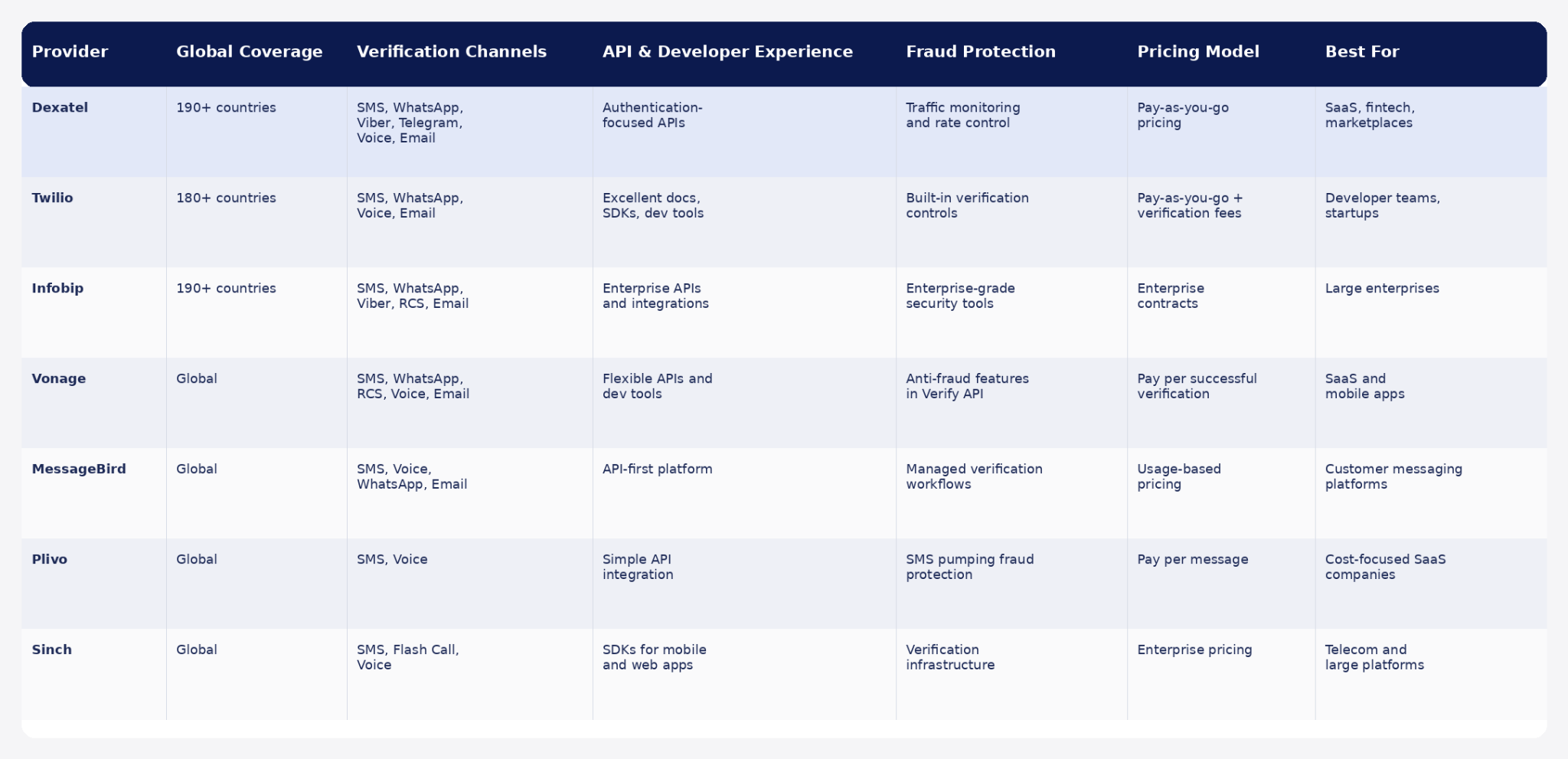
Many businesses evaluate several OTP providers before choosing one. While the comparison above highlights the core differences, the right choice often depends on your authentication volume, geographic coverage requirements, and whether your platform requires multi-channel verification beyond SMS.
Why Businesses Choose Dexatel for SMS Verification
- Global coverage: Deliver OTP messages reliably across 190+ countries and mobile networks.
- Intelligent routing: Optimize delivery paths automatically based on carrier and network performance.
- Multi-channel fallback: Switch between SMS, WhatsApp, Flash Call, and Voice OTP automatically.
- Fraud prevention: Detect suspicious activity and reduce verification abuse before it escalates.
- Fast API integration: Launch OTP verification quickly using APIs, SDKs, and documentation.
- Real-time reporting: Monitor delivery, verification success, and channel performance instantly.
- Dedicated support: Access expert guidance for integration, optimization, and authentication strategy.
Industries That Rely on SMS OTP Verification
Banking and Financial Services
Protect customer accounts and sensitive financial transactions with secure SMS OTP verification. Banks, fintech companies, payment providers, and digital wallets commonly use OTP authentication for login verification, transaction approvals, password recovery, device registration, and multi-factor authentication workflows. SMS OTP adds an additional layer of security while helping organizations meet regulatory and compliance requirements.
Retail and eCommerce
Secure customer accounts and reduce fraud throughout the online shopping journey. Retailers use SMS OTP verification to validate new registrations, protect customer logins, confirm high-value purchases, and prevent unauthorized account access. By verifying user identities at critical points, businesses can strengthen security without creating unnecessary friction during checkout.
Healthcare
Support secure access to patient portals, telehealth platforms, and healthcare applications through SMS-based verification. OTP authentication helps healthcare organizations verify patient identities before granting access to appointments, medical records, prescriptions, and other sensitive information. This improves account security while helping protect patient data and privacy.
Logistics and Delivery Services
Verify users and secure operational workflows across delivery and transportation networks. SMS OTP can be used to authenticate drivers, confirm package handoffs, validate delivery recipients, and prevent unauthorized pickups. These verification processes help reduce fraud while improving accountability and trust throughout the supply chain.
SaaS and Technology Platforms
Protect user accounts, administrative access, and business-critical actions with scalable authentication workflows. SaaS companies frequently use SMS OTP verification during onboarding, login, password recovery, and account management processes to reduce credential abuse and strengthen account security. The result is a safer user experience without adding significant complexity to the customer journey.
Emerging Authentication Trends: Silent Network Authentication (SNA)
While SMS OTP remains the most widely deployed phone number verification method, newer authentication technologies are beginning to gain traction. One of the most notable developments is Silent Network Authentication (SNA), sometimes referred to as frictionless verification. Instead of sending a verification code, SNA validates a user's identity directly through mobile network data in the background, eliminating the need to receive or enter an OTP altogether.
The primary advantage of SNA is reduced user friction. Because no code entry is required, verification can often be completed automatically, improving conversion rates and reducing authentication abandonment. However, SNA availability depends on carrier support, regional coverage, mobile network integrations, and device conditions, which can limit adoption in some markets.
For businesses seeking a more seamless verification experience today, flash call verification offers a similar goal of reducing user effort while maintaining broad compatibility. Rather than requiring users to manually enter a code, flash calls can automatically verify phone numbers through an incoming missed call and caller ID detection. As authentication technology continues to evolve, many organizations are combining SMS OTP, flash calls, and emerging methods such as SNA to balance security, coverage, cost efficiency, and user experience across different markets and devices.
How to Test an SMS OTP Provider Before Integrating It
Before you integrate an SMS OTP provider into your authentication stack, take a moment to test how it works in real-world conditions. This small window of time can reveal how long it takes for messages to be delivered, how it handles different routes, or even hidden fees.
Here’s how you can do it in practical ways:
- Test delivery in your key markets: OTP services may be delivered differently in different countries. You should test how it works in the regions where most of your customers are located.
- Measure delivery speed: OTP is expected to be delivered in seconds. You should test how long it takes for verification messages to be delivered to different devices.
- Check fallback and failover options: A robust authentication solution may require fallback options, like voice OTP, flash call verification, or messaging app OTP, in case of failures in sending verification codes via SMS. You should test how it works in these cases.
- Test API: Finally, you should test how stable its API is. APIs that work well can help you create robust authentication solutions.
Some engineering teams initially consider building OTP infrastructure in-house, but authentication systems quickly become more complex than simply sending SMS messages. Carrier connectivity, global routing, fraud prevention, delivery optimization, compliance requirements, sender registration, monitoring, and fallback logic all require ongoing maintenance and expertise. For most businesses, partnering with a specialized OTP provider significantly reduces time to market while providing access to established messaging infrastructure, fraud controls, and global carrier relationships that would be costly and time-consuming to build internally.
Choose an OTP Provider That Supports Growth
Working with the best SMS OTP provider can significantly affect the reliability and security of your authentication system. Factors such as delivery speed, global coverage, API quality, and pricing should all be carefully evaluated before integration.
Many businesses are also moving toward multi-channel verification to improve delivery success and reduce authentication delays. By comparing providers and testing their performance in real conditions, companies can build verification systems that remain reliable as their platforms grow. Start building secure, reliable OTP authentication with Dexatel today.
Secure your users with SMS OTP
Deliver one-time passwords instantly via SMS — fast, globally supported, and easy to integrate. Start your 30-day free trial today.
Frequently Asked Questions
How much does SMS OTP verification cost?
The cost of SMS OTP verification depends on several factors, including the destination country, messaging volume, and the provider’s pricing model. Most providers charge per SMS message sent, while some platforms also include verification fees or additional costs for other authentication channels. Some providers, including Dexatel and Plivo, focus on more transparent pay-as-you-go pricing models.
How quickly can I integrate an OTP API?
Most OTP API integrations can be completed within a few hours using REST APIs, SDKs, and developer documentation. The exact implementation time depends on your application architecture, authentication requirements, and any custom workflows you need to support.
Can I use WhatsApp or Flash Calls as an OTP fallback?
Yes. Multi-channel authentication strategies allow businesses to automatically switch to WhatsApp OTP, Flash Calls, Voice OTP, or other verification methods when SMS delivery is delayed or unsuccessful. This helps improve verification completion rates while providing a smoother user experience.
What causes OTP delivery delays?
OTP delivery can be affected by factors such as carrier congestion, routing quality, network availability, sender registration requirements, and local filtering policies. Delivery performance may also vary by country, mobile operator, and time of day, making routing optimization an important part of authentication infrastructure.
How can I reduce OTP costs?
Reducing authentication costs often involves more than finding the lowest SMS price. Improving delivery rates, minimizing failed verification attempts, optimizing routing, and using intelligent fallback logic can help lower overall verification costs while maintaining a positive user experience.
Do I need a global OTP provider?
If your users are located across multiple countries or mobile networks, a global OTP provider can significantly improve delivery performance and verification success rates. Broad carrier connectivity, international coverage, and region-specific routing optimization help ensure a more consistent authentication experience for users worldwide.


