

Communications API for high-volume SMS and voice traffic
Dexatel Link connects you to our routes over SMPP, HTTP or SIP. Reach 190+ countries through 100+ direct MNO connections, without negotiating with each operator yourself.


countries
direct MNO connections
27001 certified
average uptime over the last twelve months


Why businesses choose Dexatel Link as their communications API
One provider for SMS, voice and number intelligence. Enterprises and CPaaS providers connect Link to their own communication API, with visibility into routing, costs and traffic performance


Manage wholesale SMS, voice termination and number intelligence through one account, one dashboard and one support team. Your team spends less time coordinating providers and has one place to investigate issues.


What Dexatel Link includes for SMS and voice
Dexatel Link includes SMS transit, voice termination, routing controls and traffic reporting. Number intelligence, connection protocols and fraud controls support the same communications infrastructure.


A2P SMS transit
A2P SMS services run over wholesale SMS routes across 190+ countries, with sender ID management and delivery receipts (DLR) returned for each send. Throughput is agreed per connection rather than fixed, so capacity matches the traffic profile you actually send.
Voice termination with CLI options
Voice termination carries CLI to the destination network. Route options vary by destination, and the requirements each market enforces on caller identification apply regardless of which route carries the call.
Dynamic SMS routing and voice routing
Route switching runs automatically, against rules the Dexatel team configures for your destinations and traffic. Changes happen without a ticket, and the outcome of every message is visible in your dashboard.
Direct carrier connections
Link gives you access to 100+ direct carrier connections. Each one reaches the receiving operator without an intermediary in between for that connection.
Number intelligence
Number status, current operator and line-type data come from Dexatel Lookup, which returns active status, line type as mobile, landline or service, and a ported flag showing whether a number has moved networks. Checks run on request through a separate API call and are billed separately from delivery.
Multiple connection protocols
SMPP and HTTP/REST are available for SMS, with SIP for voice. These interfaces connect to messaging platforms, gateways and voice systems you already run, with credentials issued once your application is approved.
Traffic monitoring and reports
Your dashboard shows every message with its price, destination, network, sender ID, channel and status, plus charts for spend and volume over time. Two-way traffic appears in the inbox alongside it.
Fraud prevention and filtering
Spam and phishing traffic is blocked by keyword and AI content rules. AIT monitoring alerts on number ranges, volume against expectation, spikes, conversion rate and DLR, with a deeper anti-fraud option available.
Aggregations within Dexatel Link
SMS aggregation and voice aggregation run on one platform. Each provides connectivity, routing and traffic monitoring for businesses delivering messages or calls at scale.


SMS aggregation provides A2P SMS transit infrastructure for aggregators, CPaaS providers and operators across 190+ countries. The service combines direct carrier routes with delivery receipts (DLRs) and sender ID management

Dexatel Link pricing
Pricing is usage-based and tailored to your destinations, routes, traffic volume and connection requirements. Share your traffic profile to receive a rate card and commercial proposal for SMS, voice or both.
| Service | Pricing model | What affects the rate |
|---|---|---|
SMS transit and aggregation | Per submitted message. A long or multipart message is billed as one message. | Destination, route and agreed volume tier. |
Voice termination and aggregation | Per minute, rated per second, with the minimum duration and billing increment set for each destination network. | Destination network, route and traffic volume. |
Get your rate card
How enterprises and communications providers use Dexatel Link
Dexatel Link serves enterprises that send their own traffic at scale and communications providers that use wholesale carrier services to deliver traffic for customers. Both use Link for carrier connectivity, routing options and reporting across SMS and voice.
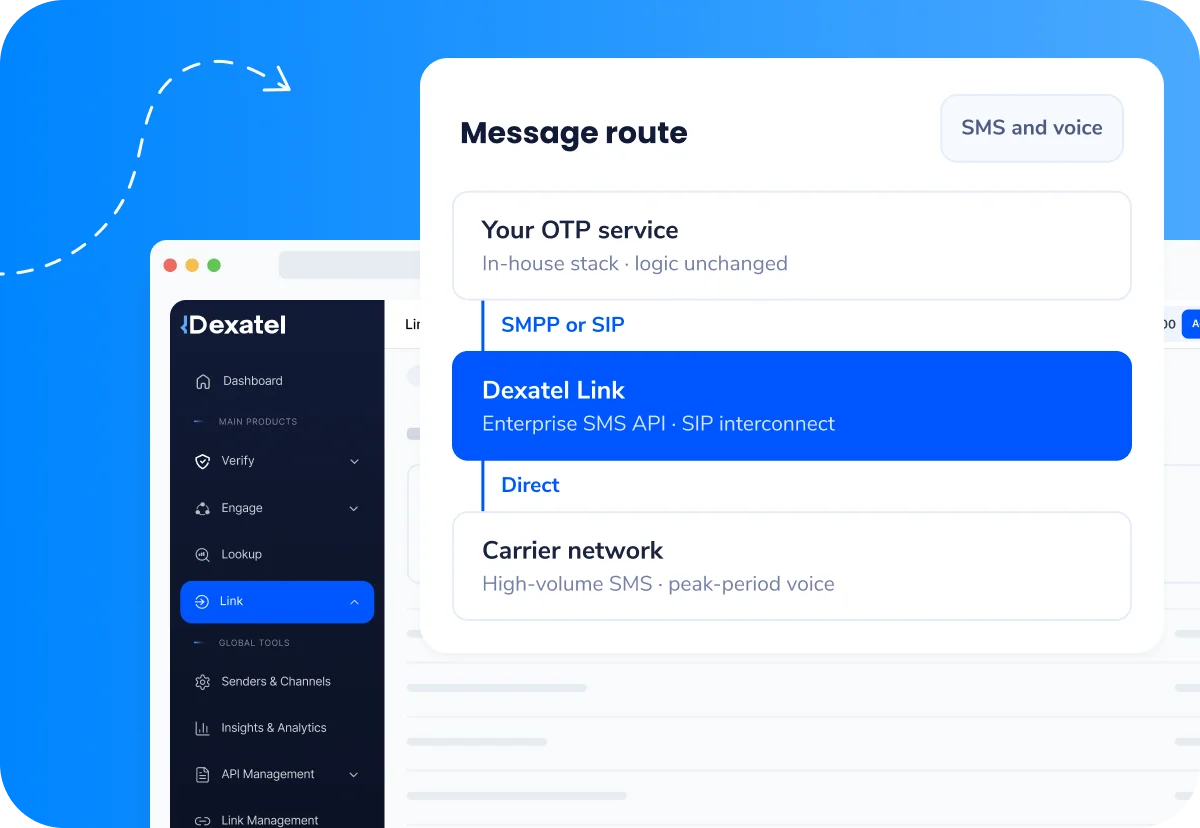
Enterprises and hyperscale platforms use Link as an enterprise SMS API and SIP interconnect behind their in-house communications stack. Existing OTP services and notification engines gain carrier connectivity without replacing application logic. Typical workloads include high volume SMS and peak-period voice.
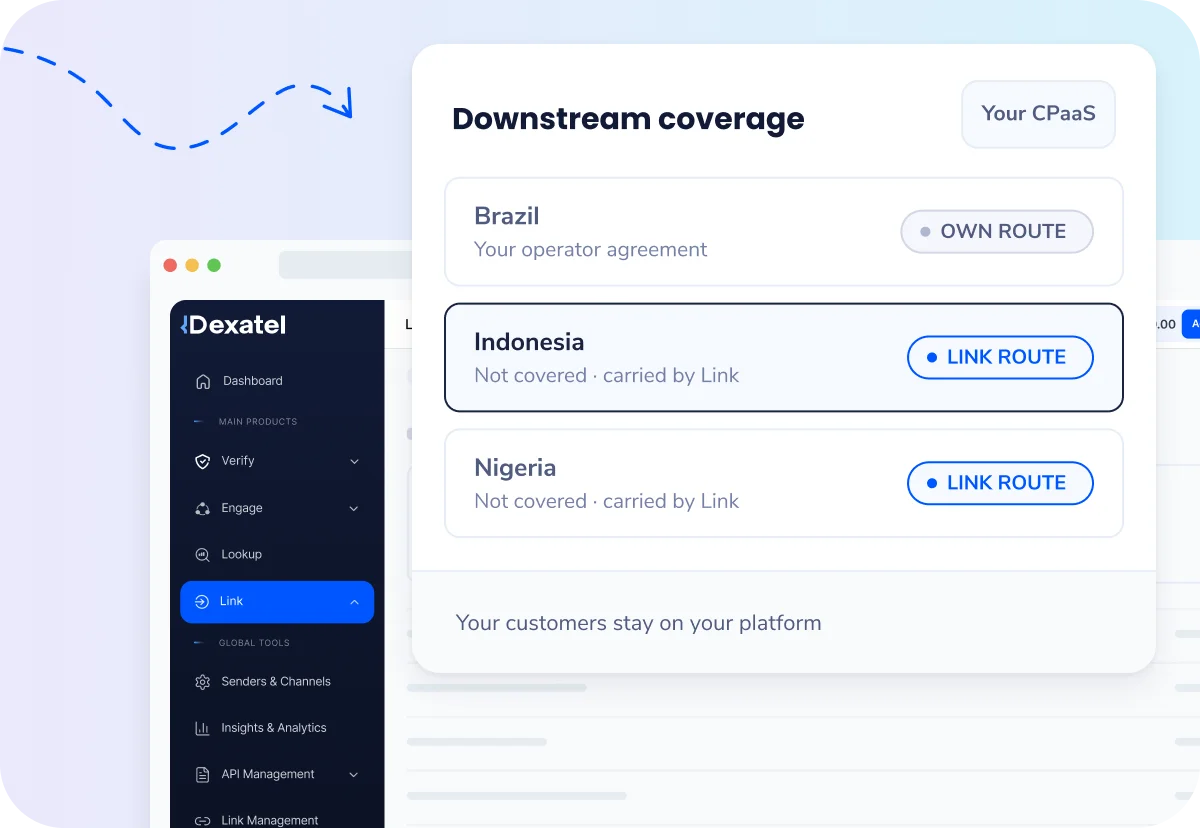
CPaaS providers use Link as an SMS and voice supplier behind their own CPaaS solutions. They keep their customer-facing platform and application delivery logic, and use Link’s routes and reporting to carry downstream traffic across destinations their own operator agreements don’t cover.
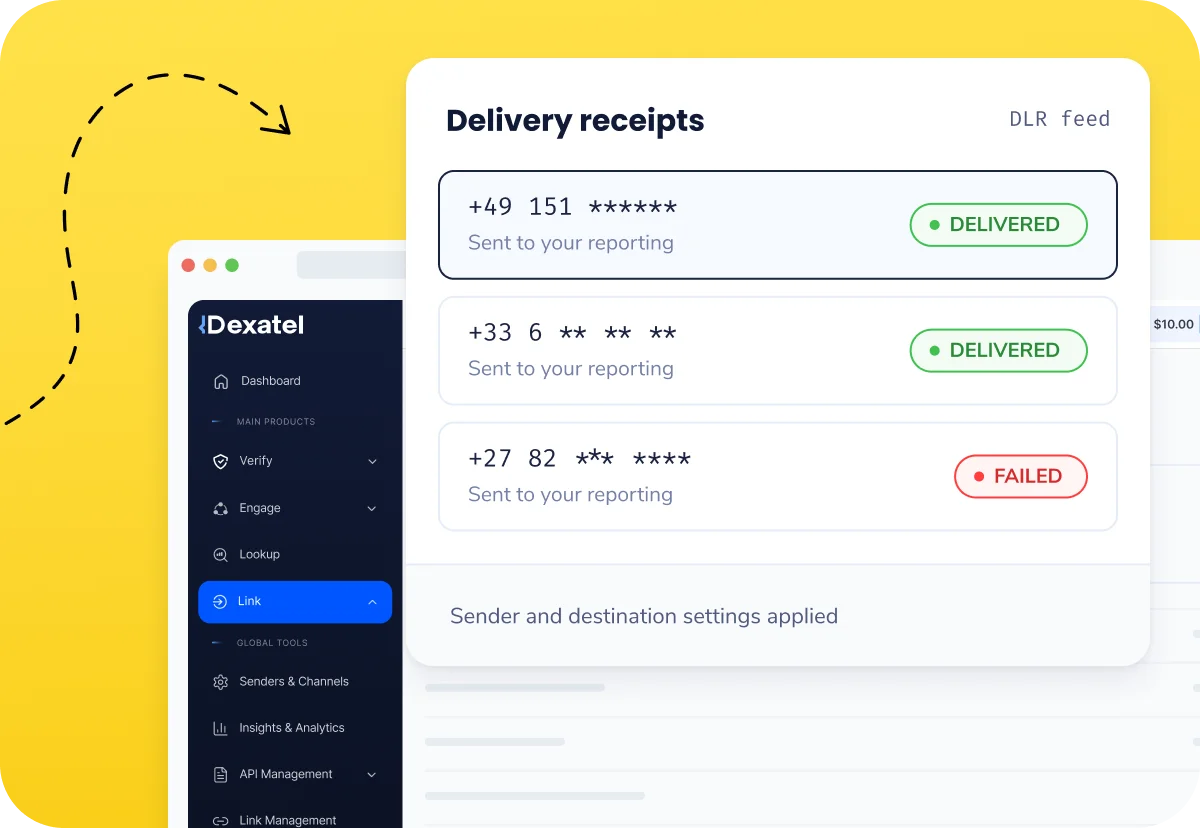
An A2P SMS provider or aggregation platform uses Link to carry customer messages across international routes and extend its existing operator coverage. Delivery receipts (DLRs) feed into its own reporting, while sender and destination settings help manage traffic requirements.
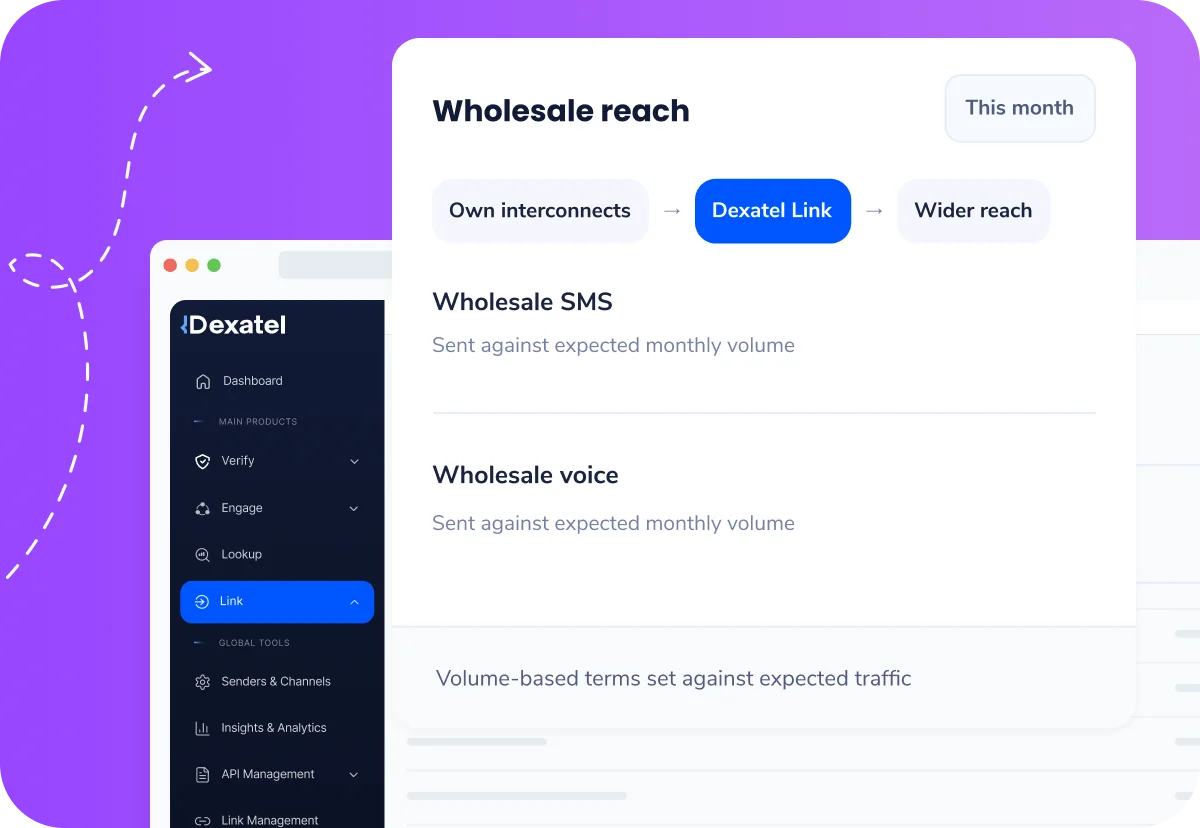
Mobile network operators (MNOs) and mobile virtual network operators (MVNOs) use Link to extend their wholesale SMS and voice reach beyond their own interconnects, with volume-based commercial terms set against the traffic they expect to send each month.
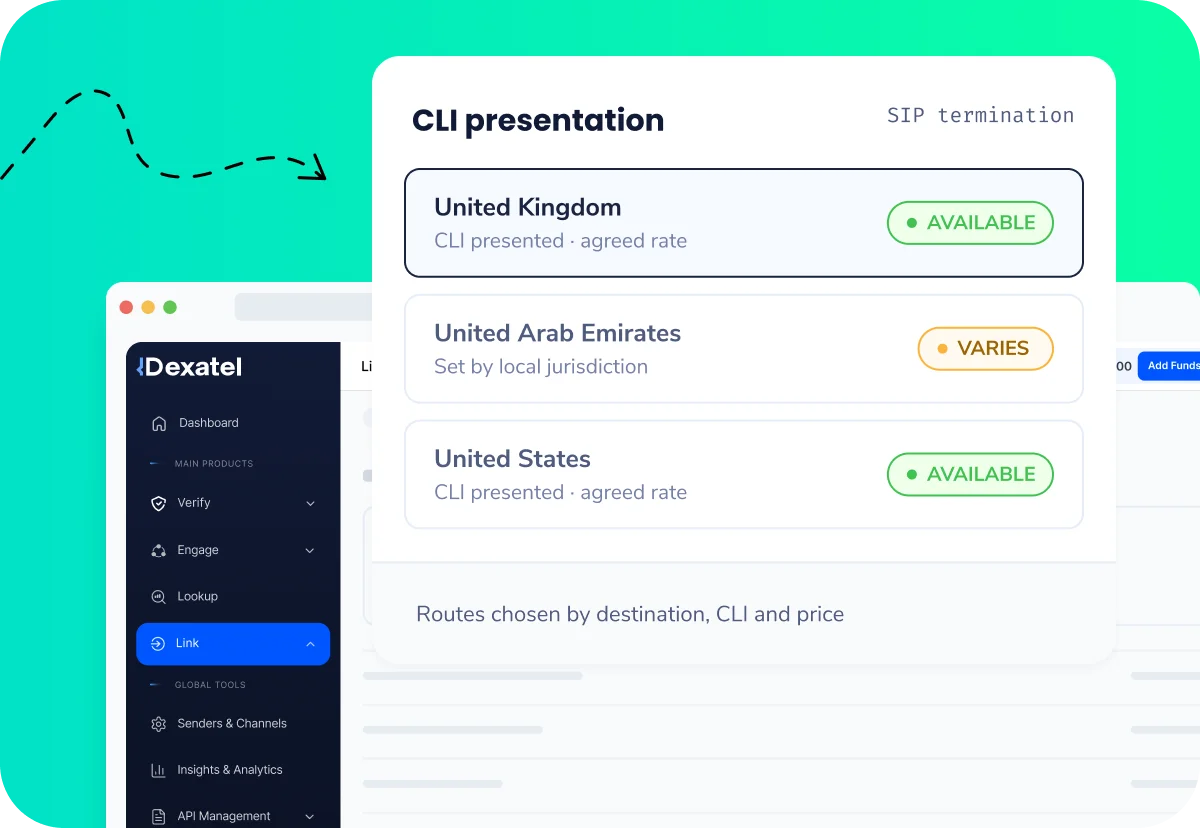
Voice carriers and call centres use Link for international call termination over SIP. Routes are selected by destination requirements, CLI presentation and agreed pricing — and what a destination does with caller identification varies by jurisdiction, so presentation isn’t identical everywhere.
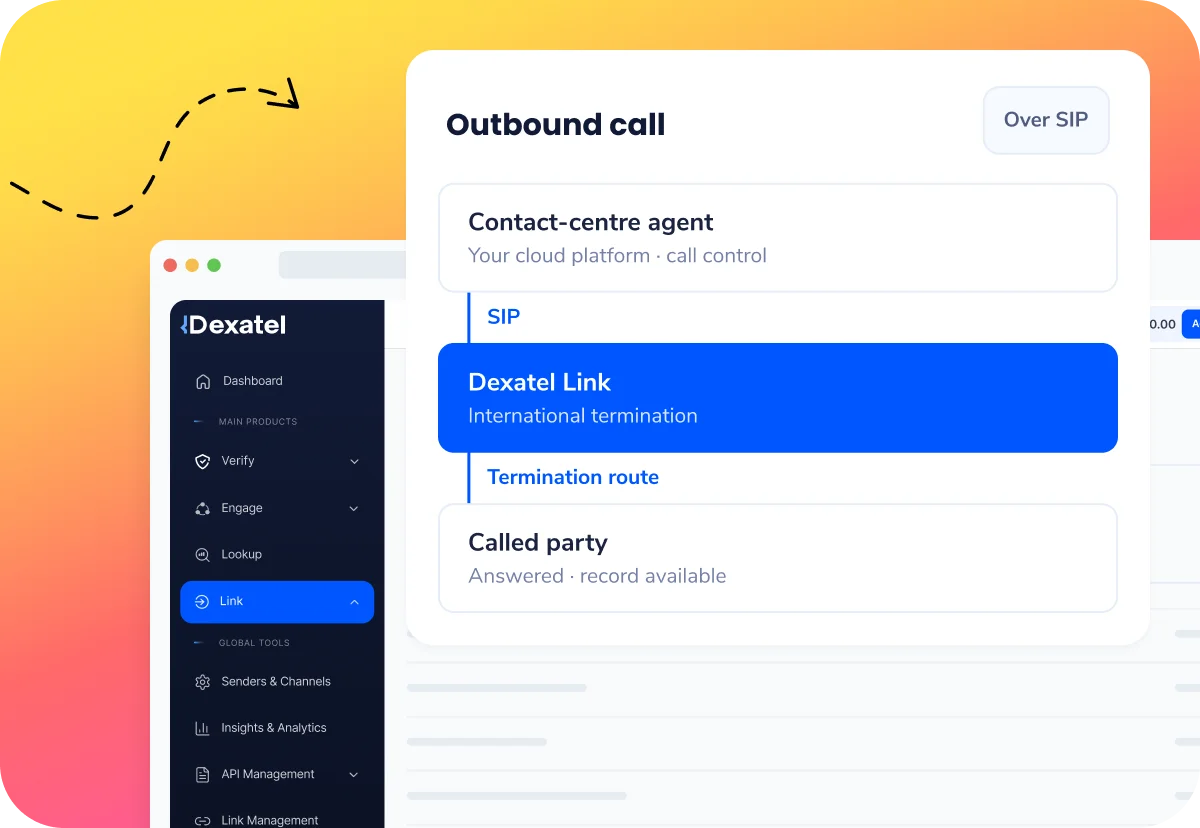
UCaaS and CCaaS platforms use Link to terminate outbound calls from their cloud phone and contact-centre services over SIP. Their platform manages the customer experience and call control, while Link supplies the termination routes and the records underneath.
Get started with Dexatel Link in four steps
Submit your use case, target destinations, expected traffic volume and preferred connection method. Include peak capacity needs so our team can review your traffic profile and identify suitable routes.
Our team configures your connection method — SMPP or HTTP/REST for SMS, SIP for voice — and assigns test routes. You receive credentials and free test credit, and agree rates and terms before launch.
Send test traffic through the assigned routes. For SMS, check delivery receipts and timing. For voice, check call completion, CLI presentation and call quality. Then move to production.
Our support team is available 24/7 to investigate performance issues. As volume grows, we review throughput, route costs and capacity with your team and arrange increases under the agreed terms.
Tell us your monthly volumes and the destinations you send to, and we’ll come back to you.
Protocol and integration options for connecting to Dexatel Link
SMS and voice API access combines with carrier protocols for existing telecom infrastructure. Connect SMS traffic through SMPP or HTTP/REST and voice traffic through SIP. Number checks and traffic records support the same integration.

SMS access runs over SMPP or HTTP/REST, with delivery feedback on both. The SMPP API connects your gateway through persistent sessions, with Dexatel as the SMPP provider supplying credentials. HTTP/REST gives request-based access to the communication API, with webhooks returning delivery updates.


Industries supported by Dexatel Link
Dexatel Link supports industries with demanding SMS and voice traffic requirements. Its communications API and carrier connections provide access to wholesale SMS and voice termination, with routing and reporting for everyday traffic and peak periods.

Telecom operators, MNOs and MVNOs use Link’s wholesale carrier services to reach networks beyond their direct connections. A2P SMS and international voice traffic run through supported interconnects, with traffic records for quality reviews and reconciliation.


Don’t see your industry here? Talk to our experts about your destinations, traffic volumes and existing systems.
Security and standards behind Dexatel Link
Dexatel Link combines telecom connectivity with security controls, data-handling policies and operational reporting. Supporting documents define the service scope, commercial terms and responsibilities.

Dexatel OÜ holds ISO/IEC 27001:2022 certification under certificate EE/1429IS/1497. The certified scope covers CPaaS provision and support, including A2P voice and SMS delivery.


Got questions? We've got answers.
Should I use SMPP or the HTTP/REST API for my SMS traffic?
Most wholesale customers connect to Dexatel Link over SMPP, which keeps a persistent session open and suits high, steady volumes. HTTP/REST is available where a persistent bind doesn’t fit your setup. Both return delivery feedback, and the choice is agreed during onboarding.
What SMS throughput and concurrent voice-call capacity can I get?
Voice connections start at 100 concurrent calls and 20 calls per second, and are increased on request. SMS throughput is agreed per customer rather than fixed, because wholesale traffic profiles differ, so your binds and message rate are set during onboarding against the volume you expect to send.
Does Link support Unicode and long SMS messages, and how are they billed?
Dexatel Link bills a long or multipart message as one message, not per segment.
Can I test SMS and voice routes before going live, and are tests billable?
Approved accounts receive free test credit — €1 or $1 by default, increased for larger customers — to send live traffic through assigned routes before production. There is no separate sandbox, so testing runs against the real platform.
Can Dexatel help migrate traffic from my current SMPP provider or voice carrier?
Your connection method, binds and routes are configured by the Dexatel team during onboarding, and test credentials are issued before you move production traffic across. Time from application to live traffic runs from 15 minutes to a few days, depending on whether your Sender ID needs whitelisting with the destination operator.
How are wholesale SMS and voice charges calculated, including failed messages and unanswered calls?
Dexatel Link charges SMS per submitted message, so a message that is submitted is billed whether or not the destination network delivers it. Voice is rated per second and billed using the minimum duration and increment set for each destination network, and calls that go unanswered or fail to connect are not billed.
How long does it take to start sending traffic through Dexatel Link?
Time from application to live traffic on Dexatel Link runs from 15 minutes to a few days. Where a destination operator requires your Sender ID to be whitelisted, that approval sets the pace rather than the technical setup.
Does Dexatel Link come with an SLA?
Dexatel Link has maintained 99.95% average uptime over the last twelve months. Service Level Agreements are available upon contract for enterprise and wholesale customers, with the committed terms set out in the agreement.
