


What Is a Flash Call and How Does It Work?


Published: May 28, 2026

Today, virtually every digital interaction requires some form of verification, and that’s where authentication enters the scene. Yet for most users, it’s also the part they dread—the endless passwords, codes, and app prompts that interrupt what should be a simple login. That constant tug-of-war between safety and convenience has pushed businesses to search for better, faster ways to confirm a user’s identity without compromising protection.
One solution that’s quickly gaining traction is flash calls. This modern authentication method offers speed, security, and affordability—all without requiring extra effort from the user. It’s already being adopted across banking, e-commerce, telecom, and other industries that are looking to streamline their verification process. In this article, we’ll explore what flash calls are, how they work behind the scenes, and why they’re becoming one of the most practical alternatives to traditional authentication methods today.
What Is a Flash Call?
A flash call is a modern phone verification method where an automated system initiates a brief call to a user's registered phone number for authentication purposes. Unlike traditional SMS-based verification that requires users to manually enter a code, flash calls work in the background by verifying the incoming phone number itself.
The "flash" in flash call refers to the call's extremely brief duration, as in it typically disconnects automatically within seconds, often before the user even has a chance to answer. This creates a frictionless verification experience that doesn't interrupt the user's workflow or require any manual action beyond having their phone in hand.
Rather than waiting for a text message, reading a code, and typing it into an application, the entire authentication process happens automatically by simply receiving, but not answering, a call.
How Does a Flash Call Work?
Flash call authorization works through a quick, automated process that verifies a user’s identity in seconds. Here’s what the process looks like:
Step 1: User Initiates Login or Transaction
When a user wants to log into an application, complete a transaction, or verify their identity, they enter their phone number into the system.
Step 2: System Places a Flash Call
The authentication system immediately initiates a call to the registered phone number. This call is automated and generated by the verification service provider. In many mobile applications, an SDK can automatically detect the incoming call and extract the required digits without requiring the user to enter a code manually. Depending on the operating system and implementation method, the app may request permission to access call-related information or call logs to complete verification automatically.
Step 3: Automatic Disconnection
The call disconnects automatically within a few seconds, typically before the user can answer. The user sees a missed call notification on their device, displaying a specific phone number.
Step 4: Verification Through Number Matching
The system verifies the user's identity by matching the incoming caller ID number to a pre-generated code or identifier associated with that authentication session. Since the call originated from the verification system and reached the correct phone number, the user's identity is confirmed.
Verify Users Faster With Dexatel's Flash Call API
Authenticate users using missed-call verification instead of traditional OTP delivery. Dexatel's Flash Call API helps businesses reduce authentication costs, accelerate onboarding, and improve verification completion rates through automated phone number verification.
Verify users instantly — no SMS needed
Flash calls authenticate users in seconds with a missed call — lower cost, higher conversion. Try Dexatel free for 30 days.
Why Businesses Use Dexatel for Flash Call Verification
Flexible Pricing
Dexatel offers flexible flash call pricing options that allow businesses to choose the authentication strategy that best fits their usage patterns and budget. Whether you're handling a few thousand verifications per month or operating at enterprise scale, pricing can be tailored to support your growth without unnecessary overhead.
Global Coverage
Verify users across multiple countries through a global network of carrier connections and telecommunications partners. Dexatel's infrastructure helps businesses maintain consistent authentication experiences for users regardless of their location or mobile network.
Fast API Integration
The Flash Call API is designed for quick implementation using standard REST API architecture and developer-friendly documentation. Businesses can integrate flash call verification into existing applications and authentication workflows without extensive development effort.
Real-Time Analytics
Monitor authentication performance through detailed reporting and real-time insights. Visibility into verification attempts, completion rates, delivery outcomes, and channel performance helps businesses optimize their authentication strategy over time.
Dedicated Support
From onboarding and implementation to scaling and troubleshooting, Dexatel provides access to experienced support specialists. Our team can help businesses configure verification workflows, address technical challenges, and optimize authentication performance as requirements evolve.
.jpg)
Key Features of the Dexatel Flash Call API
Global Carrier Connectivity
Verify users across multiple countries through a network of carrier connections and telecommunications partners. Global coverage helps ensure that flash call verification remains available as businesses expand into new markets and serve international audiences. By managing connectivity through a single provider, businesses can simplify deployment and reduce operational complexity.
Automated Verification Workflows
Integrate flash call verification directly into onboarding, login, account recovery, and authentication processes. Automated workflows allow verification requests to be triggered instantly based on user actions, reducing manual intervention and improving the overall user experience. This helps businesses create faster and more scalable verification journeys.
Real-Time Verification Status
Monitor verification attempts and outcomes through real-time status updates and reporting tools. Immediate visibility into successful, failed, and pending verifications helps businesses troubleshoot issues, measure performance, and optimize authentication workflows. Detailed reporting also supports auditing and operational monitoring requirements.
Intelligent Fallback Routing
Not every verification attempt can be completed through a single channel. Dexatel's fallback logic can automatically switch to alternative methods such as SMS OTP when a flash call cannot be completed successfully. This helps maximize verification completion rates while minimizing user frustration and authentication delays.
Scalable Authentication Infrastructure
Whether you're verifying a few thousand users per month or processing millions of authentication requests, the platform is designed to handle growing demand. High-performance infrastructure supports large-scale verification traffic while maintaining reliability, speed, and consistent user experiences. This makes the Flash Call API suitable for both startups and enterprise organizations.
API and Dashboard Management
Manage verification workflows through a developer-friendly API or monitor activity through a centralized dashboard. Businesses can track performance, configure authentication settings, review reporting data, and manage verification operations from a single platform. This flexibility allows both technical and non-technical teams to oversee authentication processes efficiently.
Use Cases of Flash Calls Among Industries
Flash calls come in handy across numerous sectors where quick, reliable identity verification is essential. Here's how different industries use this technology:
Banking and Fintech
Financial institutions are increasingly turning to flash calls for secure logins, transaction approvals, and password resets. Banks use this method for its balance of speed and security. It simplifies customer onboarding by reducing friction during account creation while maintaining strong verification standards. Fintech apps also rely on flash calls to authenticate peer-to-peer transfers and mobile wallet access, giving users instant verification without sacrificing security.
eCommerce and Delivery Services
Flash calls allow online retailers to verify customer phone numbers during checkout processes and prevent fraudulent orders. Delivery platforms use this method to confirm both customer and driver identities. The speed of flash call verification also helps reduce cart abandonment rates by eliminating the frustration of waiting for SMS codes that may arrive with delays.
Ride-Sharing and Travel
Ride-sharing companies use flash calls to verify both drivers and passengers during the registration process and when requesting rides. For travel booking platforms, this authentication method helps confirm reservations and prevent booking fraud. The instant nature of flash calls is especially valuable in time-sensitive scenarios where users need immediate access to services.
Gaming and Entertainment
Gaming platforms rely on flash calls for account creation and login verification, helping to prevent unauthorized access and account takeovers. Meanwhile, streaming services use it during subscription sign-ups to guarantee genuine user registrations. The low-friction experience goes hand-in-hand with the entertainment industry's need to minimize barriers while maintaining security.
Government and Public Services
Public sector organizations use flash calls for citizen portal access, benefit distribution verification, and digital identity programs. The method's accessibility is especially valuable for government services, as it works on any phone capable of receiving calls. This includes basic feature phones that may not support SMS in certain regions or for users with limited literacy who might struggle with code entry.
Benefits of Flash Calls
Flash calls offer several compelling advantages that make them an attractive authentication option for businesses and users alike:
Speed
Flash calls deliver near-instant verification, typically completing the authentication process in just a few seconds. Unlike SMS codes that are sometimes prone to delivery delays ranging from several seconds to minutes—or fail to arrive at all—flash calls establish a connection immediately through the voice network. This quick verification significantly improves user experience by eliminating waiting periods and reducing the likelihood of session timeouts during authentication.
User Experience
The automatic nature of flash calls removes manual steps from the verification process. Users don't need to switch between applications to retrieve codes, memorize or copy-paste numbers, or worry about typographical errors during entry. For users in situations where reading or entering codes is inconvenient, such as while driving, exercising, or holding items, flash calls provide hands-free verification. The method also benefits users with visual impairments or those who struggle with small text entry on mobile devices.
Security
Flash calls provide strong security through device-based verification rather than information-based authentication. Since the verification occurs through possession of the physical device that receives the call, it's virtually impossible for attackers to intercept compared to SMS codes, which can be vulnerable to SIM swapping attacks, SS7 protocol exploits, or social engineering. The automated nature of flash calls also eliminates the risk of users accidentally sharing verification codes with malicious actors through phishing attempts.
Cost Savings
Flash calls typically cost less than SMS-based verification because the calls disconnect before the user responds, resulting in minimal or zero telephony charges. For businesses processing thousands or millions of verification requests, these savings compound significantly. Additionally, the reduced customer support burden associated with failed SMS deliveries, code confusion, and re-send requests translates to operational cost reductions beyond just the per-verification pricing.
Global Reach
Flash calls work across virtually all mobile networks worldwide and function on both smartphones and basic feature phones. This universal compatibility makes them ideal for businesses serving diverse markets, including regions where smartphone penetration remains limited or where SMS infrastructure may be unreliable. The method doesn't require internet connectivity, making it accessible even in areas with poor data coverage.
Reduced Friction
By eliminating the need for users to manually retrieve and enter codes, flash calls significantly minimize authentication friction. This leads to higher completion rates during sign-ups, logins, and transaction confirmations. Lower friction directly impacts conversion rates, with businesses often seeing reduced abandonment during critical user flows like checkout or registration.
.jpg)
Limitations of Flash Calls
While flash calls offer numerous benefits, they do come with certain limitations.
Reliance on Mobile Network Quality
Flash calls depend entirely on the voice network infrastructure to establish a connection. In areas with poor cellular coverage or network congestion, calls may fail to connect properly, preventing successful verification. Users traveling internationally may experience issues if their phones are in airplane mode or if roaming services don't properly register incoming calls. These network dependencies can create verification failures that frustrate users and require fallback authentication methods.
User Understanding and Confusion
Since flash calls represent a relatively new authentication approach, some users may not understand the process, especially if they're used to SMS-based verification. They might wonder why they received a missed call, whether they should return the call, or if the authentication failed because they didn't answer. Without proper user education and clear on-screen instructions explaining that they should simply wait for the missed call, confusion can lead to support inquiries or users attempting alternative verification methods unnecessarily.
Potential Blocking by Telecom Providers
Some telecommunications providers implement call-blocking measures or spam filters that may inadvertently prevent flash calls from reaching users. Carrier-level spam detection systems might flag the brief, automated calls as suspicious activity, particularly if large volumes originate from the same number ranges. Certain regions have stricter regulations around automated calling systems, requiring special registration or compliance measures that can complicate implementation.
Not Suitable as a Standalone Method for Highly Sensitive Transactions
While flash calls provide solid security for standard authentication needs, they may not offer sufficient protection for highly sensitive operations like large financial transfers, account ownership changes, or access to critical systems. For these scenarios, businesses typically need multi-factor authentication combining flash calls with additional verification layers such as biometrics, knowledge-based questions, or device fingerprinting. Relying solely on flash calls for high-stakes transactions could expose businesses to risk if an attacker gains temporary physical access to a user's device.
Compatibility Issues with VoIP and Virtual Numbers
Flash calls may not work reliably with Voice over IP (VoIP) services or virtual phone numbers, which some users employ for privacy or business purposes. These services handle calls differently than traditional cellular networks, potentially causing verification failures. Businesses need to implement detection mechanisms and alternative verification paths for users with such phone numbers.
No Confirmation of User Presence
Unlike biometric authentication or codes that users must actively enter, flash calls only confirm that the registered device received a call, not that the legitimate user is present and actively authorizing the action. This limitation means flash calls work best for scenarios where device possession provides adequate security assurance rather than situations requiring proof of user presence.
Carrier Support and Regulatory Limitations
Carrier support for flash call verification can vary significantly by country and mobile network. One reason is that flash calls bypass traditional SMS messaging revenue streams, which has led some operators to actively monitor, restrict, or block flash call traffic. Industry research has estimated that mobile operators lose billions of dollars annually to flash call verification traffic, prompting some carriers to introduce filtering policies, monetization programs, or alternative verification frameworks designed to recover lost messaging revenue. As a result, businesses deploying flash call authentication at scale should consider carrier support, regional regulations, and fallback options such as SMS OTP to maintain consistent verification coverage across markets.
Flash Call Adoption in Emerging Markets
Flash call verification has seen particularly strong adoption in parts of Africa, the Middle East, Asia, and other emerging markets where businesses are highly focused on verification costs and user acquisition efficiency. In some regions, SMS delivery costs can be relatively high, while network congestion, carrier filtering, or inconsistent delivery performance may affect OTP reliability. Flash calls offer an alternative verification method that can reduce authentication costs while simplifying the user experience, making them especially attractive for high-volume applications such as fintech platforms, marketplaces, ride-hailing apps, gaming services, and digital wallets. As a result, many businesses operating in emerging markets use flash call verification as a primary authentication channel while maintaining SMS OTP as a fallback option to maximize coverage and verification success rates across diverse carrier networks.
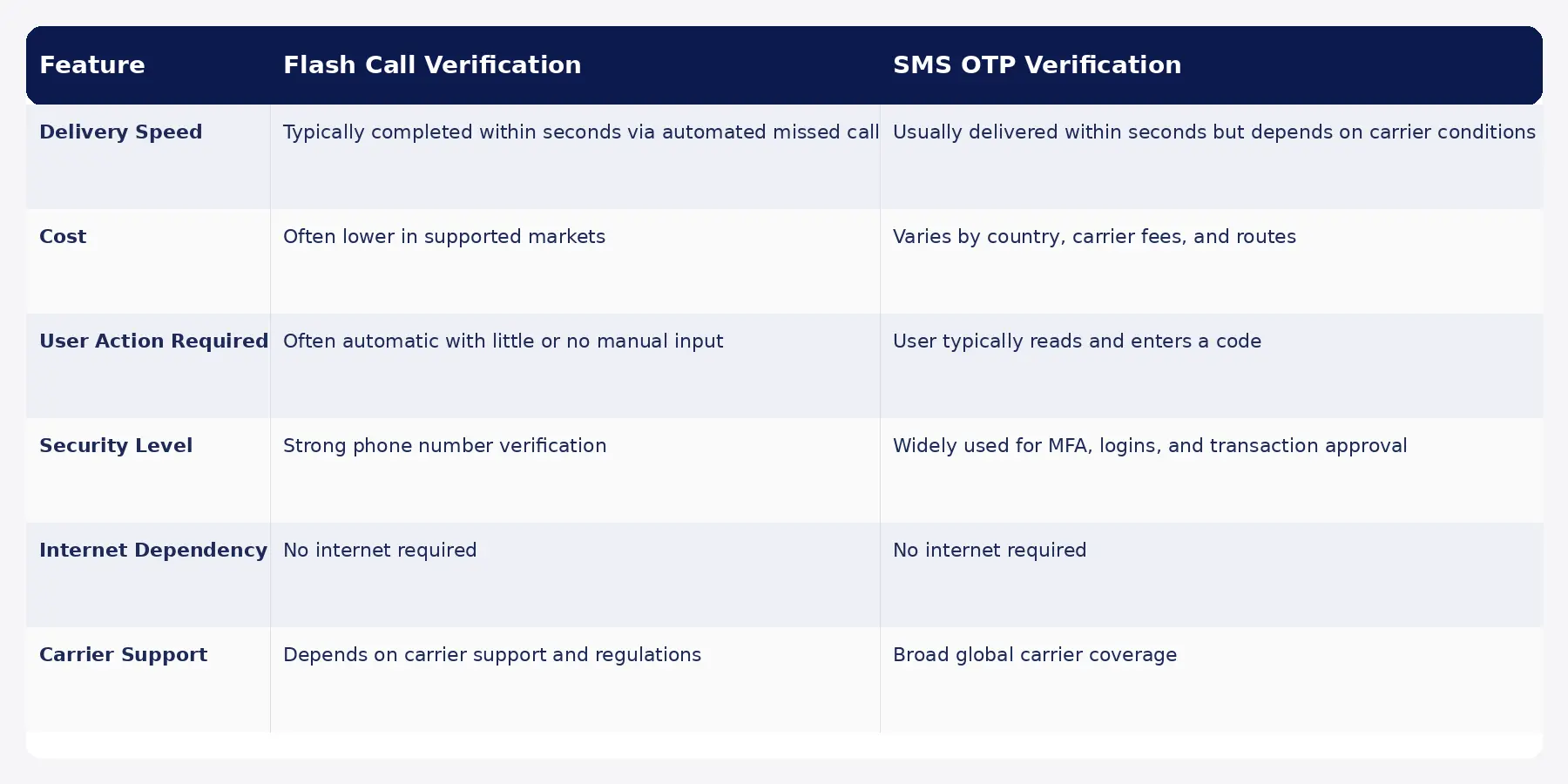
Flash Call vs. SMS OTP
Both flash call verification and SMS OTP authentication are widely used to verify phone numbers and protect user accounts. While they serve the same purpose, they differ in cost, user experience, delivery method, and infrastructure requirements.
Which Verification Method Is Right for You?
The best verification method depends on your target markets, authentication volume, user experience goals, and cost requirements. While both flash call verification and SMS OTP can effectively verify phone numbers, each approach offers distinct advantages depending on the environment in which it is deployed.
Flash call verification is often the better choice when reducing verification costs and minimizing user friction are top priorities. Because users typically do not need to manually enter a verification code, flash calls can streamline onboarding flows and improve conversion rates. This approach works particularly well in regions where carrier support for flash calls is strong and regulatory restrictions are limited.
SMS OTP verification is generally the safer option when broad international coverage and maximum compatibility are required. SMS OTP works across virtually all mobile devices and carrier networks, making it a reliable choice for account authentication, transaction approvals, password recovery, and other security-sensitive workflows. It is also commonly used in markets where flash call verification may be restricted or inconsistently supported.
For many global businesses, a hybrid verification strategy delivers the best results. Flash calls can be used as the primary authentication method to reduce costs and improve user experience, while SMS OTP serves as an automatic fallback whenever flash call verification is unavailable, blocked, or unsuccessful. This combination helps maximize verification completion rates while maintaining broad geographic coverage and consistent authentication performance.
Flash Calls vs. Flash SMS: A Clarification
Although their names are similar, flash calls and flash SMS serve different purposes and operate through entirely different communication channels. Flash call verification is a voice-based authentication method that places a brief call to a user's phone number. The verification process is completed by validating the incoming caller ID, allowing users to confirm their identity without manually entering a code.
Flash SMS, also known as a Class 0 SMS, is a special type of text message that appears directly on a recipient's screen instead of being stored automatically in the device's messaging inbox. These messages are typically used for urgent notifications, critical alerts, and time-sensitive information that requires immediate visibility.
While flash SMS focuses on delivering information quickly, flash calls are primarily designed for phone number verification and user authentication. Businesses commonly use flash calls to streamline onboarding, account verification, and login workflows, whereas flash SMS is more suitable for emergency notifications, security warnings, and other high-priority communications that need to capture immediate attention.
Start Verifying Users Faster With Flash Calls
Flash calls are an innovative solution in phone verification technology, offering a streamlined authentication experience that balances security, speed, and user convenience. By automatically verifying users through brief, automated calls that require no manual code entry, this method addresses many pain points associated with traditional SMS-based verification while reducing costs for businesses.
The versatility of flash calls makes them valuable across diverse industries, from banking and fintech to eCommerce, ride-sharing, gaming, and government services. Their benefits include instantaneous verification, enhanced security against common SMS-based attacks, significant cost savings, universal device compatibility, and dramatically reduced user friction during authentication flows.
However, businesses must also consider the limitations, including dependency on network quality, potential user confusion, possible carrier blocking, and the need for supplementary authentication methods in high-security scenarios. The most effective implementation often combines flash calls with fallback options and clear user communication to ensure reliable verification across all use cases.
For businesses looking to implement flash call verification, choosing the right technology partner is crucial. Dexatel offers flash call solutions that help companies streamline their authentication processes while maintaining high security standards. Whether you're building a fintech application, scaling an eCommerce platform, or developing any service requiring reliable user verification, Dexatel's flash call technology can help you reduce friction, cut costs, and improve user experience.
Improve your authentication flow with Dexatel's voice verification solutions and discover how this innovative technology can transform your user verification process.
Verify users instantly — no SMS needed
Flash calls authenticate users in seconds with a missed call — lower cost, higher conversion. Try Dexatel free for 30 days.
Frequently Asked Questions
Is flash call verification cheaper than SMS OTP?
In many regions, flash call verification can be a more cost-effective alternative to SMS OTP authentication. Because the verification process relies on a brief phone call rather than message delivery, businesses may be able to reduce authentication costs while maintaining a smooth user experience.
Can flash calls replace SMS OTP completely?
Some organizations use flash calls as their primary verification method, particularly in markets where call-based authentication performs well. However, many businesses also implement SMS OTP as a fallback option to ensure broader coverage and maintain verification success when flash calls cannot be completed.
Do flash calls work internationally?
Yes. Flash call verification can be deployed across multiple countries through supported carrier networks and telecommunications infrastructure. Availability and performance may vary depending on local regulations, carrier policies, and regional network conditions.
How quickly can I integrate a flash call API?
Most Flash Call API integrations can be completed within a few hours using standard REST API endpoints and implementation guides. The exact timeline depends on your application architecture, authentication workflow, and any additional customization requirements.
Can I combine flash calls with other verification methods?
Absolutely. Many businesses use flash calls alongside SMS OTP, voice OTP, and messaging-app authentication to create a multi-channel verification strategy. Combining multiple methods helps improve reliability, increase completion rates, and provide fallback options when a preferred channel is unavailable.
Do flash calls work on iPhone?
Yes, flash call verification can work on both iPhone and Android devices, but there are important differences. On Android, apps can often access call state information and, with the appropriate permissions, automatically detect the incoming verification call and complete authentication without requiring any user action. On iPhone, Apple's privacy restrictions limit access to call-related data, making fully automated caller ID detection more difficult or impossible for many implementations. As a result, flash call verification on iOS may require additional user interaction, such as returning to the app after the call or confirming the verification request, depending on the implementation, while Android generally supports a more seamless verification experience.


.jpg&w=828&q=75)
.jpg&w=828&q=75)