


Best WhatsApp API Providers for Business in 2026


Published: Jun 8, 2026
.jpg "WhatsApp API providers")
WhatsApp has over 3 billion active users, and businesses across industries are using it to handle everything from customer support to order updates to user verification. But to do any of that at scale, you need more than the standard Business App. You need API access, and you need the right provider behind it. This guide covers what to look for, which providers stand out in 2026, and how to get started.
TL;DR
The best WhatsApp API provider depends on your business size, technical requirements, automation needs, and budget.
Dexatel, Twilio, Infobip, Respond.io, and 360dialog are authorized WhatsApp Business Solution Providers (BSPs), while other providers focus on specific use cases such as no-code automation or AI-driven support.
Pricing ranges from free plans and subscriptions starting at around $15–$79 per month to pay-as-you-go models based on message volume and Meta fees.
Businesses should compare BSP status, pricing, onboarding support, automation capabilities, and multi-channel features before choosing a provider.
What Exactly Is a WhatsApp API?
The WhatsApp Business API is the programmatic layer that lets businesses send and receive WhatsApp messages at scale. Unlike the WhatsApp Business App, which is designed for small teams managing conversations manually, the API connects WhatsApp directly to your CRM, support platform, or custom application, so you can automate messaging, handle high volumes, and build real workflows around it.
Access isn't direct. To use the API, you either go through Meta's Cloud API or work with an authorized Business Solution Provider who handles provisioning and compliance on your behalf.
WhatsApp Platform vs. WhatsApp API
A lot of businesses start with the WhatsApp Business App and outgrow it fast. It works well for small teams handling a manageable number of conversations, but it has its limits: one device, no automation, no way to connect it to your existing tools, and no support for multiple agents working simultaneously.
The WhatsApp Business Platform is the broader term Meta uses for its business-facing infrastructure, and the API is how you actually access it programmatically. Once you're on the API, those limits go away. You can connect WhatsApp to your tech stack, set up automated flows, assign conversations to different team members, and send messages at volume.
The Business App is for small businesses that need a basic presence on WhatsApp and handle conversations one by one. The WhatsApp Business App vs API distinction matters more as your volume grows, since the API is what makes WhatsApp a real business channel rather than just a messaging app.
Talk to customers on WhatsApp — at scale
From transactional alerts to customer support, Dexatel's WhatsApp Business API helps you engage users on the world's most popular messaging app.
What to Look for When Choosing a WhatsApp API Provider
Picking a provider affects how reliably your messages get delivered, how much you pay per conversation, how well WhatsApp fits into your existing tools, and how much your team can actually do with it. Here's what to evaluate before you commit.
Official Meta Partnership and Compliance
WhatsApp isn't an open channel, and not every provider has the same level of access. There are a few things you need to check.
BSP status: Every legitimate provider needs to be an authorized WhatsApp Business Solution provider, meaning Meta has vetted them and granted them the ability to provision WhatsApp Business Accounts on behalf of their clients. Working with a low-tier reseller adds unnecessary complexity and can create compliance gaps.
Meta policy compliance: WhatsApp has strict rules around messaging content, opt-in requirements, and conversation categories. A good provider keeps you on the right side of those rules and flags issues before they become problems.
Template approval handling: Every business-initiated message requires a pre-approved template. Providers with solid review workflows help you structure and submit templates in a way that reduces rejections and speeds up approvals.
Infrastructure and Delivery Reliability
If your messages aren't getting delivered consistently, nothing else about the provider matters.
Global routing depth: Providers with strong carrier relationships and regional infrastructure will consistently outperform those relying on a single routing path, especially in markets where connectivity is less predictable.
Fallback routing: If a WhatsApp message fails to deliver, a good provider automatically reroutes it through SMS or voice. This matters most for time-sensitive messages like OTPs or delivery updates.
Uptime SLAs: Look for documented uptime commitments and clarity on what happens during outages.
Scalability: A provider that handles your current volume comfortably may struggle during a large campaign or a seasonal spike. Make sure their infrastructure can absorb sudden demand without affecting delivery rates.
Automation and AI Capabilities
One of the biggest reasons businesses move to the API is to stop handling conversations manually. What a provider offers on the automation side will determine how much you can act on that:
Chatbot builders: Some providers include no-code chatbot tools that let you set up automated responses without developer involvement. Others offer API-level flexibility for teams that want to build custom logic.
Workflow automation: Look for trigger-based flows that can handle things like welcome messages, follow-ups, or escalations automatically based on user actions or message content.
AI-assisted support and routing: More providers are adding AI layers that detect intent, suggest replies, or route conversations to the right agent. This is particularly useful for high-volume support operations where speed and accuracy both matter.
CRM and Omnichannel Integrations
WhatsApp works best when it's connected to the rest of your stack, not running as a separate tool your team has to check independently:
CRM and platform integrations: The strongest providers offer native integrations with tools like Salesforce, HubSpot, Zendesk, and Shopify. This means customer data, conversation history, and order context are all in one place rather than scattered across systems.
Unified inboxes: If you're running WhatsApp alongside SMS, Viber, or email, a unified inbox lets your team manage all channels from a single view. This reduces response times and makes it easier to maintain consistent communication across touchpoints.
Pricing Transparency
Not all WhatsApp API providers present their pricing in the same way, which can make direct comparisons difficult. Before choosing a provider, make sure you understand exactly what is included in the advertised price and how your costs will scale over time.
How Meta and provider fees are charged: WhatsApp Business API costs typically consist of Meta messaging fees plus any charges imposed by the provider. Some providers clearly separate these costs, while others bundle them together into a single rate, making it harder to determine what portion goes to Meta and what portion goes to the platform.
How pricing models differ: Providers generally use one of three approaches: monthly subscriptions, usage-based billing, or a combination of both. Understanding whether you're paying a fixed fee, a per-message fee, or both will help you estimate costs accurately as your messaging volume grows.
How WhatsApp API Pricing Works in 2026
WhatsApp Business API pricing changed significantly when Meta moved away from its conversation-based billing model and adopted per-message pricing for business-initiated template messages. Today, the total cost of using the WhatsApp API typically consists of Meta's messaging fees plus any platform fees charged by your chosen BSP.
The amount you pay depends on the type of message being sent:
Marketing Messages
Marketing messages include promotional campaigns, product announcements, special offers, recommendations, and other communications intended to drive engagement or sales. These messages generally have the highest per-message cost.
Utility Messages
Utility messages are transactional communications related to an existing customer interaction. Examples include order confirmations, shipping updates, appointment reminders, account notifications, and payment receipts.
Authentication Messages
Authentication messages are used for identity verification and account security. Common examples include one-time passwords (OTPs), two-factor authentication (2FA) codes, and login verification messages.
Service Messages
Service messages are sent in response to a user-initiated conversation and help businesses provide customer support. In many cases, these messages can be exchanged without additional Meta messaging charges while the customer service window remains open.
In addition to Meta's fees, some providers charge a monthly subscription, while others use a pay-as-you-go model with platform fees applied per message. When comparing WhatsApp API providers, evaluate both Meta's messaging costs and the provider's pricing structure to understand the total cost of ownership.
WhatsApp API Providers at a Glance

Best WhatsApp API Providers
The right provider depends on whether you're optimizing for delivery reliability, automation depth, ease of use, or raw API access. Here's a look at the leading options in 2026.
1. Dexatel
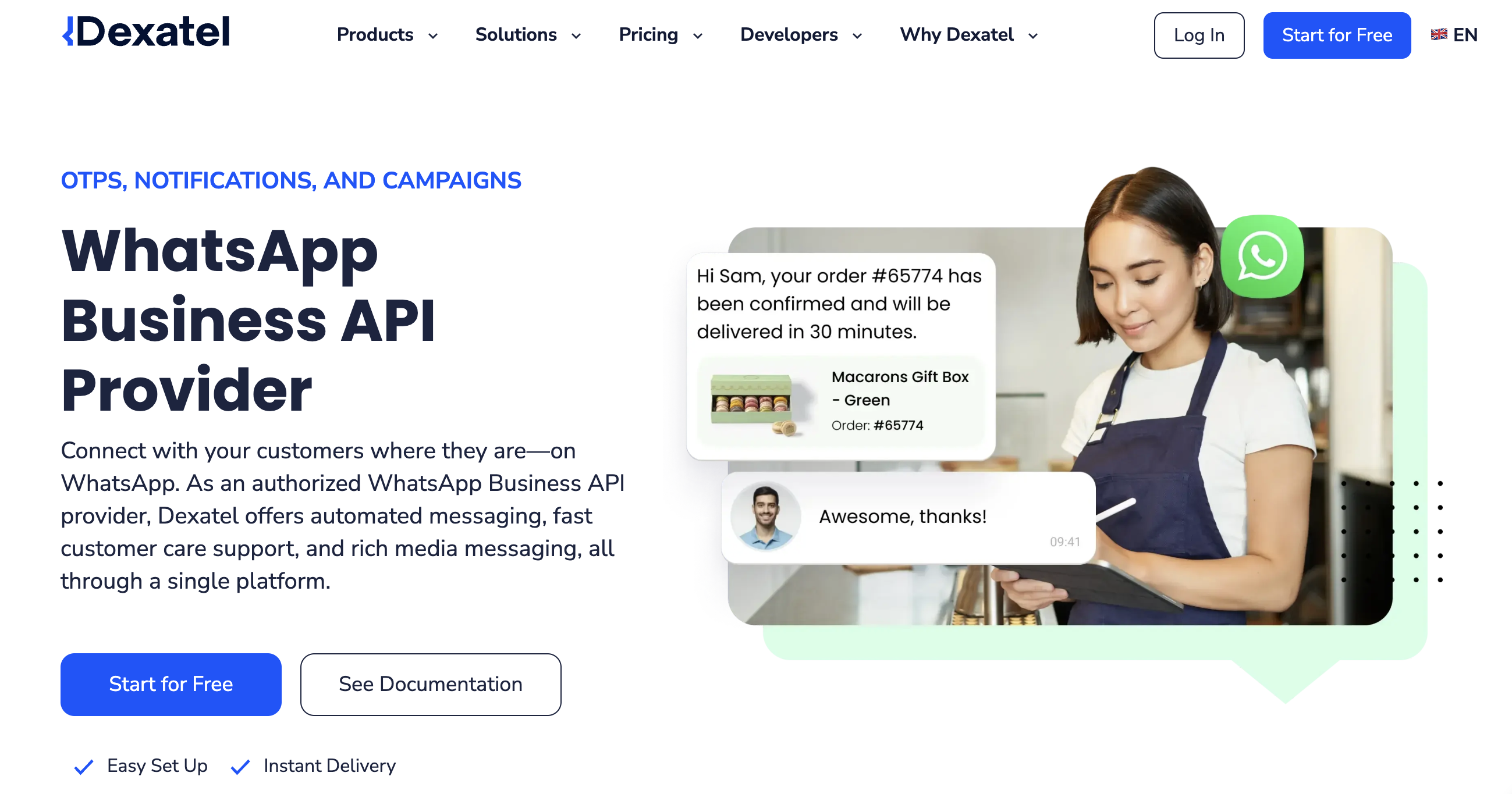
Dexatel is an authorized WhatsApp Business Solution Provider and a multi-channel CPaaS platform that covers WhatsApp, SMS, Viber, Telegram, RCS, and more under a single API. For businesses that need WhatsApp as part of a broader communication stack, be it for verification, customer engagement, or notifications, Dexatel handles the full setup from WABA registration and template approval to webhook integration and ongoing compliance support. The platform is especially ideal for teams that want reliable delivery at scale without managing multiple vendors.
Key features for WhatsApp API:
Verified business messaging with support for templates, rich media, and two-way chat
Multi-channel fallback routing across SMS, voice, and flash call for undelivered messages
OTP and 2FA flows with multi-channel fallback and fraud prevention
Shared inbox for managing customer conversations across agents and teams
Chatbot integration and webhook-based automation
WABA onboarding, template submission, and compliance guidance included
Number lookup and pre-send validation to improve deliverability and reduce cost
Best for: Businesses that want WhatsApp and other channels managed from one platform with carrier-grade reliability and strong verification capabilities.
Pricing (as of 2026): Pay-as-you-go, starting from $0.0041 per utility and authentication messages and $0.0288 for marketing messages. Service messages are free of charge, and the monthly fee is $28.
2. Twilio
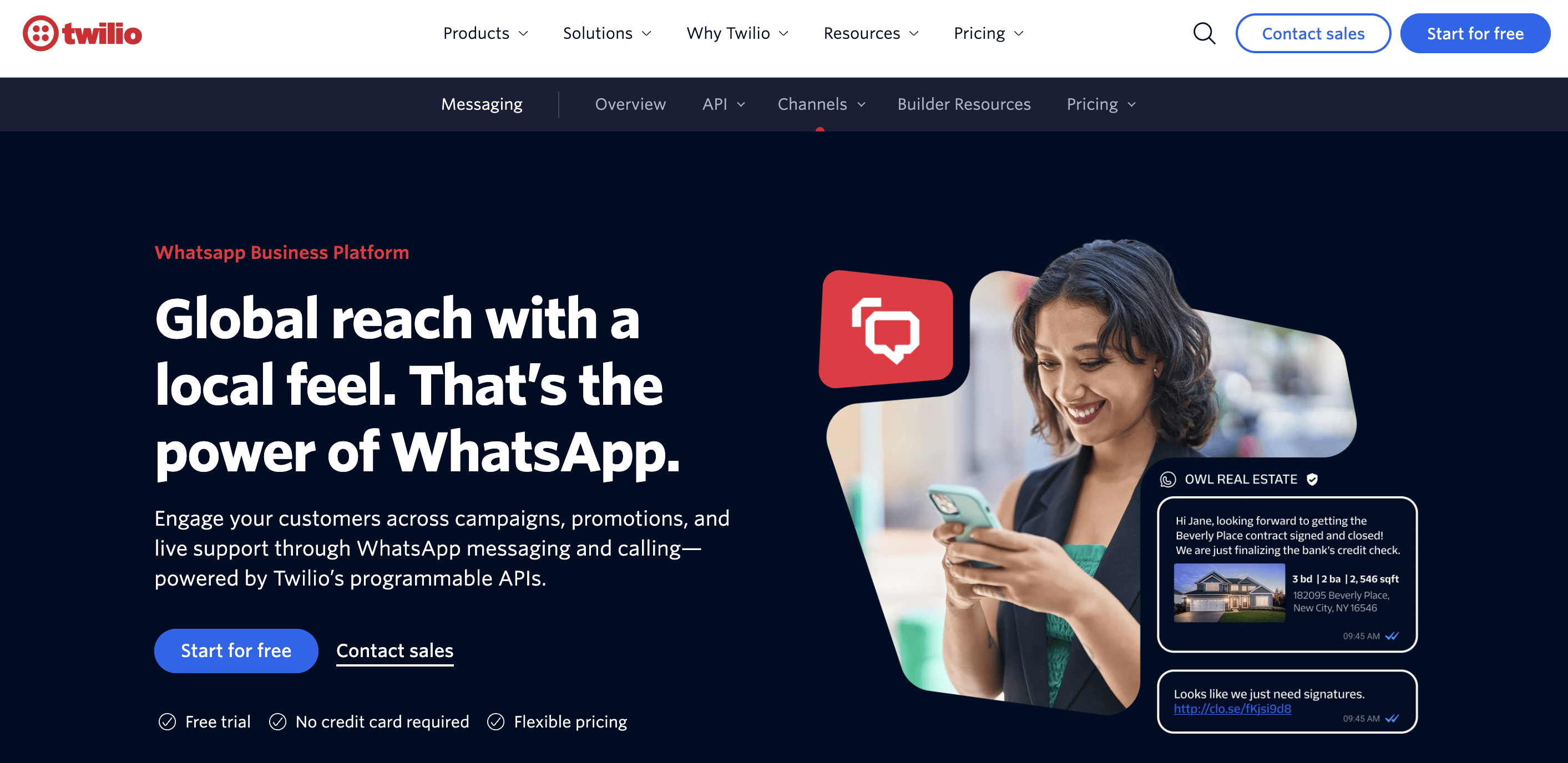
Twilio is a developer-focused communications platform with broad channel coverage and a strong emphasis on AI-powered conversation orchestration. Its WhatsApp API supports the full range of business messaging needs, from alerts and verification to live support and conversational commerce, and extends into WhatsApp Business Calling, which lets businesses handle voice and chat within the same thread.
Key features for WhatsApp API:
Programmatic sender management and template handling
Utility direct send (Beta) for faster setup without pre-approval
WhatsApp Business Calling with click-to-call buttons and IVR integration
AI-powered conversation flows combining chatbots, LLMs, and live agents
Cross-channel continuity across WhatsApp, SMS, RCS, voice, and email
Verification and OTP support across multiple channels
Best for: Engineering teams that need deep customization and are comfortable building on a developer-first platform.
Pricing (as of 2026): Twilio charges $0.005 per WhatsApp message, plus Meta’s per-template message fee.
3. Infobip
Infobip is an enterprise-grade communications platform and one of the earliest BSPs for WhatsApp, with a presence in over 190 countries and 2,500 brands using its WhatsApp infrastructure. It covers the full customer journey from marketing campaigns and transactional notifications to live support and OTP verification, with strong analytics and AI capabilities built into the platform.
Key features for WhatsApp API:
Full omnichannel platform with WhatsApp as a primary or failover channel
Personalized campaign orchestration with segmentation and scheduling
Smart chatbots with live agent escalation
Consent management and built-in compliance tools
Marketing Messages API for optimized promotional delivery
24/7 technical support and expert onboarding guidance
Best for: Large enterprises looking for a mature, full-stack omnichannel platform with deep WhatsApp expertise and global reach.
Pricing: Pay-as-you-go. The price per WhatsApp message varies by country and category (utility, authentication, marketing, marketing cloud, and free form).
4. WATI
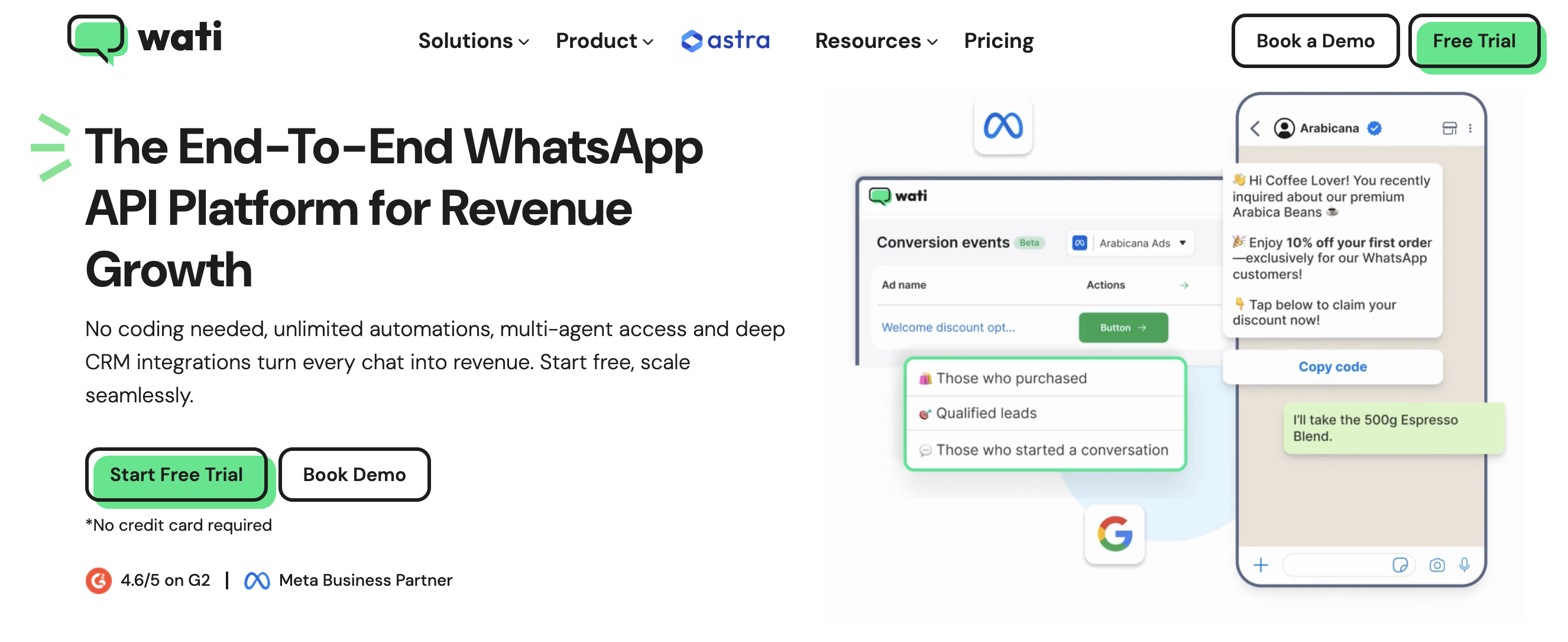
WATI is a WhatsApp-native platform with a no-code approach that makes it accessible to businesses without dedicated development resources. It covers the full commercial cycle from lead capture and broadcast campaigns to support automation and post-sale engagement, with a unified inbox that extends beyond WhatsApp to Instagram, Facebook, SMS, and website chat.
Key features for WhatsApp API:
No-code chatbot builder with 24/7 automated responses
Broadcast and bulk messaging with multi-language template support
Click-to-WhatsApp ads with conversion signal tracking
WhatsApp Flows for surveys, registrations, and interactive experiences
WhatsApp Catalog for in-chat product browsing and purchases
AI-powered routing and agent handoff via shared Team Inbox
Integrations with CRM, payment, and analytics tools
Best for: Small to mid-sized businesses that want a feature-rich WhatsApp platform without the complexity of a developer-first setup.
Pricing: WATI has three tiers, starting at $67 a month (with annual billing) for the Growth plan.
5. Yellow.ai
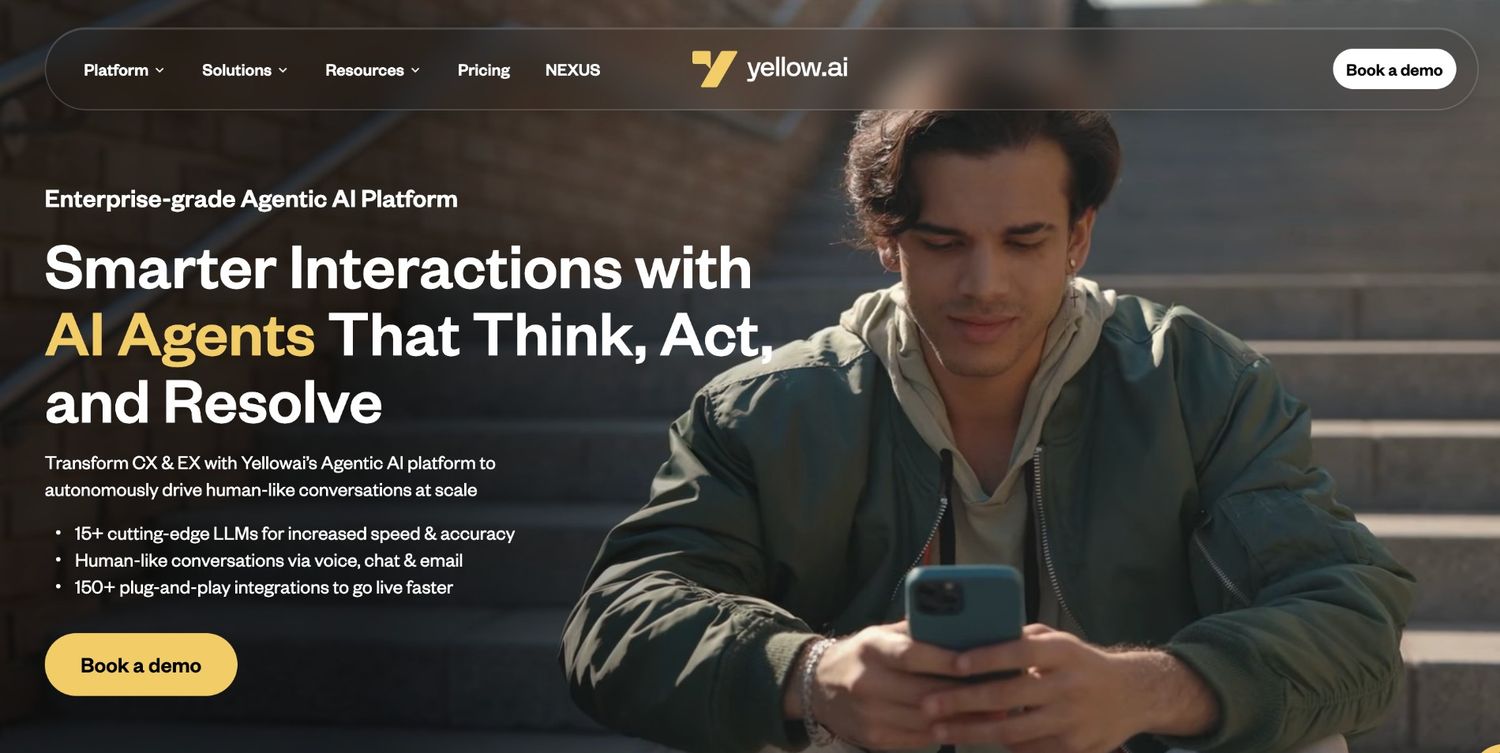
Yellow.ai is an AI-first conversational platform built around agentic AI, meaning its bots don't just respond to predefined inputs but understand intent, maintain context, and handle complex scenarios autonomously. For businesses prioritizing automation depth over simplicity, it offers one of the more capable AI layers available through a WhatsApp API provider.
Key features for WhatsApp API:
Agentic AI with support for 15+ LLMs and multi-modal input (voice, image, document)
Over 80% query automation with dynamic conversation flows
Hyper-personalized campaign orchestration via Conversational Marketing Cloud
End-to-end conversational commerce with in-chat product discovery and payment integration
150+ plug-and-play integrations for fast deployment
Smart analytics that improve AI performance over time
Best for: Mid-to-large businesses that want AI-driven automation at the core of their WhatsApp strategy, particularly for support and conversational commerce.
Pricing: Yellow.ai offers an Enterprise package with custom pricing.
6. Respond.io
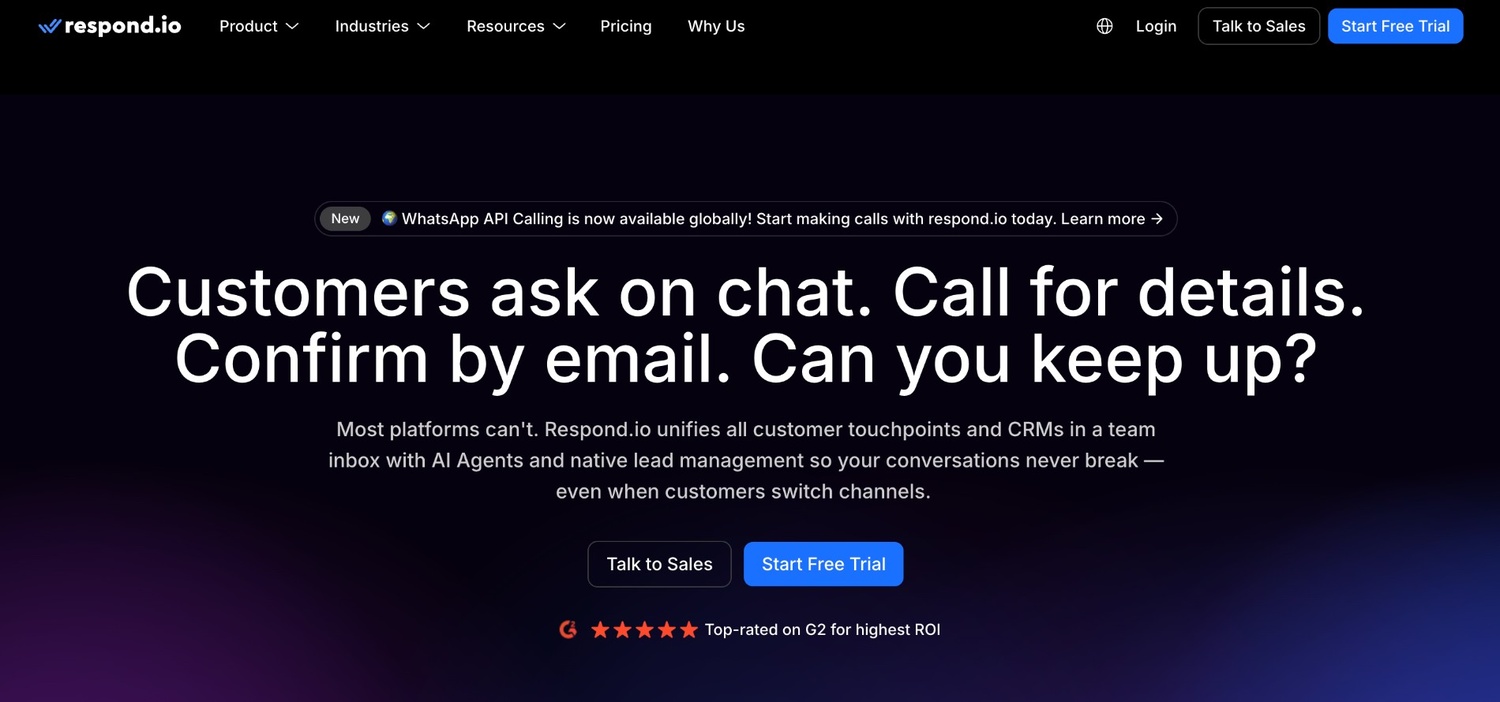
Respond.io is a conversation management platform focused on helping customer-facing teams handle high inbound volumes efficiently across channels. Its WhatsApp Coexistence feature lets businesses run the WhatsApp Business App and API on the same number. The platform offers transparent pricing with no setup fees or markups on Meta's conversation rates.
Key features for WhatsApp API:
WhatsApp Coexistence: run Business App and API on the same number
Unified team inbox across WhatsApp, and other channels with multi-user access
WhatsApp Business Calling API integrated in the same conversation thread
AI agents for FAQ handling, lead qualification, routing, and product recommendations
Click-to-WhatsApp ad lead capture with Meta Conversions API (CAPI) optimization
Native CRM integrations with HubSpot, Salesforce, Zoho, and Shopify
99.999% uptime with ISO 27001 and GDPR compliance
Best for: Fast-growing B2C businesses that need a scalable, team-focused inbox with transparent pricing and strong Meta partnership standing.
Pricing: Respond.io offers tiered pricing with four plans, starting from $79 a month for the Starter plan.
7. 360dialog
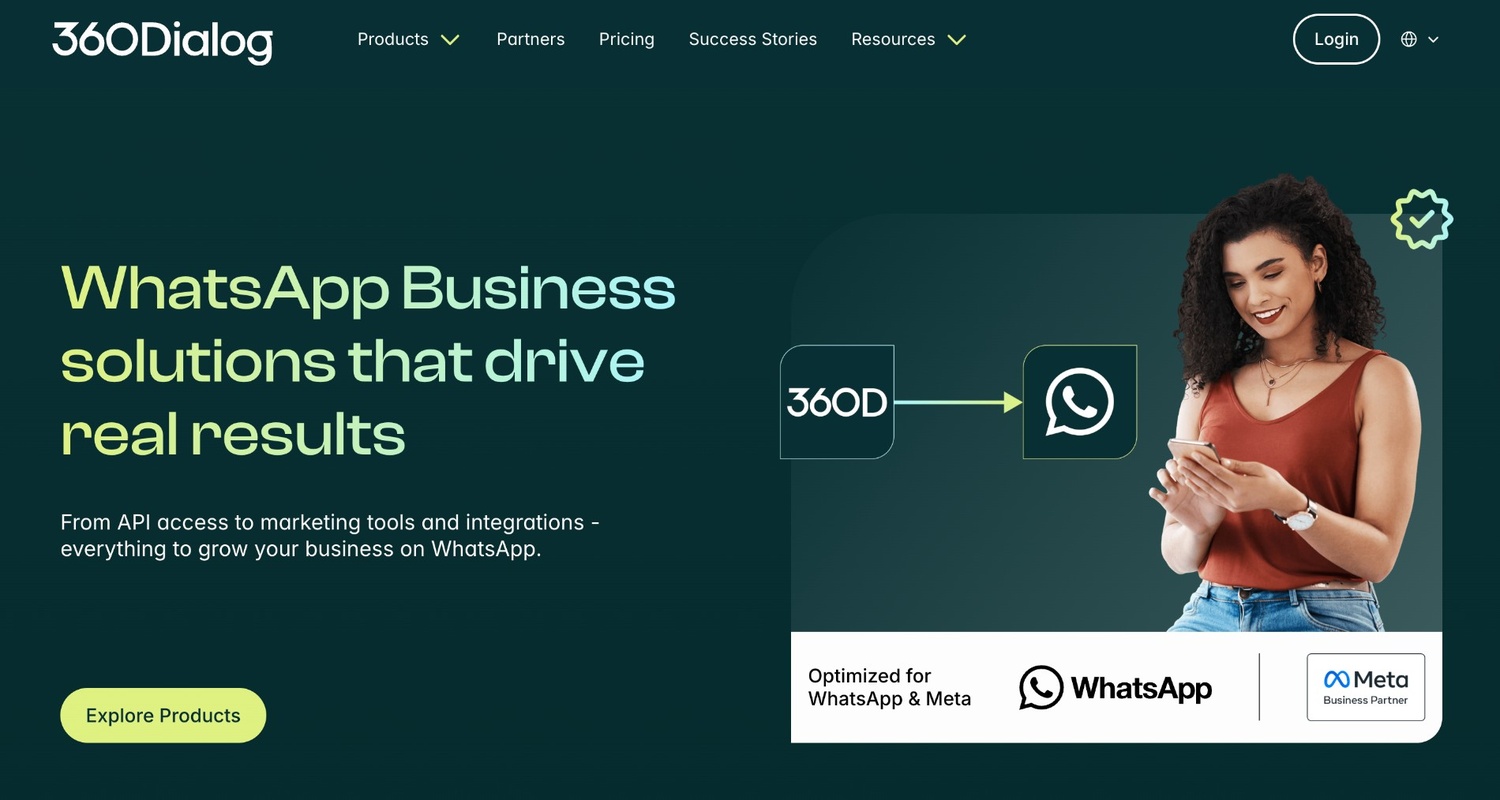
360dialog is a direct BSP that gives developers clean, well-documented API access without the added complexity of a full platform layer. With transparent pricing starting at $59 a month and no markups on Meta's conversation fees, it appeals to in-house engineering teams that want to build their own workflows rather than work within a provider's interface.
Key features for WhatsApp API:
Direct WhatsApp API access with no hidden layers or middleware
Comprehensive documentation with working code examples and a testing sandbox
Full webhook and extensions support
Transparent pricing with no markups on Meta fees
24/7 support from engineers with direct Meta relationship benefits
Partner Platform for agencies managing WhatsApp across multiple clients
Best for: Developers and technical teams that want raw API access, clean documentation, and predictable pricing without paying for platform features they won't use.
Pricing: 360Dialog has four pricing plans for WhatsApp API, starting from $55 for the Regular plan.
8. AiSensy
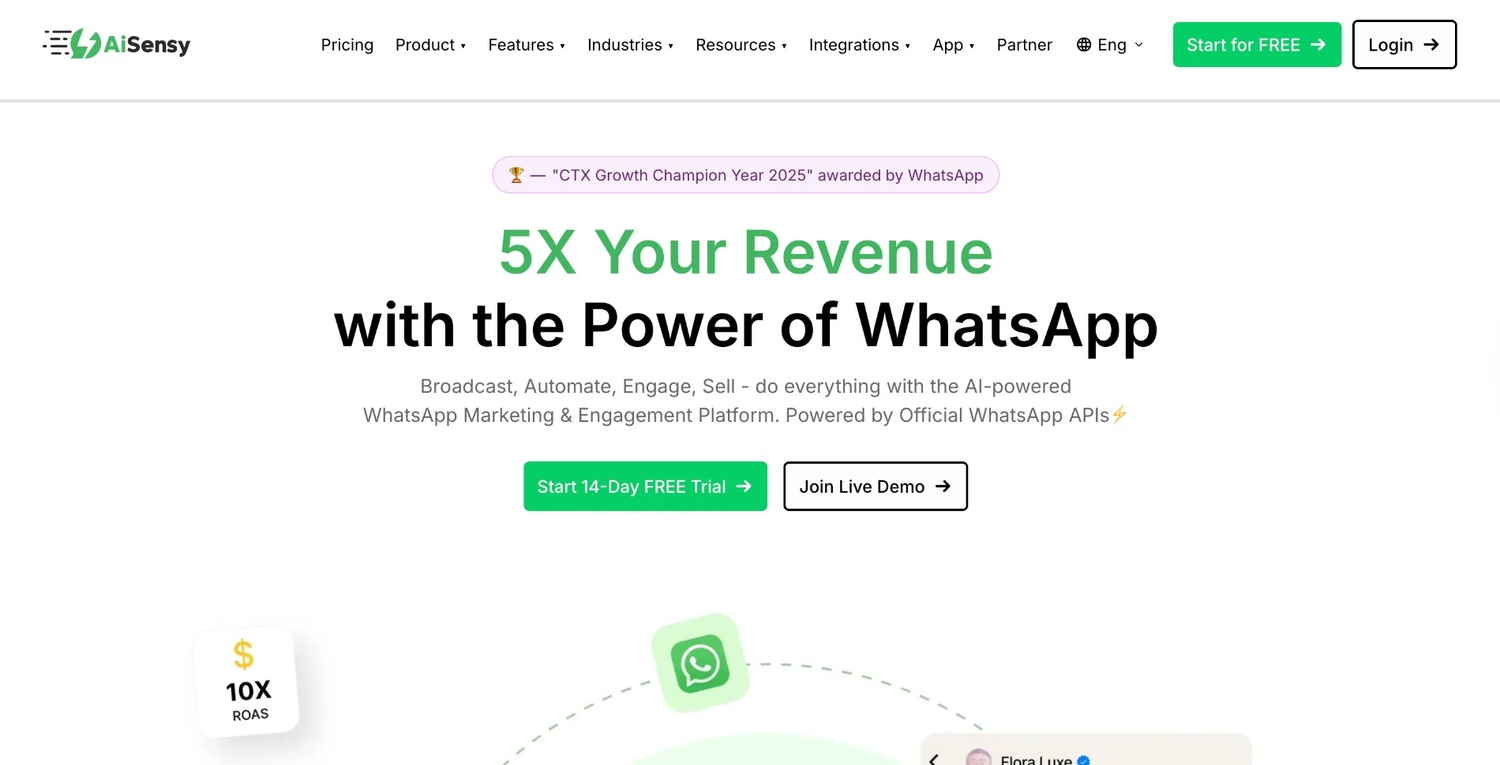
AiSensy is a WhatsApp-focused marketing and engagement platform with a strong emphasis on broadcast campaigns, lead generation, and in-chat commerce. It's especially popular in the Indian market and among businesses that run high-frequency promotional campaigns on WhatsApp. The platform is designed to get businesses up and running quickly, with free onboarding, no setup fees, and a zero-barrier entry point.
Key features for WhatsApp API:
Broadcast messaging with scheduling up to two months ahead
Click-to-WhatsApp ads with AI-powered lead segregation and conversion tracking
No-code chatbot and catalog flow builder
In-chat payments via WhatsApp Pay, Razorpay, and PayU
WhatsApp Forms for lead capture and user data collection
Multi-agent live chat with smart routing and tag-based filtering
Real-time campaign analytics with retargeting capabilities
Best for: Businesses with a strong focus on WhatsApp marketing campaigns, particularly in price-sensitive markets where broadcast reach and in-chat conversions are the primary goals.
Pricing: The platform offers five pricing plans, including a Free Forever plan. The Basic plan is $15 a month.
Other WhatsApp API Providers Worth Considering
While the providers above cover most business needs, several other established WhatsApp API providers are also worth evaluating:
Gupshup
One of the largest messaging platforms globally, Gupshup offers WhatsApp, SMS, RCS, and conversational AI tools. It's particularly popular among enterprises and businesses operating in Asia, Latin America, and emerging markets.
Sinch
Sinch combines WhatsApp with SMS, voice, email, and verification services through a single communications platform. It is often chosen by businesses that want customer messaging and authentication managed by the same provider.
Bird (formerly MessageBird)
Bird provides omnichannel customer communications across WhatsApp, SMS, email, voice, and other channels. Its API-first approach and automation tools make it a common choice for businesses building customer engagement workflows across multiple touchpoints.
Interakt
Interakt is a WhatsApp-focused platform designed primarily for small and medium-sized businesses. It offers shared inboxes, broadcast messaging, catalog management, order notifications, and CRM integrations with a relatively simple setup process.
These providers may be a better fit depending on your geographic coverage requirements, preferred pricing model, automation needs, and existing technology stack.
Regional Considerations When Choosing a WhatsApp API Provider
The best WhatsApp API provider often depends on where your customers are located. In regions where WhatsApp serves as a primary communication channel—such as India, the Middle East, Latin America, Southeast Asia, and parts of Africa—businesses typically prioritize providers with strong local expertise, regional support teams, and experience navigating market-specific regulations. For example, AiSensy has built a strong presence in India, while providers such as Infobip and Dexatel support businesses across multiple international markets. If your customer base spans several countries, consider a provider with global coverage, local number support, multilingual capabilities, and reliable message delivery across your target regions.
Common WhatsApp API Use Cases for Businesses
Once you have API access, the range of things you can do with WhatsApp expands significantly. These are the most common ways businesses are putting it to work:
Customer Support and Live Chat
WhatsApp has become a natural first contact point for customer queries, and the API makes it practical to manage that at scale. Shared inboxes let multiple agents work from the same number, chatbots handle common questions automatically, and more complex issues get routed to the right person without the customer having to start over. The result is faster resolution times without a proportional increase in support headcount.
Transactional Notifications and Alerts
Order confirmations, delivery updates, appointment reminders, account alerts. These are messages people actually want to receive, and WhatsApp is where they're most likely to see them quickly. Open rates on WhatsApp significantly outperform email, which makes it a practical upgrade for any business that relies on time-sensitive notifications reaching their audience. You can also automate WhatsApp appointment booking and result updates, reducing no-shows and manual follow-up in one go.
OTP and User Verification
WhatsApp is gaining traction as a primary channel for sending login codes and transaction verification, particularly in markets where it has higher reach than SMS. Combining it with SMS or voice fallback means a failed WhatsApp delivery doesn't turn into a failed authentication attempt, which directly reduces friction in the authentication flow and keeps drop-off rates low.
Marketing and Re-Engagement Campaigns
With the API, you can broadcast promotional messages to opted-in contact lists, run Click-to-WhatsApp ads that bring leads directly into a conversation, and follow up with personalized offers based on user behavior or purchase history. It's worth noting that this is distinct from WhatsApp channels, which are one-way broadcast tools with no two-way interaction. API-based campaigns are fully conversational and consent-gated, which tends to produce stronger engagement than traditional broadcast formats.
Conversational Commerce
Rather than redirecting customers to a website, conversational commerce lets the entire purchase happen inside the chat. Customers can browse products, ask questions, get personalized recommendations, and complete a transaction without leaving WhatsApp. Payment links and in-chat checkout flows reduce the steps between interest and purchase, which has a direct impact on conversion rates, particularly on mobile.
When WhatsApp API Works Best (And When It Doesn’t)
Although WhatsApp API is a strong channel, it's not the right fit for every situation. Knowing where it performs well and where it falls short saves you from building on the wrong foundation.
Works Best When
Your audience is mobile-first and already active on WhatsApp. In many markets across LATAM, MEA, South Asia, and parts of Europe, it's the default communication channel, which means your messages land where attention already is.
Response time matters. WhatsApp conversations feel immediate in a way that email doesn't, and users expect and deliver faster replies as a result.
Message visibility is a priority. With open rates that consistently outperform email and SMS, WhatsApp is hard to beat for time-sensitive or high-stakes communication.
Less Effective When
Your audience isn’t active on WhatsApp
You rely heavily on cold outreach (strict opt-in rules)
Conversations require complex UI interactions
How to Set Up WhatsApp API for Your Business
Getting started with the WhatsApp API involves a few key steps, but with the right provider guiding you through it, the process moves quickly.
1. Choose a Whatsapp API Provider
Pick an authorized BSP that fits your use case, team size, and budget. Your provider will handle WABA onboarding, template management, and technical support, so the choice matters beyond just pricing.
2. Create and Verify Your Whatsapp Business Account
Your provider will walk you through setting up and verifying your WABA via Meta Business Manager, including business identity confirmation and phone number linking.
3. Set Up Your Messaging Profile
Configure your display name, description, logo, and contact details. This is what recipients see when you message them, so keep it accurate and on-brand.
4. Configure Message Templates
Any message sent outside the 24-hour customer service window needs a pre-approved template. Work with your provider to create and submit templates for your main use cases.
5. Integrate the API
Connect WhatsApp to your existing systems via webhooks, SDK, or your provider's no-code connector, making it part of your actual workflow rather than a separate tool.
6. Add Automation and Workflows
Set up automated replies, chatbot routing, triggered notifications, and escalation logic. Most providers offer visual builders or webhook-based tools to handle this without heavy development work.
7. Test, Optimize, and Scale
Test your flows before going live, then monitor delivery rates, response times, and conversation quality once you are.
Pro Tip: Don’t Build WhatsApp in Isolation
WhatsApp API works best when it's one part of a broader messaging strategy rather than a standalone channel. SMS remains the most universal fallback for users who aren't on WhatsApp or when delivery fails. Viber covers specific regional markets where it has stronger penetration. Email handles non-urgent, content-heavy communication that doesn't need instant visibility. Running these channels together from a single platform means you're not dependent on any one channel's limitations, and your messages find the right path to every user. Platforms that support WhatsApp alongside SMS, Viber, voice, and other channels under one API make that significantly easier to manage.
Final Thoughts
So, what is the best WhatsApp Business API provider for your business? The answer starts with a few core questions: Is the provider an authorized BSP? How reliable is their delivery infrastructure? What does their automation and integration support actually look like? And does their pricing model make sense for your volume? The right answer will look different depending on your use case and scale, but getting those fundamentals right from the start makes everything else significantly easier to build on.
Frequently Asked Questions
What is a WhatsApp Business Solution Provider (BSP)?
A WhatsApp Business Solution Provider (BSP) is a company authorized by Meta to provide access to the WhatsApp Business Platform. BSPs help businesses set up WhatsApp Business Accounts, manage messaging infrastructure, and integrate WhatsApp into their existing systems.
How much does the WhatsApp Business API cost?
Costs vary depending on the provider, message type, destination country, and pricing model. Some BSPs offer subscription plans, while others use pay-as-you-go pricing based on message volume and Meta's messaging fees.
How long does WhatsApp Business API approval take?
Most businesses can complete setup and verification within a few days, although approval times vary depending on business verification requirements and the provider's onboarding process. More complex account structures may take longer to review.
Can I keep my existing WhatsApp number when switching providers?
Yes. In most cases, businesses can migrate their existing WhatsApp Business number to a new BSP without losing the number itself. The migration process and downtime requirements vary by provider.
Is the WhatsApp Business API suitable for small businesses?
Yes. While the API was originally adopted by larger organizations, many providers now offer affordable plans and no-code tools designed for small and medium-sized businesses. The right option depends on your messaging volume and automation needs.
What's the difference between the WhatsApp Business App and the WhatsApp Business API?
The WhatsApp Business App is designed for small teams managing conversations manually from a mobile device. The WhatsApp Business API supports automation, multi-user access, CRM integrations, chatbots, and large-scale messaging.
Do I need a developer to use the WhatsApp Business API?
Not necessarily. Many providers offer no-code dashboards, chatbot builders, and prebuilt integrations that allow businesses to use the API without writing code. Developer resources are mainly required for custom integrations and advanced workflows.
Which WhatsApp API provider is best for my business?
The best provider depends on your goals, technical requirements, budget, and expected messaging volume. Some providers focus on developer flexibility, while others prioritize no-code automation, customer support, or multi-channel communication.


.jpg&w=828&q=75)

.jpg&w=828&q=75)