


WhatsApp Marketing vs SMS Marketing


Published: Jan 14, 2026

The act of messaging is the backbone of today’s customer communication.
Whether the message is an appointment reminder, an offer, or an authentication code, the question always is: WhatsApp or SMS?
The open rates of both are impressive at 98%, but the outcomes that can be achieved are quite varied.
It is up to you which one would suit your requirements, but this guide outlines all the necessary information that would enable you to take a decision or realize why the optimal course of action might involve using both.
WhatsApp Marketing vs SMS Marketing: A Quick Comparison
Before diving into the details, here's how these two messaging giants stack up:
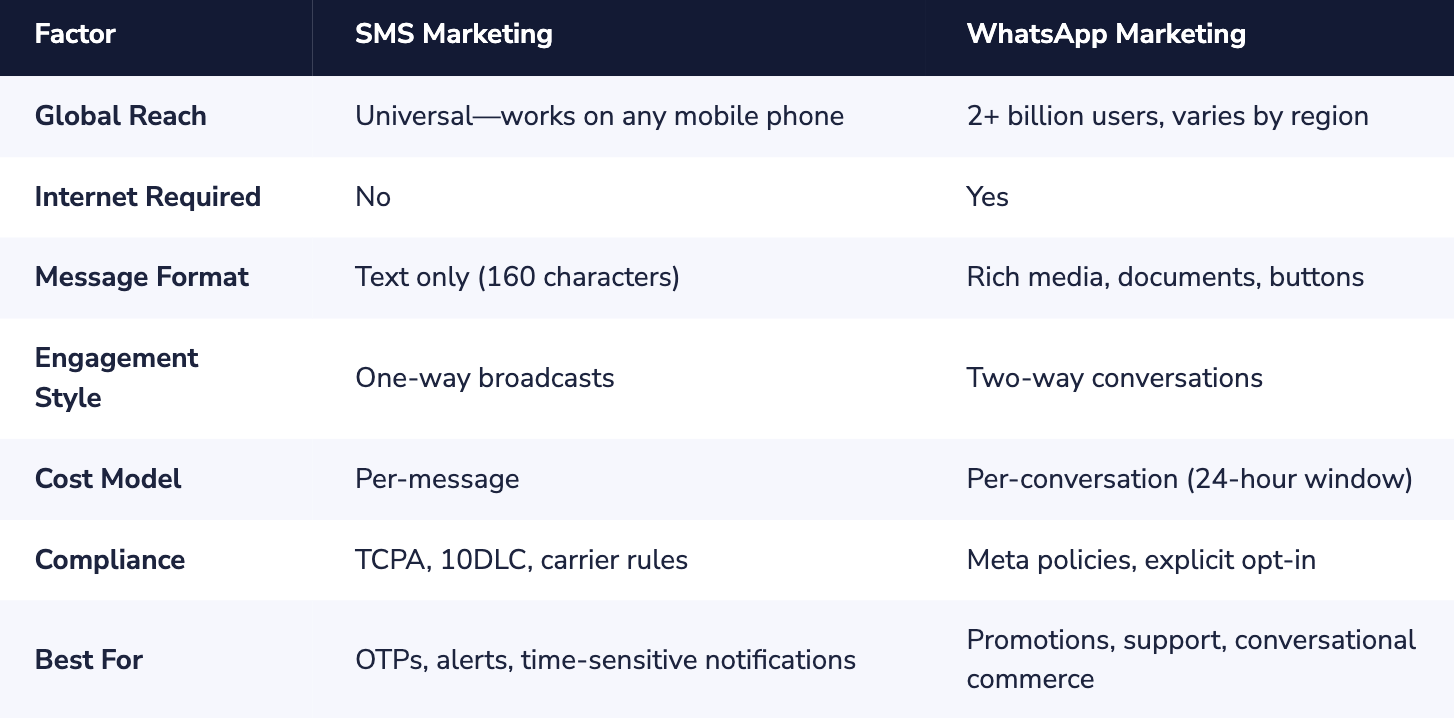
The most effective messaging strategies often leverage both channels, using each where it performs best.
What Is SMS Marketing?
SMS marketing involves the transmission of text messages to customers through the cellular network.
This is the first mobile communication service that still ranks as the most reliable means for instant communication.
How SMS Marketing Works
SMS works on a carrier level, sending messages via cellular networks as opposed to using Internet connectivity.
When sending an SMS, it is routed from the messaging application of the sending party to the cellular network of the receiving party.
The advantage of sending messages on a carrier level is that messages reach phones, even without WiFi or data connectivity, which is important when there is no Internet connectivity.
Advantages of SMS Marketing
Universal reach is SMS’s biggest strength.
All mobile phones made in the past thirty years have the ability to receive SMS, irrespective of their make, operating system, or whether it’s a smartphone or a feature phone.
One does not have to bother whether the customer has the application installed or not.
Its high deliverability makes SMS a preferred way for sending time-sensitive notifications.
Carrier networks give priority to SMS traffic, and delivery times range from a few seconds.
Such quick delivery is critical for applications that involve one-time passwords, security alerts, and delivery notifications.
The fact that no app is required means that there is no friction in customer communication.
There is no requirement for the customer to download any software, sign up for anything, or even have access to the internet—the message simply arrives.
Limitations of SMS Marketing
The character limit affects what can be said in a text.
The traditional text message has a 160-character limit, and although messages can be sent that are longer than this, they are broken up and considered multiple messages.
Rising costs have been an ever-present challenge for SMS marketers.
The cost of using carriers differs from country to country and has shown an overall increase, particularly in North America.
With the addition of A2P (Application-to-Person) and compliance charges, overall expenditure can add up quickly.
Lack of interactivity makes the SMS service good for broadcasting purposes only.
Although the recipient can send a response, it is relatively difficult compared to the current messaging systems.
Best Use Cases for SMS Marketing
SMS is still the most effective technology for mission-critical, time-sensitive communication:
- One-time passwords & Two-factor authentication
- Appointment reminders and confirmations
- Delivery and shipping notifications
- Emergency alerts & Urgent updates
- Announcements of flash sales that call for immediate action
What Is WhatsApp Marketing?
WhatsApp Marketing is based on the usage of the WhatsApp Business Platform to reach customers on the most widely used communication app globally.
With over two billion users, WhatsApp gives brands a platform to reach audiences who already spend considerable time on this app.
How WhatsApp Marketing Works
For businesses, the WhatsApp Marketing service is available through the WhatsApp Business API.
This allows the automated delivery of approved messages using templates.
In contrast to the use of WhatsApp for personal purposes, the use of the service for business communication is only possible after the sender has obtained approval for the templates to be used for communication initiation.
Once the recipient responds to the communication, a free communication window of 24 hours is opened.
Advantages of WhatsApp Marketing
Capabilities offered by rich media are revolutionary when it comes to communication.
Users can send pictures, videos, PDF documents, location markers, as well as clickable buttons within a single message on WhatsApp.
Product catalogs, tutorials, or detailed data that can be delivered through several messages on SMS can be incorporated seamlessly into a single WhatsApp conversation.
Two-way engagement enables true conversations.
Customers can pose questions, seek help, and effect a purchase within the same conversation.
Such a conversation-style service builds relationships rather than sending notifications.
The increased engagement rates are a result of the interactive platform offered by WhatsApp.
The messages sent on WhatsApp are known to achieve a response rate that is significantly higher compared to SMS, with some businesses claiming a 45-60% response rate on marketing messages.
The business profile helps to establish trust immediately.
This is because the green checkmark and the business details appear before the message is read by the customers.
Shortcomings of WhatsApp Marketing
Another challenge is the dependency on the Internet.
Unlike SMS, WhatsApp needs an Internet connection.
In areas with erratic Internet connectivity and when the Internet is down, messages may fail to reach the recipient.
The template approval process is a pain point in the launch of campaigns.
Meta checks all the templates of the outgoing messages, and the process of approval can take several hours or days.
When the templates are disapproved, it is necessary to modify and resubmit them, and this can delay the launch of the campaigns,
The adoption rate also differs greatly across different regions.
For instance, while it is popular in some regions such as Latin America, India, Europe, and Africa, it has a relatively low adoption rate in North America and some Asian countries.
Best Use Cases for WhatsApp Marketing
In particular, WhatsApp is an effective tool for engagement and relationship-building communication in the following areas
- Promotional campaigns featuring rich visual content
- Customer support and service inquiries
- Conversational Commerce & Product Recommendations
- Personalized offers based on purchase history
Cost Comparison: WhatsApp vs SMS
In order to determine the real cost of each marketing channel, one must consider more than just the cost per thousand.
SMS Tariffs
The pricing of SMS is message-based, with considerable differences depending on the target country.
Messaging to the United States tends to be more expensive than many foreign countries because of the fees charged by the carriers, as well as the 10DLC registration process.
Messages over 160 characters are charged as multiple segments.
Other charges include:
- A2P Messaging Fees Charged by Carriers
- 10DLC Registration and Monthly Fees (US)
- Short code leasing is expensive, especially when sending bulk messages
- Fees for using the platform paid to the messaging service provider
WhatsApp Pricing
Pricing for the WhatsApp Business Platform is based on conversations.
"Conversations" include all messages within a 24-hour period.
Conversation pricing categories are as follows:
- Utility conversations (transactional updates) have only one rate
- Marketing conversations (promotional content) cost more per unit of information compared to
- Authentication conversation (one-time passwords) is charged separately
- The service conversations that are customer-initiated are often free of charge.
The pricing model is beneficial for businesses that have multiple interactions with their customers, though it may be costly for one-way communication with no response from the customers.
Hidden Costs to Consider
Both types of communications have costs that go beyond the charge for each message:
- Invalid numbers consume the budget on both platforms. This is because messages are delivered even to numbers that are disconnected or incorrectly entered as well as those that do not exist.
- Undelivered messages consume resources. Sending SMS messages to numbers that are unreachable and sending messages to WhatsApp users who do not have active accounts results in unnecessary expenses, which do not create any value.
- Consequences for non-compliance can be severe. Fines for breaching TCPA can range from $500 to $1,500 for every message, and violating terms of service on WhatsApp can cause restrictions on an account.
Deliverability and Reliability
Which communication method is most reliable if timely delivery is required?
SMS: Engineered for Critical Delivery
The carrier-level infrastructure of SMS is focused on reliability.
These messages travel over channels that are optimized for telecommunication, and not the general internet traffic.
This design results in the following:
- Handling in areas of low connectivity
- Internet Disruptions: Internet service providers are required to ensure
- Carrier-grade reliability for sensitive messages
When it comes to one-time passwords, emergency alerts, or messages where failure is simply not acceptable, SMS is the safer choice.
WhatsApp: Optimized for Engagement
The power of WhatsApp is in the engagement levels after the messages are delivered, and the messages which are actually delivered show high levels of engagement compared to those which are not, as shown by the following graph:
- Read Receipts provide the sender with an indication of whether
- Interactive buttons initiate specific tasks
- Conversation threads retain context
- Rich media increase understanding
Where marketing, customer service, or other situations in which engagement trumps delivery time are concerned, WhatsApp often comes out ahead.
Compliance and Opt-In Requirements
Both channels impose strict consent requirements, but the specifics differ.
SMS Compliance
In the United States, SMS marketing operates under TCPA (Telephone Consumer Protection Act) regulations requiring:
- Prior express written consent for marketing messages
- Clear opt-out mechanisms in every message
- Immediate honor of opt-out requests
Additionally, A2P 10DLC registration requires:
- Business verification with carriers
- Campaign registration and approval
- Ongoing compliance monitoring
Violations trigger significant penalties—the TCPA allows $500-$1,500 per unwanted message, creating substantial liability for non-compliant campaigns.
WhatsApp Compliance
Meta enforces its own policies governing WhatsApp Business messaging:
- Explicit opt-in required before messaging
- Template approval for all business-initiated messages
- Quality rating monitoring affecting sending limits
- Strict prohibitions on certain content types
Violating WhatsApp policies results in quality rating drops, reduced sending capacity, or account suspension.
Regional Reality: Where Each Channel Dominates
The global communications strategy must take into consideration the fact that there are large variations between regions.
North America: SMS-First Territory
The United States and Canada are also dominated by SMS. The high smartphone penetration rate is accompanied by a lower adoption rate of WhatsApp.
Consumers in these regions tend to expect transactional messages via SMS and may view messages from WhatsApp with suspicion.
Guidance for North American viewers:
- Default to SMS for transactional messages
- Test the WhatsApp service for targeted customer groups
- Think about using WhatsApp for customer support services.
Latin America: The Land of WhatsApp
Nations such as Brazil, Mexico, and Argentina show over 90% use of WhatsApp among internet users.
SMS is available but seems antiquated for many consumers.
It is not uncommon for WhatsApp to be the only messaging service that customers check on a frequent basis.
Guidance for Latin American viewers:
- For all use cases, start with WhatsApp
- SMS as a fall-back option for critical messages
- Utilize WhatsApp to the full
India: WhatsApp is the leader
Currently, with a base of over 500 million users, the Indian market is the largest for WhatsApp.
It is the principal means of communication for personal as well as professional purposes.
Guidance for Indian audience:
- Engage with WhatsApp first
- Use SMS for OTP & Authentication
- Look at templates based on vernacular language
Europe and Africa: Mixed Markets
Both Europe and The adoption rates of messaging services in Europe are diverse, with WhatsApp being the leading platform in Spain, Italy, and Germany, while in France and some countries in Eastern Europe, the popularity of messaging services lies in the use of SMS.
In Africa, the popularity of WhatsApp is on the increase, mainly in urban areas with good connectivity.
Strategic note: Research target countries before finalizing the primary communication channel.
Decision Framework: Choosing Your Channel
The following guidelines can be used as a basis for deciding which communications channel should be used for each particular use case.
Choose SMS When:
- Non-negotiable Delivery: One-time passwords (OTPs), security alerts, and emergency notices
- The recipients do not have reliable internet connectivity: In areas where connectivity is not reliable, such as in some developing markets,
- Target audience is North American: Where SMS is the expected norm
- Messages must conform with legal requirements: Regulated industries with specific delivery requirements
- Speed trumps engagement: Time-sensitive alerts that require the message to be delivered instantly
Choose WhatsApp When:
- Engagement drives success: Marketing campaigns, promotions, and new product launches”
- Conversation provides value in terms of:
- Customer support
- Consultative selling
- Complex inquiry responses
- High-quality content is required: visual productions, tutorials, catalogs, and documents
- The audience for the book is international, including Latin America, India, and some countries in Europe and Africa.
- Building relationships is important: onboarding sequences, loyalty programs, and recommendations
Use Both When:
- Reaching diverse audiences: Various customer groups have different preferences regarding channels.
- Maximizing deliverability: With SMS backup, important messages will reach their destination.
- Optimize Costs: Routing messages to the most economical channel for a destination.
- Coverage of use cases: Transaction messages over SMS, promotion messages over WhatsApp.
Building an Omnichannel Messaging Strategy
The best messaging techniques don’t choose between the use of SMS or WhatsApp; on the contrary, the best techniques integrate the two.
SMS for Reliability
The strategy would be to position the SMS as the assured delivery method. Use it for:
- Authentication and security
- Critical alerts needing immediate attention
- Fallback if delivery of message through WhatsApp fails
- Serving customers in areas of low connectivity
WhatsApp for Engagement
WhatsApp must be positioned as the relationship-building channel. It must be used for:
- Marketing and promotion efforts
- Customer Support and Service
- Rich content delivery
- Conversational Commerce
Intelligent Routing
Specialized messaging systems make possible the automatic selection of communication channels according to the following factors:
- Recipient preference: Customers can choose either SMS or WhatsApp
- Probability of delivery: Routing to the probable channel of success
- Cost optimization: Opt for the cheapest delivery channel for each destination
- Message type: Matching the messaging to the capabilities of the communication channel fallback strategies
Enable automatic failover for critical messages:
- Try the primary channel (WhatsApp for interaction, SMS for notifications)
- Delivery Failure Detection
- Automatically retry via the secondary channel
- Delivery status of the reports during attempts
Enterprise Scenarios: Real-World Applications
Financial Services: Security Coupled with Service
In a banking application, the following may be used
- SMS Services: One-time Password, Fraud Alert, Balance Alert
- WhatsApp: Account statements, Investment updates, Customer support
This approach guarantees the swift dissemination of security messages while taking advantage of the advanced capabilities of the WhatsApp platform for better customer engagement.
E-Commerce: Transactions and Promotions
An online retailer could use:
- SMS: Order confirmations, shipment notifications, delivery alerts
- WhatsApp: New product launches, marketing campaigns, abandoned carts, customer service
The transactional reliability for SMS assists with purchases, whereas the use of WhatsApp enables repeat business.
The Healthcare: Compliance and Care book focuses
The healthcare provider may use:
- SMS: Reminders of appointments, reminders of prescriptions, urgent notifications
- WhatsApp: Educational information, wellness advice, non-urgent provider communication
Whereas SMS deals with time-sensitive healthcare communication, WhatsApp enables patient engagement.
Final Assessment
It’s difficult to find a universal winner in a comparison between WhatsApp and SMS. Both are best used in different situations:
It provides universal reach, carrier-level reliability, and guaranteed deliverability to any cellular device.
When it comes to one-time passwords, emergency notifications, and notifying customers with little to no internet connectivity, there’s simply no other solution like SMS.
Engagement, multimedia support, and conversational experiences are areas where WhatsApp shines.
When it comes to marketing, customer service, or even creating lasting connections, no other platform provides better outcomes than what is possible on WhatsApp.
The main beneficiaries here are the organizations that make use of both channels. This is because, by understanding the unique advantages of the two channels, organizations are able to maximize their benefits.
Develop Your Multi-Channel Messaging Strategy with Dexatel
Don't simply choose between reach and engagement.
With its unified messaging platform, Dexatel allows for intelligent multi-channel messaging delivery that routes communications to the best channel for each destination.
It may be a matter of reliable SMS delivery, interesting WhatsApp conversations, or complex omnichannel orchestration that is needed, Dexatel has the infrastructure that allows you to reach customers no matter where they are.
Ready to take your messaging strategy to the next level?
Get in touch with Dexatel for more information on the power of unified messaging for customer communication.


.jpg&w=828&q=75)
