


A Complete Guide to SMS Marketing Pricing in 2026


Published: May 22, 2026

The impressive open rate of 98% is enough to prove that SMS has gained massive popularity worldwide. But before venturing into the realm of business text messaging, you must consider the costs that come with it. This includes understanding the factors that contribute to SMS marketing pricing, as well as getting familiar with payment models. In any case, the return on investment of text marketing is often worth every penny you end up paying.
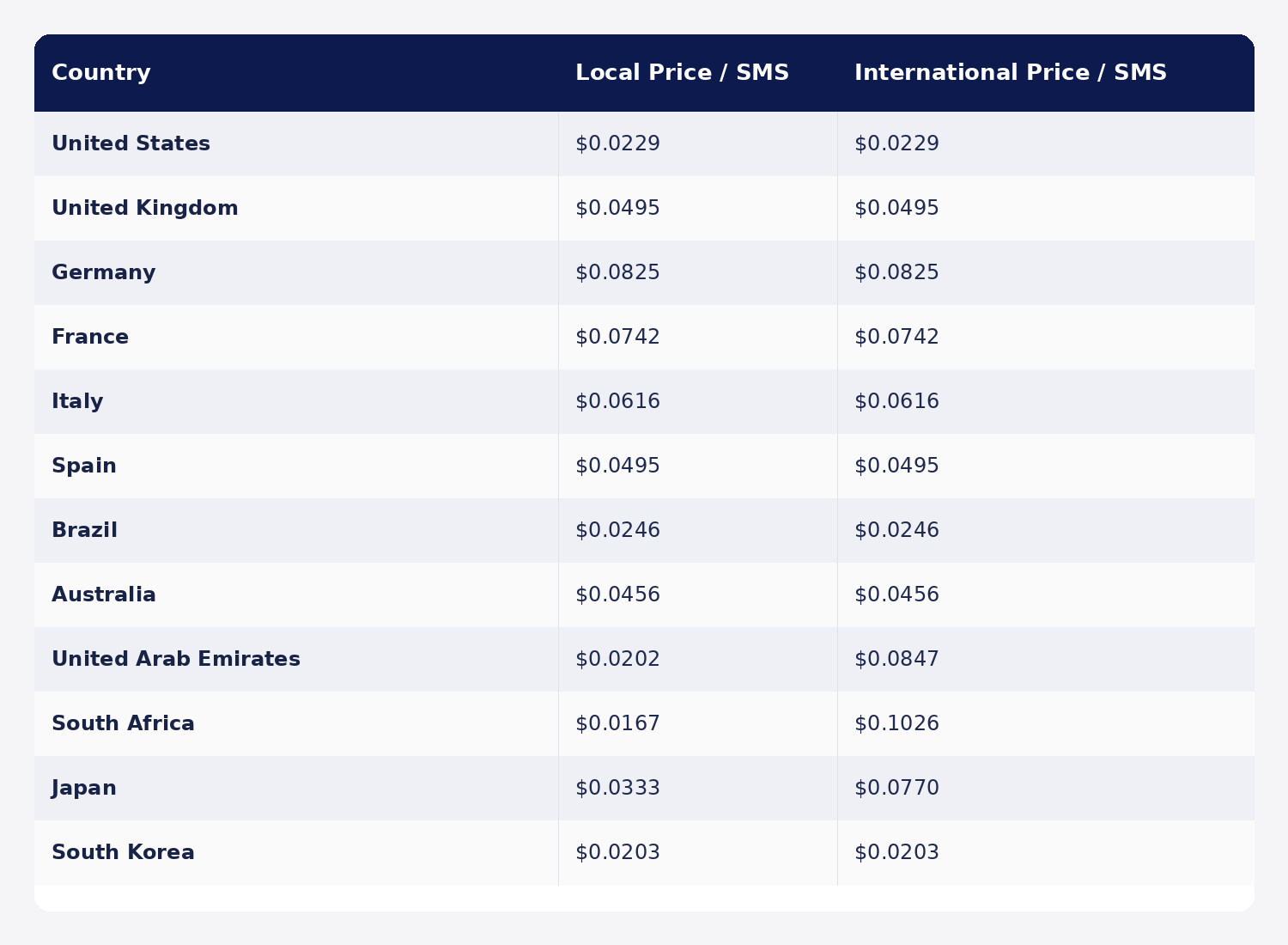
How Much Does SMS Marketing Cost With Dexatel?
What Affects SMS Marketing Pricing in 2026
Before you can control your costs, let’s understand what actually goes into SMS API pricing. The text message marketing cost depends on a range of factors, including where you’re sending, how messages are routed, and the level of delivery quality you choose.
Message Volume
One of the main factors determining the cost of SMS marketing is the volume of text messages. SMS platforms typically offer tiered pricing plans or pay-as-you-go models based on the number of messages. The cost per message is normally lower with higher volumes. If you expect to send many messages regularly, go for a pricing plan that suits your volume needs while maintaining cost-effectiveness.
Country
The country you’re sending your marketing campaigns to can play a major role in the pricing. Carrier fees and regulations vary from one country to another. This results in a different text message marketing cost of sending messages to each country. Many regions apply extra fees on top of standard messaging rates. For example, in the US, A2P 10DLC introduces registration requirements and per-message charges tied to compliance.
Since international SMS rates tend to be higher than domestic rates, make sure to account for the geographical reach of your campaigns. Certain business messaging services offer specific international pricing plans or charge extra fees for SMS texts that you send outside of certain regions.
Type of Phone Number
Another factor that affects the text message marketing cost is the type of phone number you’re using. Leasing a standard long code doesn’t cost as much as leasing a short code or a toll-free number.
While short codes are more memorable and ideal for high-volume SMS campaigns, their setup and monthly fees can be higher. Standard long codes, on the other hand, are typically cheaper and better suited for campaigns on a smaller scale. The type of number you choose ultimately depends on your campaign goals and budget.
Inbound vs. Outbound
SMS marketing typically involves carrying out two-way communications with subscribers. In certain cases, outbound and inbound messages may have different pricing. For inbound messages, you may sometimes expect additional fees, especially if you’re using keywords that trigger auto-replies. Account for the ratio of inbound to outbound texts in your messaging campaigns to figure out how they influence the pricing.
Carrier Fees
Mobile carriers charge fees for sending SMS or MMS messages to subscribers. These fees differ from carrier to carrier and depend on the volume of texts you send. Providers often include carrier fees as part of their pricing plans, either based on usage or as a flat rate. Getting familiar with carrier fees is key to measuring the overall cost of an SMS marketing campaign.
Setup Fees
In some cases, you may need to pay a one-time setup fee when onboarding with a platform provider and having your account configured. Providers may charge this fee to cover the configuration of the messaging platform according to your needs and preferences. This can vary depending on how complex the setup is, the level of customization you need, and the extent of integration with other systems.
Additional Features
Added features that platform providers offer can affect SMS API pricing. These often include multimedia messaging, short links, advanced reporting, and analytics. While certain communication platforms offer such features as add-ons to their basic packages, others include them in higher-tier plans. Make sure to evaluate how relevant these are to your campaigns if you end up paying for them.
Compliance and Regulatory Costs
Ensuring that you’re compliant with SMS marketing regulations, like the Telephone Consumer Protection Act (TCPA), may involve additional expenses. These can include the cost of implementing certain features, such as SMS opt-in and opt-out mechanisms, enhanced data security, and more. This may require technical development in addition to legal consultation fees.
Sender Registration Requirements
Many countries require businesses to complete sender registration before SMS traffic can be delivered. Depending on the market, this may involve registering sender IDs, message templates, or entire messaging campaigns. For example, India mandates DLT registration for many business communications, while the United States relies on A2P 10DLC registration for application-to-person messaging. These frameworks help reduce spam and increase transparency, but they can also influence setup timelines, operational requirements, and messaging costs.
SMS Routing and Delivery Performance
The routing infrastructure used to deliver SMS messages plays a major role in both cost and performance. Higher-quality direct carrier routes typically offer better deliverability, faster message transmission, and more accurate reporting. Lower-cost routes may reduce expenses, but they can also increase the likelihood of delays, message filtering, or inconsistent delivery. Businesses sending time-sensitive communications such as OTPs, alerts, or transactional notifications often prioritize delivery reliability over the lowest possible price.
Grey Routes and Reliability Concerns
Grey routes are unofficial delivery paths that some providers use to lower SMS marketing rates. While these routes can appear attractive from a pricing perspective, they often come with increased delivery failures, inconsistent performance, and potential compliance issues. Businesses that rely on SMS for authentication, financial transactions, or critical customer communications typically choose carrier-approved routes to ensure dependable delivery and protect their brand reputation.
A2P SMS Pricing
Another key factor in SMS marketing pricing is A2P (application-to-person) messaging, where businesses send messages directly to users through messaging platforms and carrier networks. While pricing is often presented as a simple per-message rate, the actual cost can vary depending on routing quality and delivery infrastructure. Local routes send messages through in-country operators, generally providing better delivery speed and reliability, while international routes may lower costs but can introduce delays or reduced delivery performance. Pricing is also influenced by the difference between Tier-1 routes and grey routes: Tier-1 routes use direct operator connections for higher delivery quality and stability, whereas grey routes are cheaper but less reliable for business-critical messaging.
How SMS Message Length Affects Pricing
SMS pricing is not determined solely by the number of messages you send. The length and character set of each message can also affect how many billable SMS segments are used. Understanding SMS segmentation can help businesses estimate costs more accurately and optimize campaign performance.
A standard SMS message uses the GSM-7 character set and supports up to 160 characters in a single segment. If the message exceeds 160 characters, it is split into multiple segments. Because segmentation requires additional technical information to reassemble the message on the recipient's device, each segment is reduced to 153 characters. For example, a 280-character GSM-7 message would be billed as two SMS segments.
Messages containing Unicode characters, such as emojis, Arabic, Chinese, Cyrillic, or other non-Latin scripts, have lower limits. A single Unicode SMS supports up to 70 characters, while multi-segment Unicode messages are limited to 67 characters per segment. As a result, messages with special characters or emojis may cost more than expected because they consume additional segments.
To keep SMS costs under control, aim for concise messages, avoid unnecessary special characters, shorten URLs using link shorteners, and review message length before launching campaigns. Even small reductions in character count can significantly lower costs when sending messages at scale.
Get more from every SMS send
Check Dexatel's SMS pricing by country and volume — competitive rates, no hidden fees, and a 30-day free trial to get started.
What Drives SMS Marketing Costs Up
Even with clear pricing, many businesses still end up spending more than expected. In most cases, it’s not the rates themselves, but how an SMS service is used that drives costs higher.
Sending Too Many Low-Value Messages
One of the most common reasons behind rising SMS marketing costs is over-messaging without a clear strategy. When the same message is sent to a large audience without proper segmentation, it often leads to low engagement and missed opportunities.
Poor targeting is a major factor here. Messages that aren’t relevant to the recipient are more likely to be ignored, which means you’re paying for sends that don’t convert. Over time, this not only increases costs but also reduces the overall effectiveness of your campaigns.
Inefficient Routing and Delivery Failures
Routing decisions can have a direct impact on both performance and cost. While cheaper routes may look appealing at first, they often come with trade-offs that affect delivery.
Low-quality or indirect routes can lead to delayed or failed messages. If your SMS arrives late or doesn’t arrive at all, the opportunity to engage the customer is lost. In many cases, you’re still paying for those messages, even if they never reach the recipient.
Over time, this drives up your overall SMS marketing cost without improving results. Reliable delivery may come at a slightly higher price per message, but it often leads to better engagement and a lower cost per conversion.
Lack of Segmentation and Personalization
When every contact receives the same message, it becomes much harder to get meaningful results. Sending one generic campaign to your entire database might feel efficient, but it often leads to low engagement and unnecessary spend.
Without segmentation and personalization, you miss the chance to send more relevant messages. Instead of focusing on users who are more likely to act, you end up paying to reach people who aren’t interested. This not only increases your SMS marketing cost but also lowers the overall return on your campaigns.
Poor Timing and Frequency Strategy
Even well-composed messages can underperform if they’re sent at the wrong time or too often. Timing plays a key role in how users respond, and getting it wrong can quickly lead to wasted spend.
Messages sent too early, too late, or during busy hours are more likely to be ignored. On the other hand, sending too frequently can feel overwhelming and push users to opt out. Over time, this reduces your active audience and increases the cost of reaching the people who remain.
Finding the right balance between timing and frequency helps you get more value from each message and keeps your SMS marketing expenses under control, especially when you figure out the best time to send the SMS.
How to Reduce SMS Marketing Costs Without Sacrificing Performance
Reducing your sms marketing cost doesn’t mean sending fewer messages across the board. It means sending smarter. With the right strategy, you can lower your spend and improve results at the same time.
Segment Your Audience Aggressively
Segmentation is one of the most effective ways to cut unnecessary costs and improve performance. Instead of sending messages to your entire audience, focus on smaller groups that are more likely to engage.
Behavioral targeting: Reach users based on their actions, such as recent purchases, clicks, or browsing activity. This makes each message more relevant and increases the chance of conversion.
Lifecycle-based messaging: Align your messages with where the user is in their journey, from onboarding to re-engagement. Timely, context-aware messages perform better with fewer sends.
Smaller lists, higher conversion: When you narrow your audience, you send fewer messages overall, but each one carries more value. This leads to stronger results and a lower cost per outcome.
Optimize Message Content for Conversion
The content of your message has a direct impact on how much value you get from each send. Even small improvements can help you get better results without increasing volume.
Clear CTAs: Make it obvious what the user should do next. A simple, direct call to action helps reduce hesitation and increases conversions.
Short, high-impact copy: SMS works best when it’s concise. Focus on the key message and remove anything unnecessary so the value is clear right away.
A/B testing to eliminate waste: Testing different versions of your messages helps you understand what works and what doesn’t. Over time, this reduces guesswork and ensures you’re not spending on messages that underperform.
Use Smart Scheduling and Automation
When your messages that are sent matter just as much as what they say, smart scheduling and automation help you reach users at the right moment without increasing volume.
Trigger-based messages vs batch sends: Triggered messages are sent based on user actions, like a signup or purchase, making them more timely and relevant, which is exactly how SMS drip campaigns are typically structured. Batch sends go out to large groups at once, which can be less effective if not carefully timed.
Time-zone and engagement optimization: Sending messages based on the user’s local time and past engagement patterns increases the chances they’ll be seen and acted on. This helps you get better results from the same number of messages.
Implement Omnichannel Fallbacks
SMS doesn’t always have to be your only channel. In many cases, combining it with other messaging options can help you reduce costs while maintaining strong delivery rates.
Use WhatsApp, Viber, or RCS where it makes sense: Some channels can be more cost-effective in certain regions or use cases, especially for rich or conversational messaging.
Use SMS only when necessary: SMS remains one of the most reliable channels, so it works well as a fallback when other messages don’t go through or when delivery is critical.
Reduce cost per successful delivery: By routing messages through the most efficient channel first and falling back to SMS when needed, you avoid paying premium rates for every interaction while still ensuring your message reaches the user.
Different SMS Marketing Pricing Models
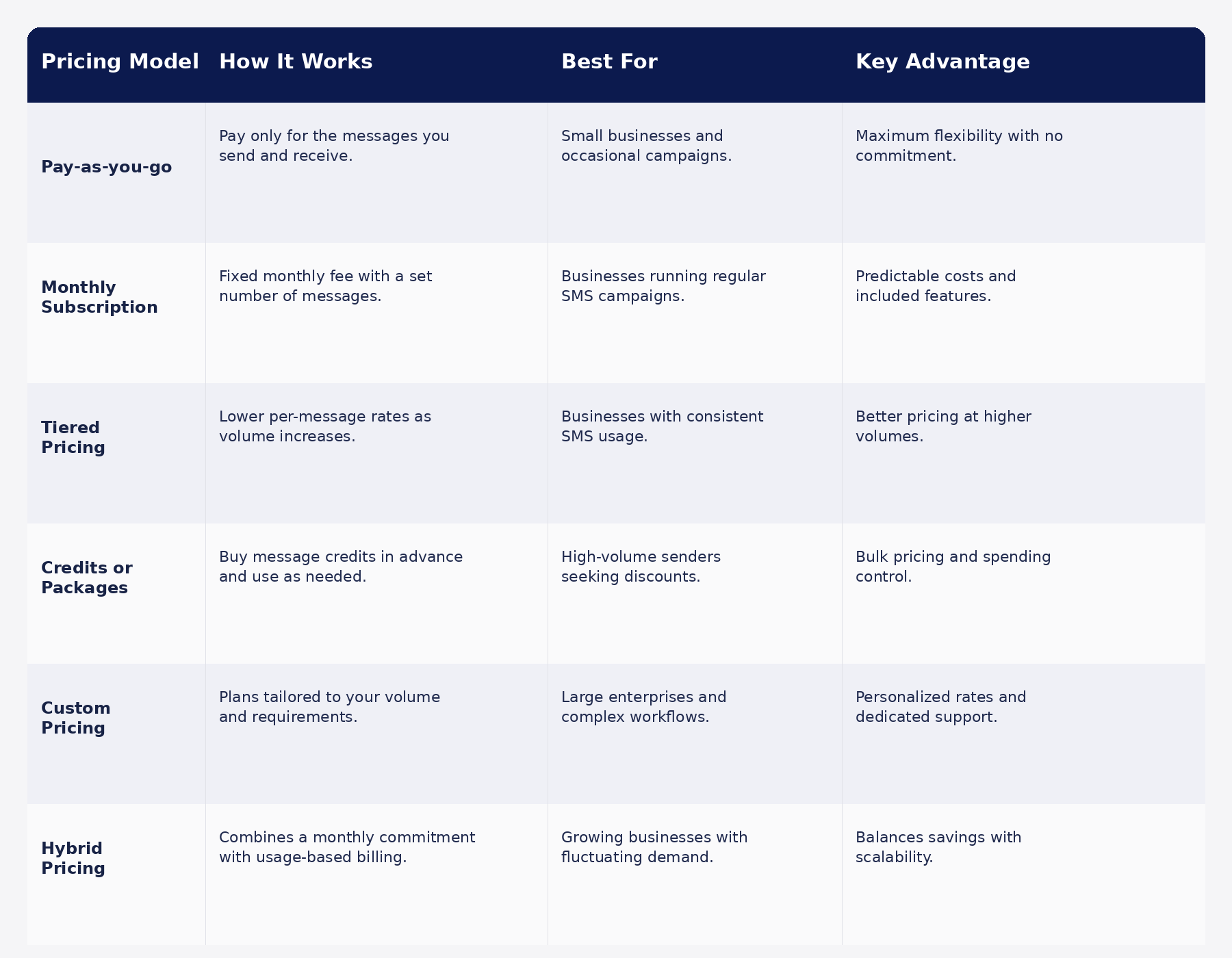
Pricing models tend to vary from one SMS platform to another, each serving different marketing requirements. Understanding these models is key to choosing the one that best aligns with your messaging needs.
Pay-as-You-Go
A pay-as-you-go model is basically when you pay for what you use. Each text you send or receive incurs a per-message fee, and your platform provider bills you accordingly. The flexibility of this payment plan makes it ideal for small businesses with varying message volumes. It doesn’t involve any contracts or monthly commitments, which is perfect for occasional or small-scale SMS campaigns.
SMS Marketing Pricing
We use a pay-as-you-go pricing model, meaning we charge per sent message. No monthly or sign-up fees. SMS marketing costs vary depending on your destination.
Monthly Subscription
This pricing model is when you pay a monthly fee for a fixed number of text messages. You are billed the same amount of money per month whether or not you use your allocated messages in full. Subscription plans can be beneficial if you’re launching campaigns on a consistent basis. This is because they offer cost predictability and often include extra perks or features.
Tiered Pricing
Certain platforms offer different pricing tiers based on the number of messages. You choose a plan that corresponds with your estimated monthly text volume. And, the cost per text decreases as you go up to higher tiers. Tiered pricing benefits businesses with steady SMS usage.
This is ideal when you want to cut costs for higher volume campaigns. It offers a balance between flexibility and cost-effectiveness for brands that have consistent marketing needs.
Credits or Packages
Text marketing services may also sell credits or packages that you can use to send a certain number of messages. Businesses buy these plans upfront and use them as necessary. Credits and packages are cost-effective when it comes to high-volume users who may be looking to benefit from bulk pricing discounts. They are normally valid for a specific period, and you would need to renew the plan every time it runs out.
Custom Pricing Model
Custom or enterprise pricing is a model that caters to larger companies that carry out SMS marketing on a larger scale. It involves tailoring the plan to the specific needs and messaging volume of the business. The plan may include personalized features, negotiated rates, and dedicated customer support. This is the go-to choice for businesses with complex campaigns or those looking to establish an extensive partnership with a provider.
Hybrid Pricing Models
Hybrid models combine a base monthly commitment with additional usage-based pricing. This gives you a balance between cost savings and flexibility, allowing you to benefit from lower rates while still having room to scale when needed. For many businesses, this approach offers the most practical way to manage costs without sacrificing control.
Pay-as-You-Go vs. Volume-Based SMS Pricing
With pay-as-you-go SMS pricing, businesses are charged only for the messages they send, making it a practical choice for organizations with variable messaging needs, seasonal promotions, or fluctuating verification traffic. Volume-based pricing, on the other hand, is geared toward businesses that send SMS messages regularly at scale, offering reduced per-message costs as monthly traffic grows.
The volume at which discounted rates become worthwhile varies based on factors such as destination markets, carrier agreements, route quality, and message type. When evaluating SMS costs at higher volumes, businesses should also account for carrier fees, sender registration requirements, message length, character encoding, and the quality of delivery infrastructure in their target regions.
SMS API Pricing With Dexatel
Dexatel’s SMS pricing is based on a pay-as-you-go model where businesses are charged per message sent, with rates varying by destination country, carrier routing, and message type. Pricing is influenced by factors such as local versus international delivery routes, Tier-1 versus grey routing quality, sender registration requirements, and regional telecom regulations. Businesses sending larger message volumes can access lower per-message pricing through volume-based agreements and optimized routing structures. The platform also supports country-specific pricing visibility, allowing businesses to estimate SMS costs more accurately across global messaging campaigns.
In addition to standard SMS delivery costs, businesses sending messages may incur registration fees. These charges cover short code leasing, brand and campaign registration requirements, and toll-free number provisioning, depending on the sender type and messaging setup you choose.
Random short codes: $1,000 a month
Vanity short codes: $2,000 a month
Long code brand registration: $4 (one-time)
Long code campaign registration: $10 a month
Toll-free number setup: $2 (one-time)
Toll-free number fee: $2 a month
How to Choose an SMS Marketing Platform
Not all SMS marketing platforms offer the same level of deliverability, functionality, or support. Before selecting a provider, evaluate the following criteria to ensure the platform aligns with your business goals and messaging requirements.
Deliverability and Carrier Connectivity
A platform's ability to deliver messages reliably is one of the most important factors to consider. Look for providers with strong carrier relationships, global coverage, intelligent routing, and transparent delivery reporting to help maximize message reach and engagement.
Two-Way Messaging Capabilities
If customer interaction is important to your business, choose a platform that supports two-way messaging. This allows customers to reply to campaigns, engage with your brand, ask questions, and participate in conversational marketing workflows.
Analytics and Reporting
Detailed analytics help you understand campaign performance and make data-driven decisions. Look for features such as delivery reports, click tracking, opt-out monitoring, conversion tracking, and audience engagement metrics.
Compliance and Regulatory Support
SMS regulations vary by country and industry, making compliance a critical consideration. A reliable provider should support opt-in and opt-out management, sender registration requirements, suppression lists, and other compliance-related processes.
Pricing Transparency
The lowest advertised SMS rate does not always represent the true cost of messaging. Review pricing structures carefully, including message segment billing, carrier surcharges, sender registration fees, platform costs, and any additional charges that may apply as your volume grows.
Integration and Automation Options
Choose a platform that integrates easily with your existing systems and workflows. APIs, CRM integrations, automation tools, audience segmentation, and scheduling capabilities can significantly reduce manual work while improving campaign efficiency and scalability.
Why Businesses Choose Dexatel
Transparent Pricing
With Dexatel, you pay for the messages you send without being locked into long-term contracts or expensive subscription plans. Our pricing structure is straightforward and predictable, helping businesses manage communication costs without worrying about hidden fees or unexpected charges.
Global Coverage
Reach customers around the world through a network of reliable carrier connections and messaging routes. Whether you're sending promotional campaigns, transactional alerts, or OTPs, Dexatel helps ensure messages are delivered quickly and consistently across international markets.
Volume Discounts
As your messaging volume increases, your cost per message can decrease through volume-based pricing incentives. This makes Dexatel a cost-effective choice for businesses running large-scale campaigns, high-volume notifications, or growing communication programs.
API and Platform Access
Manage campaigns through an intuitive web platform or integrate SMS capabilities directly into your applications using our SMS API. This flexibility allows businesses to automate messaging workflows, connect existing systems, and scale communications without changing their operational processes.
Real-Time Analytics
Track message delivery, campaign performance, and engagement metrics through detailed reporting tools. Real-time visibility into your SMS activity helps you identify trends, optimize campaigns, and make data-driven decisions that improve results over time.

Hidden Savings Opportunities Most Businesses Miss
Even when your pricing model is clear, there are still small changes that can make a noticeable difference in your total spend. These are often overlooked, but they help reduce waste and improve results without increasing volume.
Localized Sender IDs
Using localized sender IDs can improve trust and increase the chances that your messages are delivered and opened. When messages look familiar to the recipient, they’re less likely to be filtered or ignored. This leads to fewer retries and a lower cost per successful message over time.
Delivery Optimization and Routing Intelligence
Smart routing helps make sure that messages take the most efficient path to the recipient. By choosing reliable routes and adjusting based on performance, you can reduce delivery failures and delays. This means you get better results without needing to send more messages, keeping your overall costs under control.
Cleaning Your Contact List
Keeping your contact list up to date is one of the simplest ways to reduce unnecessary spend. Removing inactive or unreachable numbers means you’re no longer paying for messages that will never be delivered or acted on. A smaller, more engaged list helps improve performance and lowers your text message marketing cost at the same time.
Calculating Your SMS Marketing ROI
To understand if your campaigns are actually paying off, you need to look beyond how many messages you send and focus on what they bring back. A simple way to calculate ROI is by comparing the revenue generated from your SMS campaigns to the total cost of running them. This includes message costs, carrier fees, platform charges, and any additional expenses tied to your campaigns. Here's the formula for calculating your ROI:
SMS Marketing ROI = ((Campaign Revenue − Campaign Cost) ÷ Campaign Cost) × 100
For example, suppose an eCommerce business sends 5,000 SMS messages at $0.025 per message to promote a limited-time discount. The campaign costs $125 in total:
5,000 × $0.025 = $125
If the campaign generates $600 in revenue, the ROI would be:
(($600 − $125) ÷ $125) × 100 = 380% ROI
This means the business earned $3.80 for every $1 spent on the SMS campaign. When calculating ROI, businesses should also account for extra costs such as platform fees, link tracking tools, creative work, discounts, and any additional carrier or sender registration charges.
To get a clearer picture, it helps to track SMS KPIs alongside your ROI. Metrics like conversion rate, click-through rate, and revenue per message show how effectively your campaigns are performing. When you combine these insights with your ROI calculation, it becomes much easier to adjust your strategy and improve results over time.
ROI and Cost Effectiveness of SMS Marketing
If done right, SMS marketing can yield a sizable return on investment for businesses. You can start by thanking the high open rates of SMS, which ensure that your message reaches your target audience.
Moreover, marketing plans like personalization result in higher engagement and conversion rates. The low costs of texting make it a great bargain considering the potential of the SMS marketing ROI. This is especially true if you use it in conjunction with other tools like email marketing and social media.
There are several ways to maximize the marketing ROI and cost-effectiveness of SMS. Sending messages to interested prospects who actually opted in ensures that you’re not talking to a wall. Using third-party contact lists, on the other hand, can result in low engagement and possible legal issues.
It’s also a good idea to take advantage of real-time tracking and analytics tools to make data-driven decisions. Segmenting your audience based on preferences and purchase history allows you to deliver more tailored and relevant texts.
Benefit From Transparent SMS Marketing Pricing
Dexatel provides flexible pricing, global coverage, and volume discounts without long-term commitments. Set up your account today and start sending promotional campaigns, customer updates, and verification messages cost-effectively.
Get more from every SMS send
Check Dexatel's SMS pricing by country and volume — competitive rates, no hidden fees, and a 30-day free trial to get started.
Frequently Asked Questions
How much does it cost to send 10,000 SMS messages?
The cost of sending 10,000 SMS messages depends on several factors, including the destination countries, message type, route quality, and sender registration requirements. Contact our team for a customized quote based on your target markets and expected messaging volume.
Can I start without a monthly contract?
Yes. Dexatel offers flexible pricing options that allow businesses to get started without long-term contracts or recurring monthly commitments. This makes it easy to launch campaigns, test new markets, or scale usage according to your needs.
Are volume discounts available?
Yes. Businesses sending higher volumes of SMS traffic can benefit from lower per-message rates through volume-based pricing. As your messaging needs grow, our team can help you identify the most cost-effective pricing structure for your traffic levels.
Can I send SMS internationally?
Absolutely. Dexatel supports SMS delivery to countries around the world through a network of reliable carrier connections. International pricing varies by destination, but our platform is designed to help businesses reach global audiences with consistent delivery performance.
Is there a free trial?
Yes. You can create a free account and explore the platform before committing to a larger messaging program. This allows you to test features, evaluate delivery performance, and determine whether the platform meets your business requirements.


