


WhatsApp OTP vs SMS OTP: Which Channel is Better


Published: Feb 3, 2026

WhatsApp OTP or SMS OTP?
The answer depends on who your customers are.
Both can be used for sending one-time codes.
Both can work, and both have a good record of doing so.
However, they are meant for different situations, and which one you should use depends on a number of questions that most businesses never bother asking themselves.
- Where are your customers located?
- Do your customers have reliable internet connectivity?
- What are your customers’ ages?
- How sensitive is your customers’ data?
- How many OTPs are you sending each month?
This is not about which one is better, which is a futile exercise since both can work and have a good record of doing so.
This is about which one you should use based on your actual business needs.
This discussion compares and contrasts using WhatsApp and SMS for sending one-time codes, including security, cost, reach, usability, and infrastructure requirements.
SMS OTP: The Traditional Workhorse
OTP delivery using SMS has been the norm for many years.
It is simple, universally available, and reliable for businesses worldwide.
Advantages of SMS OTP
- Universal Reach: Works on any phone with a SIM card
- No Internet Required: Works even in areas with low or no data connection
- Global Coverage: Supported by telecommunication providers in over 190 countries
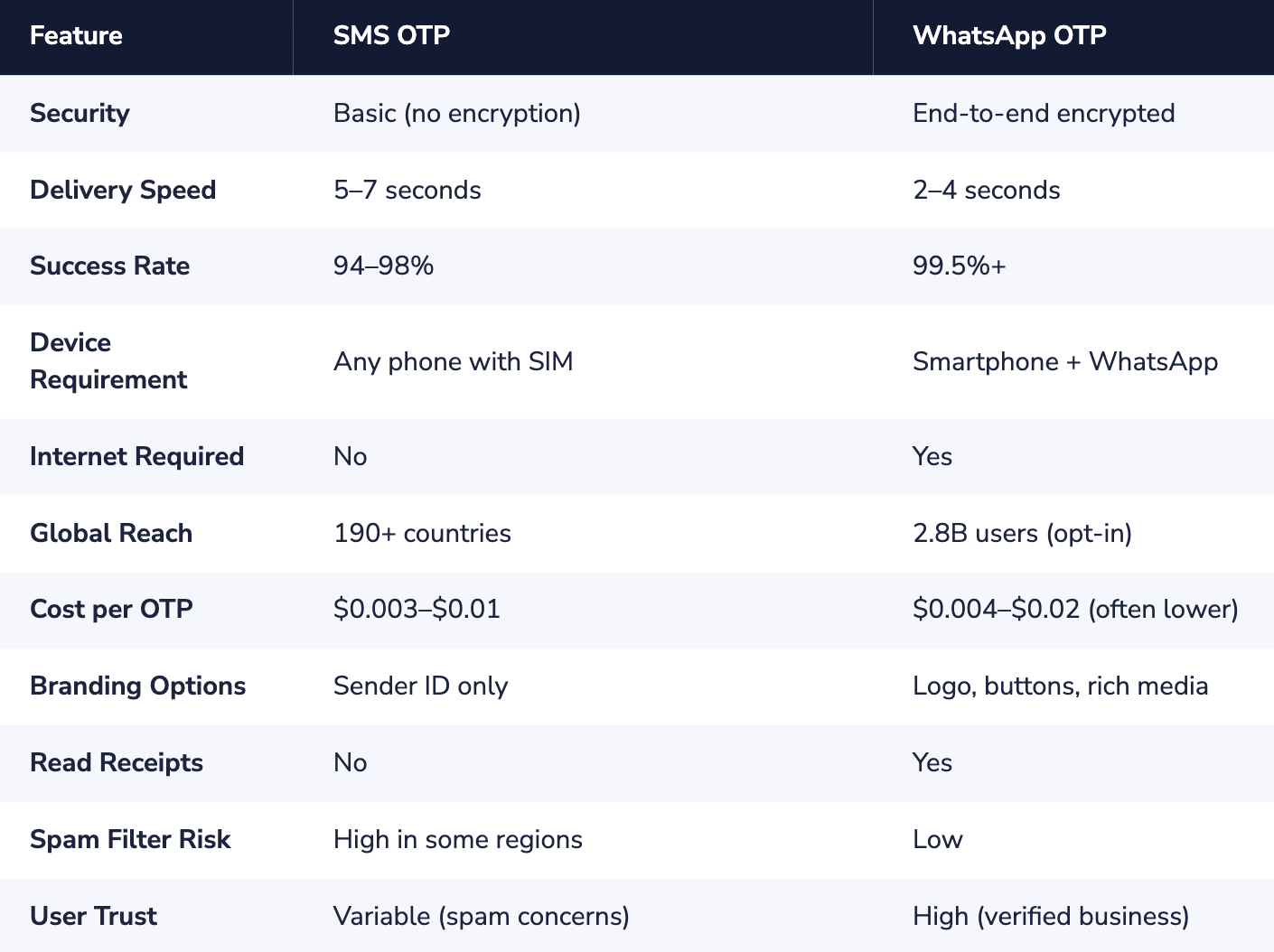
- Fast Delivery: Delivered within 5-7 seconds, with an approximate 94-98% success rate
Challenges associated with SMS OTP
- Security Risks: Exposes the business to risks such as SIM swapping, interceptions, and phishing
- Lack of Encryption: SMS is not end-to-end encrypted
- Spam Filter Risk: There is a risk of being filtered by the telecommunication providers
- Higher Costs: International SMS is costly
WhatsApp OTP: The Modern Alternative
With 2.8 billion active users, WhatsApp is also a viable solution for delivering one-time codes (OTPs).
Meta offers authentication templates for businesses to send one-time codes in a secure, affordable, and easy way.
Advantages of WhatsApp OTP
- End-to-End Encryption: Messages are completely secured against interception
- Fast Delivery: Generally takes 2-4 seconds with more than 99.5% success rate
- Rich User Experience: Can add branding with logos, buttons, etc.
- Read Receipts: Can track when the OTP is delivered and read
- Lower Spam Probability: Less likely for messages to be filtered or blocked
- Cost-Effective: Can be 50-90% cheaper compared to traditional SMS, especially for international messages
Challenges with WhatsApp OTP
- Requires App: User must have the WhatsApp application installed
- Internet Required: Requires the user to have an active internet or Wi-Fi connectivity
- Not Universal: Some groups of users, such as rural or older adults, might not use the application
- Template Approvals: Authentication templates must be approved by Meta before use
Head-to-Head Comparison: WhatsApp OTP vs SMS OTP
The table below shows a comparison of the two channels on a feature-by-feature basis to help you decide:
Security Comparison: Which Channel is Safer?
Security is normally the biggest concern when selecting an OTP channel.
Here is a table showing a comparison of the two channels:
SMS OTP Security Risks
- Sim Swapping: The attacker may persuade the telecom operator to change the victim’s phone number to a different SIM.
- SS7 Vulnerabilities: The telecom signaling system can be used for attacks.
- Interception: The message may be intercepted during transmission.
- Phishing: The attacker may send a fake message to obtain the code.
WhatsApp OTP Security Advantages
- End-to-end Encryption: Only the sender and receiver can view the message.
- Verified Business Account: The checkmark ensures trust and prevents impersonation.
- No Telecom Vulnerabilities: It does not use the SS7 system and is not subject to telecom operator security risks.
- Device-Level Security: It is device-bound and therefore more secure.
Winner: WhatsApp OTP is more secure than SMS OTP since it is encrypted and has a verified business account feature.
Cost Comparison: ROI Analysis
This is particularly true for companies that need to send thousands of OTPs every month, and cost is a big factor for them.
In fact, WhatsApp authentication messages were up to 97.4% cheaper for companies due to the price changes that came into effect in July 2025.
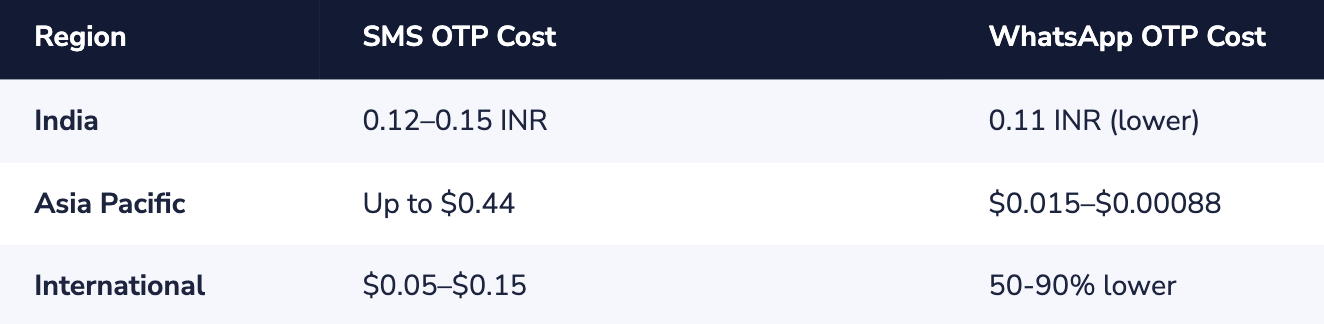
Key Insight: Companies can save up to 90% of their costs by moving from SMS to WhatsApp for OTPs, particularly for the Asia Pacific region.
Use Case Scenarios: When to Use Each Channel
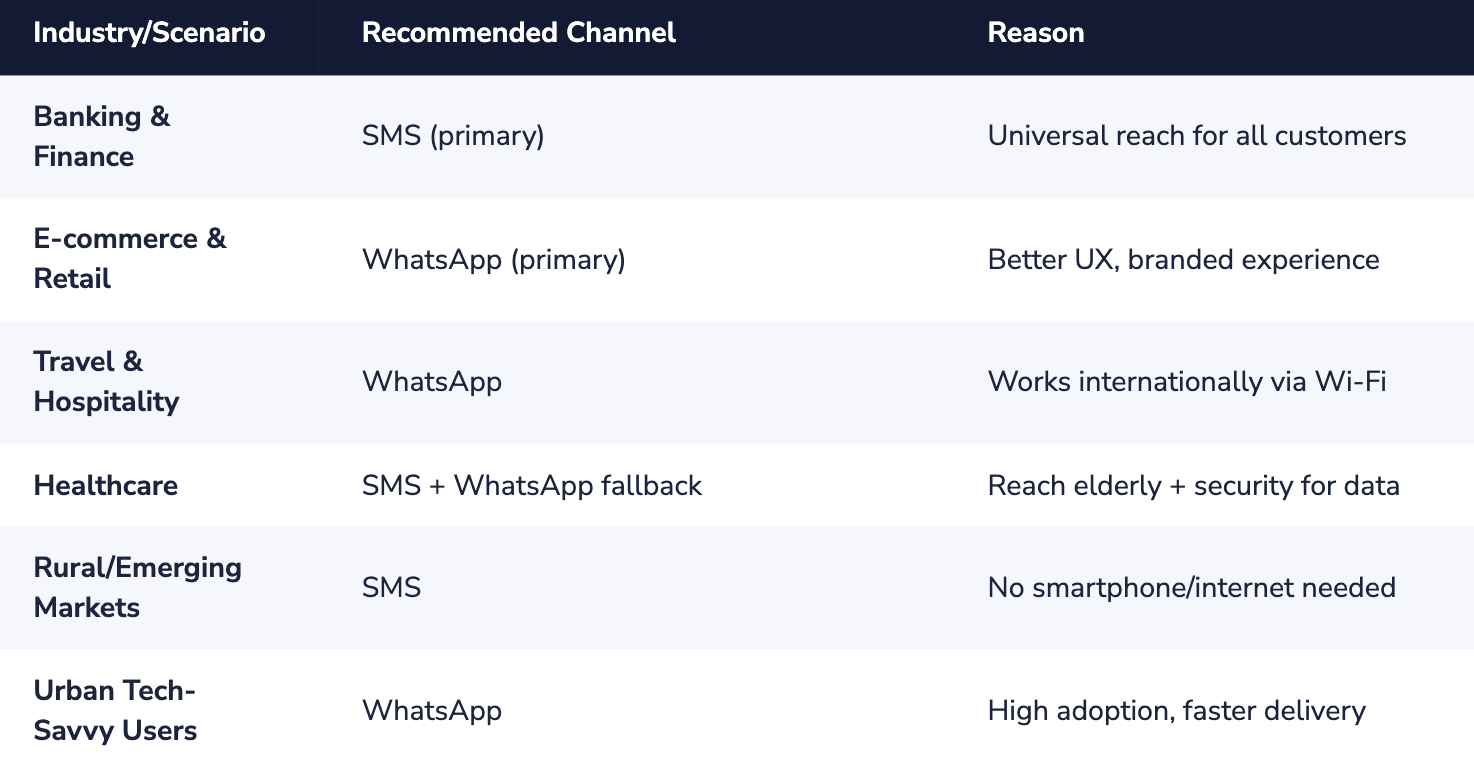
Decision Framework: How to Choose the Right Channel
Choose SMS OTP If:
- You wish to target users who don’t have internet access
- Your users include elderly people who aren’t familiar with WhatsApp
- You must comply with regulatory requirements that mandate SMS
- You operate in areas where WhatsApp isn’t popular
Choose WhatsApp OTP If:
- Your users mostly have smartphones and prefer WhatsApp
- You require high security for your application
- You wish to reduce OTP costs, especially for international users
- You believe brand experience and rich messaging are important for your business
- You require delivery confirmation and read receipts
Use a Hybrid Approach (Recommended) If:
- You cannot afford any OTP failures
- Your users have varying preferences and demographics
- You wish to reduce costs while reaching all users
- You wish to transition from SMS to WhatsApp OTP.
The Best of Both Worlds: Implementing a Fallback Strategy
The simplest method for businesses is a dual channel plan with automatic fallback.
Let me walk you through this process:
- First, use WhatsApp as your primary method.
- Then, in case of failure of delivery via WhatsApp (no app installed, no internet access, etc.), automatically fall back to using SMS.
- Send the same OTP code without requiring any further actions from the end-user.
- And that's it! You get a 99.9%+ delivery success rate.
Example: A ride-hailing service in Brazil, 99 (DiDi Chuxing), used WhatsApp OTP with fallback to SMS.
Outcome: 6% increase in OTP delivery rate and 34% decrease in support tickets for "OTP not received."
Implementation Best Practices
For SMS OTP:
- Register with DLT (India) or 10DLC (US) to avoid carrier filtering.
- Use an identifiable sender ID to establish trust.
- Ensure the message is concise. Only display the code and its expiry time.
- Choose an optimal value for the time-to-live (TTL) based on your security requirements.
For WhatsApp OTP:
- Leverage Meta’s pre-approved templates for quicker approval.
- Obtain user consent before sending WhatsApp messages.
- Choose the best button type: Copy Code, One-Tap, or Zero-Tap Autofill.
- Include the security disclaimer and expiry time in the templates.
- Obtain the business verification badge with the checkmark for maximum trust.
The choice between WhatsApp OTP and SMS OTP is not an either/or situation.
It is a strategic choice.
The bottom line:
- Use SMS for reach when you need to send messages that can be delivered offline
- Use WhatsApp for security, speed, cost, and user experience
- Use both with a fallback for the best of both worlds with very high delivery success
There are many successful businesses that use both WhatsApp and SMS for OTP delivery, with WhatsApp as the first choice for security and cost, and SMS as the fallback for the best of both worlds with very high delivery success rates.
Whatever choice you make, remember: in the matter of delivering OTPs, every second counts—and every failure will lose you a customer!


.jpg&w=828&q=75)
