


WhatsApp Enterprise API: The Complete Guide to Solutions, Setup (2026)


Published: Mar 11, 2026
Quick Answers
Is there an enterprise WhatsApp? Yes. WhatsApp Business Platform (API) is the enterprise infrastructure developed and provided by Meta. It is not branded as such, but rather as a separate technical layer, accessible either via the Meta Cloud API or an approved Business Solution Provider, designed for use by organisations which need automation, multi-team access, system integration, and governance at scale.
Does WhatsApp have an enterprise variant? The WhatsApp Business Platform is the enterprise variant, with features such as unlimited agents, workflows, and CRM connections, which the free Business App does not offer.
What makes the enterprise deployment different from the simple API access? The enterprise variant has organisational constructs on top of the API, such as governance, integration architecture, multi-market rollouts, security review and compliance, SLA management, and a centre of excellence model. These are operational, not technical, differences.
What Makes a WhatsApp Deployment Genuinely "Enterprise-Grade"
There is no product called "WhatsApp Enterprise API" as such.
What is common is that the underlying infrastructure, or WhatsApp Business Platform, is the same regardless of whether you are a 10-person startup or a 10,000-person corporation.
What is different is not the API itself but everything that is built around it.
A WhatsApp Enterprise deployment is characterized by a number of organizational and architectural requirements that are beyond 'having API access':
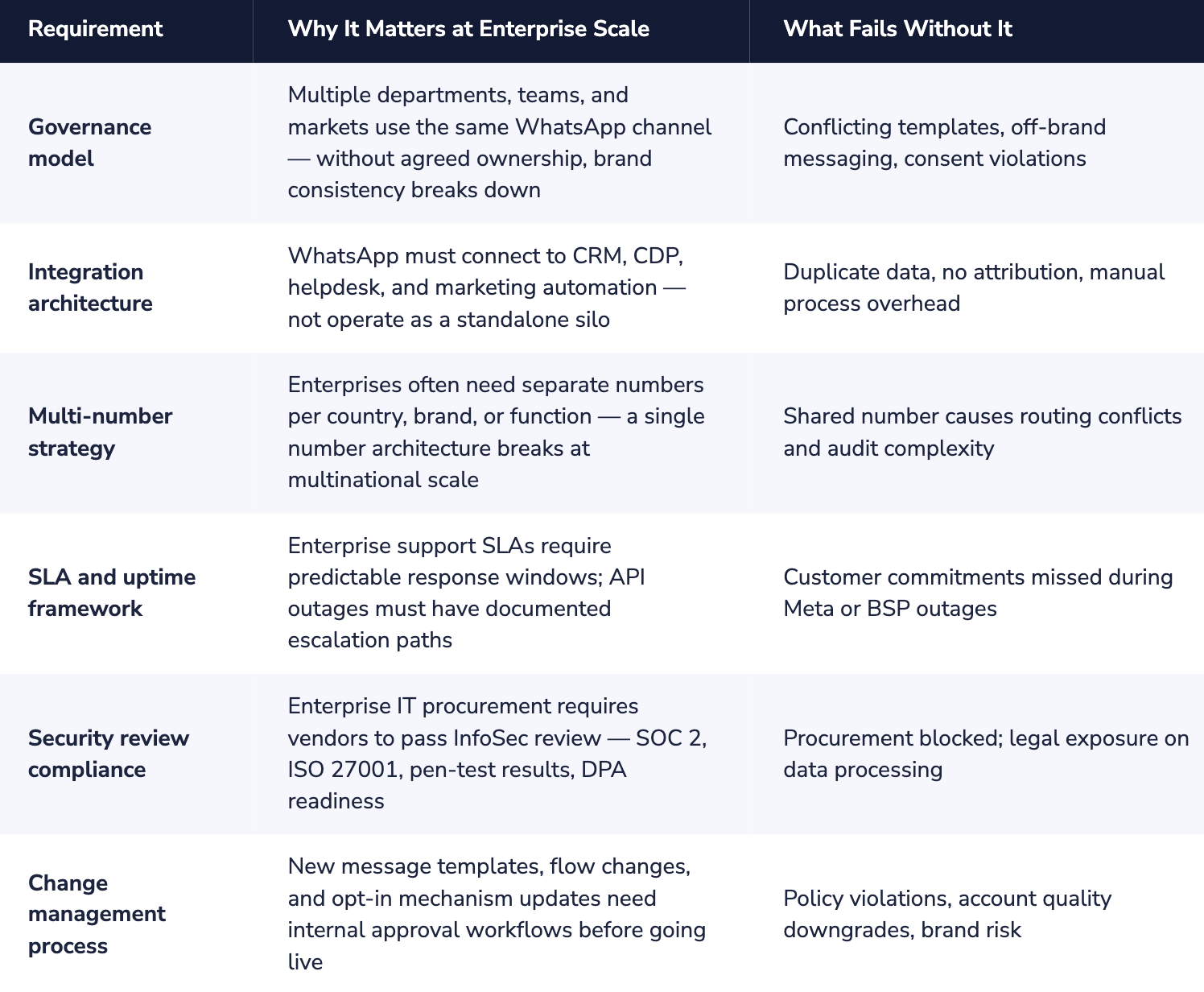
The WhatsApp Business Platform provides you with this ability.
Enterprise deployment is the 'operational layer' that you build on top of this.
Organizations that treat this as 'just an API' consistently underestimate the amount of work involved and end up paying for it downstream in areas such as compliance and data management.
The Enterprise Business Case: What Actually Gets Budget Approved
The generic "WhatsApp has 3 billion users and 98% open rates" argument does not get deals done in enterprise budgets.
Someone inside an organization, whether a CMO, CTO, or Head of CX, needs a business case that is articulated around cost savings to the organization, revenue impact, and risk mitigation.
Here is the framing that gets deals done in enterprise procurement:
The Cost-to-Serve Reduction Argument
The cost of serving in an enterprise contact center is high, both in terms of headcount and telephony infrastructure, and in terms of the cost of synchronous communication (calls require real-time presence on both ends of a call).
WhatsApp reduces a part of that cost to serve to asynchronous communication.
- A single WhatsApp AI chatbot for tier-1 support is equivalent to 3-5 human agents at a much lower cost per interaction
- Unlike telephone-based support, there is no need for a customer to repeat their context in a WhatsApp conversation after a delay in between messages
- For organizations with inbound support volumes above 50,000 contacts per month, modeling a cost-per-resolution savings of 25-45% is a common outcome for organizations using WhatsApp automation correctly
The Revenue Attribution Argument
For organizations with direct-to-consumer revenue models, WhatsApp is increasingly attributable in a way that can justify investment to their finance teams:
- Conversational commerce experiences, in which a customer moves from product exploration to question-answering to purchase within a single WhatsApp conversation, have higher average order values than web-based experiences because of lower friction in the checkout process
- Retention marketing campaigns using WhatsApp consistently outperform the same campaigns using email because of higher levels of customer engagement
- Attribution modeling is also cleaner on WhatsApp compared to social channels, as a click on a WhatsApp click-to-action is linked to an opt-in phone number, making attribution of generated revenue to a marketing campaign much more accurate
The Channel Diversification Risk Argument
Marketing departments of enterprises that are currently reliant on a single marketing channel, usually email marketing or paid social, are exposing their business to a significant level of strategic risk.
A change in algorithm or a problem in deliverability can severely impact an enterprise’s revenue generation in a short space of time.
WhatsApp is a channel that is significantly different from any other marketing channel in that it is an opt-in channel, not an opt-out channel.
It is also delivered in a private messaging interface that is significantly less crowded compared to email or SMS.
For a direct comparison of using WhatsApp and SMS, please read our blog on WhatsApp marketing vs SMS marketing.
Internal Budget Note
The most robust business case for WhatsApp marketing in enterprises is when all three arguments are combined.
When WhatsApp is positioned as a cost centre or a revenue centre, it is positioned from a different budget and a different business leader.
When all three arguments are combined, it is positioned from all budgets and all business leaders.
Enterprise Technical Considerations Beyond the Basics
For enterprise IT and engineering teams, the architectural decisions of most consequence are not discussed in the conventional “how to set up the WhatsApp API” blogs.
This is what changes for enterprises at scale:
Multi-Number Architecture
For enterprises, there are typically not one but many WhatsApp numbers to be integrated. There are several common architectural patterns, such as:
- Country-specific numbers: A DE-specific phone number for the DE market, and a UK-specific phone number for the GB market
- Function-specific numbers: A phone number for support (inbound, reactive), a phone number for marketing (outbound, broadcast), and a phone number for transactional communications
- Brand-specific numbers: Companies with many brands under their umbrella often need to maintain separate phone numbers for each brand to preserve brand identity
Each phone number integrated to the WhatsApp Business Platform is essentially independent, with its own quality score, message tier limits, and template library.
A multi-number architecture requires an equally robust organizational architecture to handle templates, quality, and throughput across all phone numbers
Message Throughput and Tier Management
The WhatsApp Business Platform operates under a tiered message limit system, which essentially measures how many unique users can be messaged within a 24-hour window.
This is something enterprises need to understand before they can effectively plan their campaign throughput:
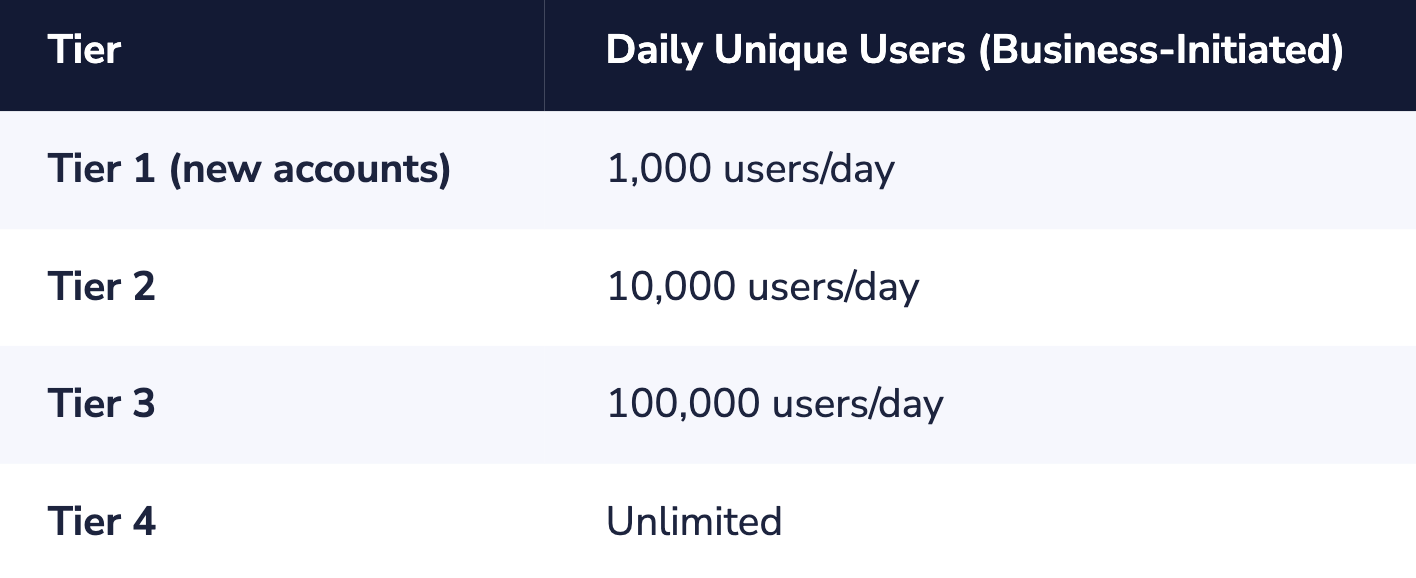
Tier upgrades are done automatically over time based on account quality and messaging volume, but new enterprise accounts start at Tier 1.
If an enterprise needs to send broadcast messages to hundreds of thousands of contacts on day one, they will need to plan a tier warm-up period (usually 4-8 weeks) or use additional numbers.
Webhook Architecture and Reliability
The WhatsApp Business Platform sends inbound messages and delivery receipts to the enterprise through webhooks, which are HTTP POST calls to an endpoint defined by the enterprise.
Enterprise-scale businesses require webhook reliability as well, especially when sending thousands of delivery receipt callbacks within seconds of sending the message as part of a large broadcast campaign:
- The webhook endpoint needs to be publicly accessible, HTTPS-enabled, and capable of handling bursts of traffic. A broadcast message to hundreds of thousands of users will require thousands of delivery receipt callbacks within seconds of sending the message.
- The enterprise needs to implement message deduplication logic. It’s possible for WhatsApp to send the same webhook event more than once. If the enterprise processes the same message twice, it will cause duplicate actions to be taken on the CRM.
- The enterprise needs to implement webhook retry logic. If the webhook endpoint returns any response other than 2xx, the WhatsApp Business Platform will retry the message. The enterprise needs to ensure that the endpoint is idempotent, meaning that the same message will be processed the same way every time. If the endpoint processes the same message twice, it will take the same action on the CRM as it did the first time.
- The enterprise needs to implement a message queue (such as AWS SQS or Google Pub/Sub) as an intermediate step to handle bursts of traffic to the webhook endpoint.
CRM and CDP Integration Patterns
The value of WhatsApp for Enterprises is proportional to the depth of integration with existing customer data systems.
Three integration patterns have been observed in WhatsApp for Enterprises implementations:
- Event-driven sync: WhatsApp conversation events (e.g., “message received,” “message sent,” “conversation resolved”) drive records in the CRM. This is the minimum integration required for most Enterprises.
- Data-in enrichment: CRM pushes customer data into WhatsApp at conversation initiation. This allows for personalized messages based on customer data without requiring the agent to look up information in separate systems.
- Bi-directional orchestration: WhatsApp is fully embedded in the customer lifecycle, driven by CRM events (e.g., order shipped → send delivery update) and providing data back to the CRM (e.g., survey response → update preference profile). This is the most mature integration and is often done via custom coding or a BSP with very high CRM certification.
Integration Priority
Enterprises always underestimate integration complexity and overestimate time-to-value.
Most common integration deployment failure pattern: WhatsApp channel is deployed but operates as a “silo.” Agents have no customer context, no data in the CRM, and no ability to measure attribution. Integration architecture should precede your first campaign.
True Total Cost of Ownership — What the Pricing Page Doesn't Show
The fees for Meta’s conversations are listed on the WhatsApp Pricing page and are easy to understand once you grasp the concept of the per-24-hour session and the categories (Marketing, Utility, Authentication, Service).
Where the three levels of cost above the base fee that enterprise finance teams tend to underestimate are:
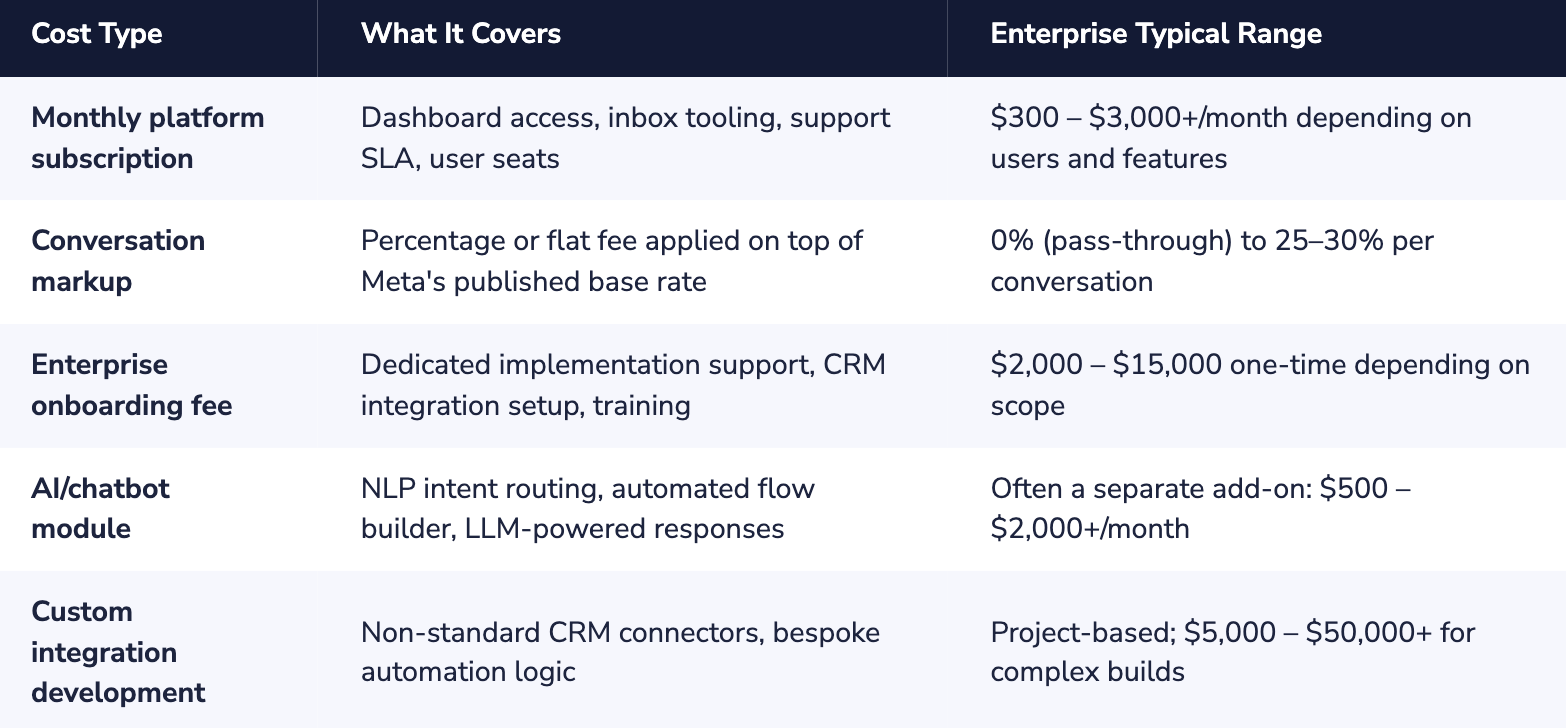
Layer 1: BSP Platform and Margin
If you use the API through a Business Solution Provider, you will also pay a fee on top of the platform fee that Meta charges.
This varies significantly and is not well understood at the start of the vendor conversation:
Layer 2: Internal Engineering and Operations
Enterprise usage incurs ongoing internal costs that are never included in a vendor cost model:
- Integration build: 15-50 engineering days to build the initial integration to a well-architected CRM integration with event-driven sync, deduplication logic, and webhook reliability infrastructure
- Template lifecycle management: New campaigns require new templates to be written, submitted to, and approved by Meta every 2-5 working days per template
- Conversation flow management: Chatbots require ongoing management as the conversation flows change over time due to product offerings, policy changes, and increasing consumer questions. Plan 4-8 hours of engineering or operations staff per week to maintain these flows
- Quality score monitoring: WhatsApp account quality score impacts messaging tier limits. This requires ongoing monitoring and template optimisation to ensure tier limits are not impacted, especially during periods of high-volume campaigns
Layer 3: Organisational Change Costs
- Agent training and process design: Customer-facing teams require new process design to accommodate WhatsApp's unique context, including threading, rich media, and the asynchronous communication paradigm, which is different from phone and email
- Legal and compliance analysis: Review of GDPR opt-in mechanism design, DPA negotiation with BSP, template policy legal review, and other tasks that may require 2-4 weeks of internal lawyer time to get the initial deployment ready
- Stakeholder management: Multi-market, multi-department deployments require significant project management effort. While not a technical task, this can be expensive in terms of internal stakeholder time and effort
Worked TCO Example
A pan-European enterprise (3 countries, support and marketing use cases):
- Year 1, Meta conversation fees at 60,000 conversations/month and increasing at a linear rate. Estimated at 8,000 Euros/month.
- BSP subscription and associated markup at 1,500 Euros/month.
- Engineering and ops resource at 2,000 Euros/month equivalent.
- Legal and compliance at 500 Euros/month equivalent.
Total monthly cost at 12,000 Euros.
Estimated attributable revenue at 1.88 Euros RPR and 30,000 marketing conversations.
Estimated at 56,400 Euros/month.
The Access Path Decision: Direct Cloud API vs Business Solution Provider
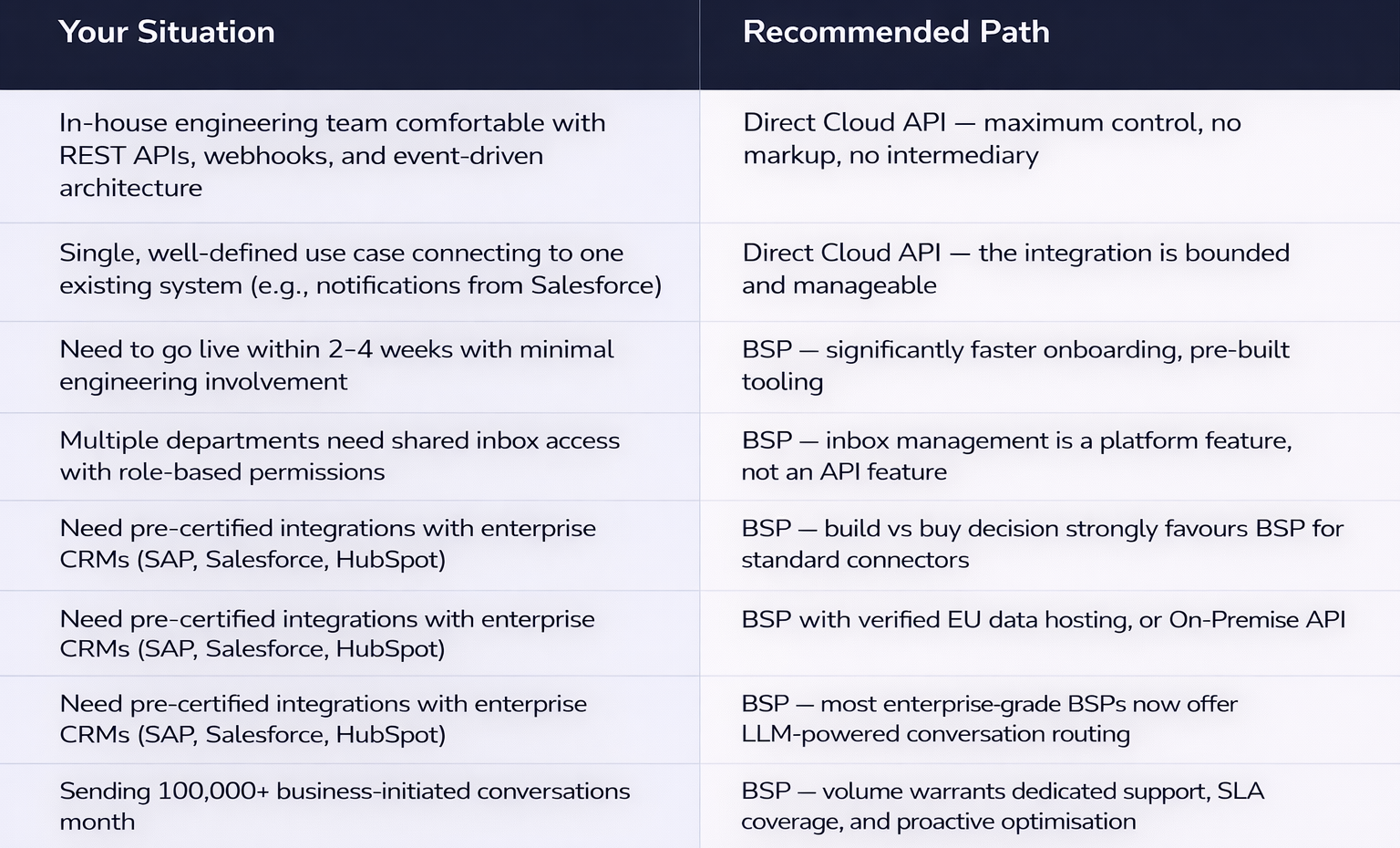
This is the most important infrastructure choice in any enterprise implementation of WhatsApp, and it is one of the most poorly documented in vendor literature for equally obvious reasons.
Here is a framework organised in terms of organisational scenario rather than feature set:
The Questions That Determine the Right Choice
However, before you make a decision either way, lock in these three questions first:
- How long can we wait before sending our first message? If we’re talking about days, then we’re talking about Cloud API directly. Weeks? Then we’re talking about Cloud API directly or through BSP. Months? Then we need to overcome an organizational hurdle.
- What does our current tech stack look like, and does the BSP we’re considering offer a certified and supported integration with our tech stack? Native Salesforce connector with bidirectional sync? That’s one thing. Zapier webhook? That’s another.
- What will our cost of switching to a different solution in 24 months look like if we choose a BSP today and need to switch tomorrow? All our custom flow, all our templates, all our conversation history lives in the BSP’s proprietary system.
The Vendor Lock-in Warning
Don’t think BSPs are portable.
Each BSP has its own flow builder, each BSP has its own template library, and each BSP has its own conversation history storage.
You build complex automation with a BSP’s flow builder, and you switch to another provider down the line because you were unhappy with the cost model, capabilities, or contract negotiation?
You’re rebuilding from scratch.
Before you sign up with a BSP, make sure you know what you can export, in what format, and whether the API to extract that data is even supported.
For a technical deep dive into the Cloud API itself and how we host our infrastructure, see: Meta WhatsApp Cloud API: A Complete Guide
Enterprise Use Cases: What Changes at Organisational Scale
The scenarios in which WhatsApp can be used are already well understood: customer support, marketing campaigns, transactional notifications, etc.
What is less well understood is the change in implementation requirements as one moves from the single-team, single-market scenario to the multiple departments and multiple markets scenario.
It is here that the scale factor is at its largest.
Customer Support: From Shared Inbox to Tiered Resolution Architecture
In the single-team scenario, the WhatsApp implementation requirements are obvious: one or two support staff and one inbox.
In the enterprise scenario, the requirements are much more complex:
- Tier-0 automation: the high-volume, low-complexity questions are never passed on to human support staff: balance inquiries, order status requests, answers to frequently asked questions. The automation itself must be maintained as the product and business change over time. This requires the creation of a content operations workflow.
- Tier-1 routing: the routing of the customer request to the support staff must be based on the intent of the message: the customer asking about a bill dispute must be routed differently from the one asking about the return of the product.
- Tier-2 escalation to specialist teams: the escalation to the legal or retention teams must include the context of the entire conversation up until then.
- Finally, the requirement of recording the conversations from the enterprise perspective: in the financial sector, healthcare sector, insurance sector, etc., the enterprise needs to maintain the logs of the conversations with the customers.
For a deeper dive on how these support tiers are implemented in practice, check: WhatsApp Customer Service Software
Marketing: From Campaign Sending to Programme Management
At the SMB level, WhatsApp marketing is a campaign-oriented tool: build an audience, send a message, measure response.
At the enterprise level, it becomes a programme with governance, multiple markets, and strict attribution:
- Template governance: Enterprises may have dozens of active templates across multiple markets and languages. Without a template management workflow - who is responsible for approving new templates, how are old templates deprecated, and how is brand consistency managed across markets - template quality suffers and policy non-compliance increases
- Segmentation and data compliance: Enterprises have access to sophisticated audience segmentation in their CRM and Customer Data Platforms. However, using this segmentation data in WhatsApp marketing campaigns requires legal approval of the data flows. Opt-in that is in place and valid for email marketing is not valid for WhatsApp - a separate architecture is required
- Attribution architecture: Enterprises must measure and report revenue that is driven by their WhatsApp marketing campaigns. This means implementing a UTM-equivalent architecture that tracks each WhatsApp send (typically via unique links per campaign) and ties this data into the same attribution model that is used for other marketing channels - not a separate report that is specific to WhatsApp
- Send volume and tier management: A single large broadcast campaign can consume an entire day's messaging tier capacity. Enterprise-level marketing programmes must take into account send limits and potential capacity conflicts across multiple numbers and campaigns.
For a comprehensive foundation in WhatsApp marketing strategies, messages, and campaign structures that form the basis of this enterprise programme approach, please refer to: The Ultimate Guide to WhatsApp Marketing
Operational Notifications: Alerts to Lifecycle Orchestration
Order updates and delivery notifications are the most common entry points for enterprises to use WhatsApp.
However, enterprises who think of these as mere notifications are missing the bigger picture.
Operational notifications are the highest-engagement moments of a customer conversation with the enterprise, and they are the least expensive conversation type on WhatsApp.
The enterprise approach to operational notifications:
- Order confirmation notification with a product care tip, a link to register the product for warranty, and a one-tap upsell for accessories transforms a transactional cost into a revenue conversation at a fraction of the cost of a marketing conversation.
- A delivery delay notification with proactive communication of the cause of delay and a resolution timeline negates the inbound support contact that would otherwise be generated – the ROI of this notification is the support contact that does not happen.
- A post-resolution satisfaction survey sent over WhatsApp instead of email increases response rates by 3-5 times, providing more reliable data for enterprise CX programs.
- Transaction authentication – enterprises in the financial services space, such as banking, fintech, and insurance companies, are increasingly sending one-time passwords over WhatsApp to authenticate transactions, replacing SMS-based OTPs with a channel with higher delivery rates in mobile-first markets.
Enterprise Security Evaluation and GDPR Operational Compliance
Security and compliance are procurement hurdles, not post-launch concerns, for enterprises.
The questions that are being held up or blocked on WhatsApp enterprise rollouts most frequently aren’t about WhatsApp at all.
They’re about the BSP or integration layer.
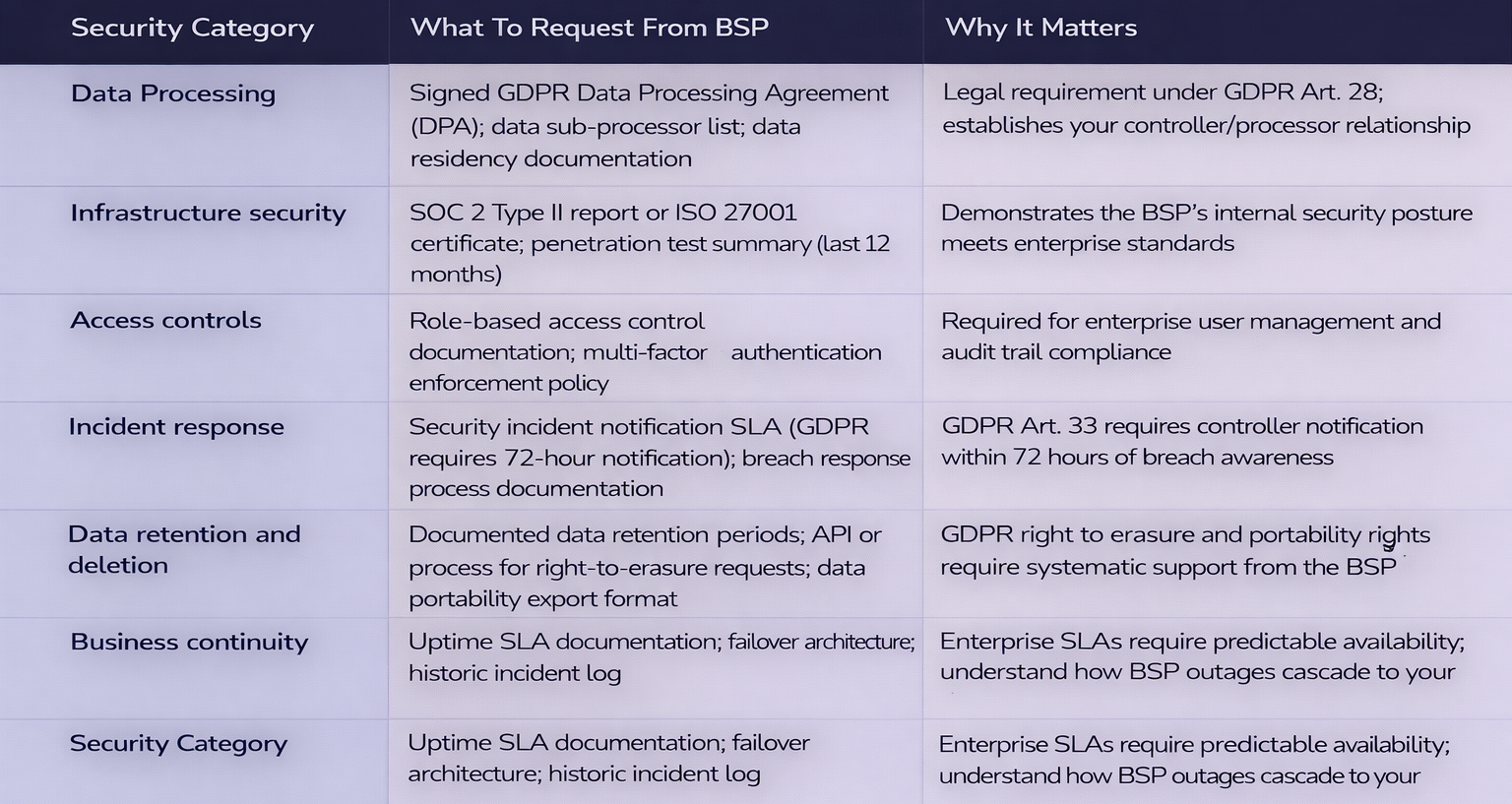
BSP Security Due Diligence: What Enterprise IT Requires
Before any enterprise IT or security organization will approve a BSP as a third-party vendor, they typically require evidence in several areas:
GDPR Operational Compliance: The Five Things Most Enterprises Get Wrong
Many organizations deploy their WhatsApp solution in production with an insufficiently robust model of compliance.
The top five most common issues:
- Existing email marketing consent: Organizations that rely on existing consent for email marketing campaigns are not GDPR compliant, as consent for email marketing does not apply to the use of WhatsApp. Organizations must obtain channel-specific, freely given, specific, and informed consent for the use of the WhatsApp channel.
- Lack of documented consent at the individual level: Organizations must be able to demonstrate consent for the use of the channel for an individual user, as per the GDPR regulations. Organizations must be able to show when the user gave consent, the mechanism through which consent was given, and the channel that the user consented to.
- Failure to review template language for consent implications: Organizations must review the content of the message template before submitting it to Meta, as the content may imply consent for additional purposes beyond the initial opt-in.
- No tested erasure workflow: The erasure workflow under GDPR requires that personal data is deleted from your system as well as your BSP’s system. If you haven’t tested a workflow that simulates a GDPR erasure request that requires personal data to be deleted from both your CRM system as well as your BSP’s database, then your erasure workflow is not compliant.
- No DPA in place with Meta: Meta is a processor when it comes to message content on their infrastructure. A GDPR-compliant Data Processing Agreement is required with Meta. The DPA is available as part of their Terms of Service on business accounts. Enterprise teams should ensure that this is reviewed and accepted in context with their specific data processing activity.
GDPR Go-live Checklist
Before Sending First Business-Initiated Message:
(1) Separately documented opt-in exists at individual CRM level.
(2) DPA is signed with BSP – review sub processor list to ensure all parties are included.
(3) End-to-end erasure workflow has been tested.
(4) Template has been reviewed to ensure that there are no claims that exceed the scope of opt-in.
(5) Data Residency has been addressed – if customers are in the EU, ensure message metadata is not processed on non-EU-based infrastructure without SCA or adequacy in place.
How to Evaluate and Choose a WhatsApp Enterprise Solution Provider
Meta has an official list of approved BSPs on business.facebook.com/messaging/partner-showcase.
This list comprises hundreds of approved BSPs that you can filter by region, industry, or capability.
This list will verify that a BSP is approved.
It will not verify that they are a good fit for your business.
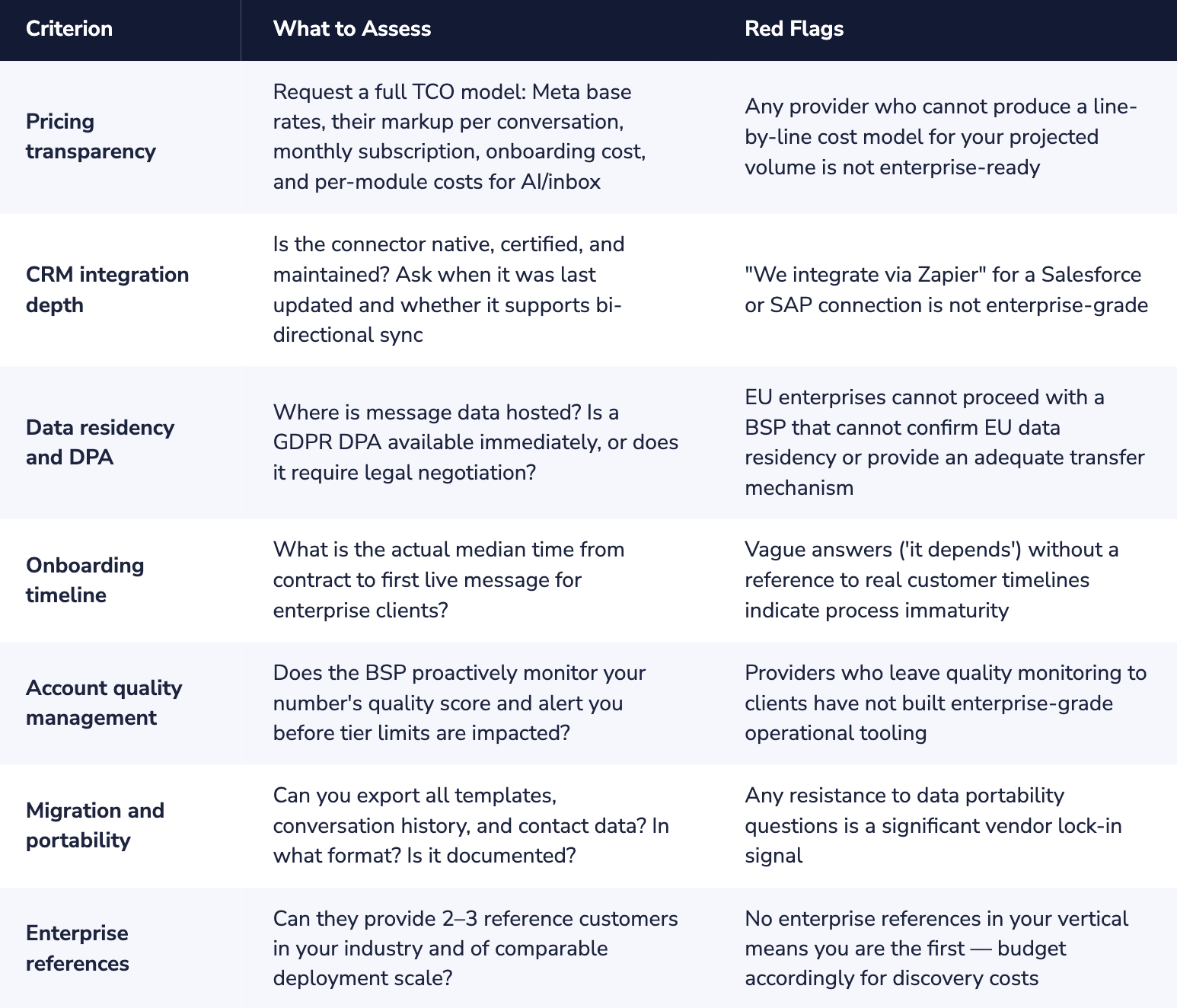
Here is an evaluation framework:
Evaluation Criteria by Priority
Six Questions to Ask Every BSP Shortlist
- What is your contractual uptime SLA, and what kind of credits or remedies are available to us if you fail to meet it? How many times have you failed to meet your SLA in the last 12 months?
- Can you walk me through your template rejection handling process? What is your response time when Meta rejects a template, and what kind of support is available to us to resubmit the rejected templates?
- If we want to terminate our contract with you and move to another vendor, what kind of data would we be able to export, in what format, and in what time frame?
- Which CRM systems have you certified, maintained, and have bidirectional integrations with, and would you be able to share the integration documentation with me, plus the last updated date on your end?
- How do you handle WhatsApp policy violations or quality downgrades, and what was the last time you escalated an account issue with Meta on behalf of a client?
- Can you give me two to three enterprise reference customers in our industry who would be willing to speak with us about your solution?
Enterprise Implementation Roadmap
The biggest failure points of enterprise WhatsApp deployments are not related to the technology implementation, which is actually pretty simple, but rather to the organizational and governance-related work that should be done first.
The roadmap below shows the sequence that actually leads to a successful deployment:
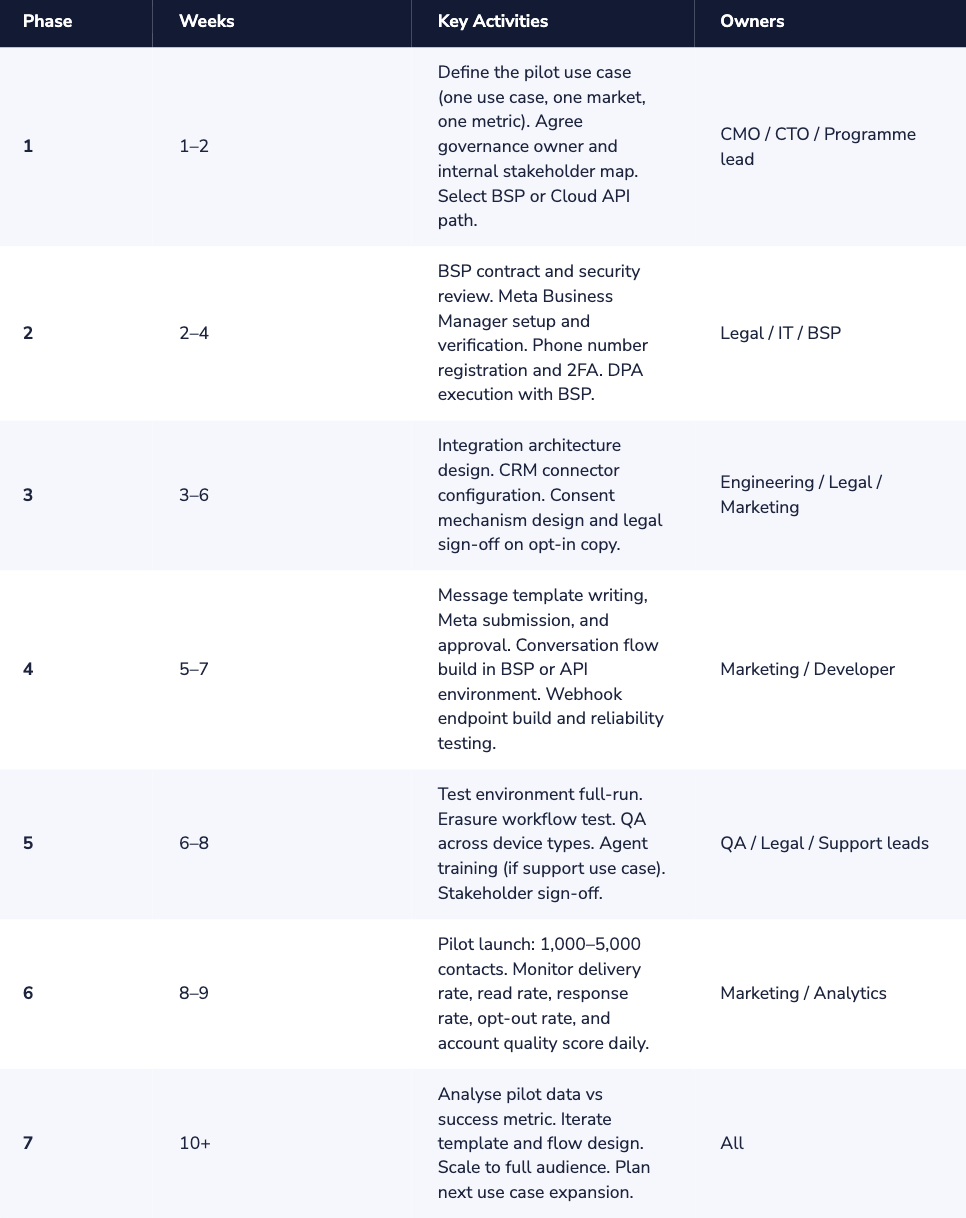
Phase 2 — account registration, Meta Business Manager verification, and phone number setup — is often where enterprise timelines first slip.
For a step-by-step walkthrough of the WhatsApp Business Account setup process, see: How to Set Up a WhatsApp Business Account.
The Pilot-first Principle
Every enterprise that has scaled WhatsApp successfully did so by starting with a single, well-bounded use case in one market, with one team, and one measurable success metric.
Organisations that try to launch support, marketing, and transactional notifications simultaneously across multiple countries in month one consistently produce poor data, compliance gaps, and overwhelmed internal teams.
The pilot is not a delay — it is where you learn what your governance model actually needs to look like at scale.
The common characteristic of the WhatsApp Business deployments that were successful is that the work of defining the organisational success preceded the sending of the first message.
The deployments that did not work are characterised by the fact that the channel went live first, and then the work of defining the infrastructure to manage the channel at scale occurred afterwards.
The stage that you are at will determine what to do next:
- Creating the business case: Cost to serve reductions, marketing attribution of revenues, value of diversifying channels should be modelled independently of one another. The most enduring business case for WhatsApp Business will address all three of these areas.
- Evaluating access paths: Apply the BSP vs Cloud API framework outlined in Section 5 to your technical capability and timeline constraints. Do not allow vendor marketing to decide for you.
- Shortlisting BSPs: Apply the six evaluation questions outlined in Section 8 to every BSP vendor that you engage with. Pricing transparency and data portability are the questions that will most readily reveal the maturity of a BSP vendor to meet the needs of your enterprise.
- Planning the pilot: Defining one use case, one market, one measurable metric, and a week-by-week plan will be required. The organisations that scale WhatsApp Business most effectively are those that earn the right to scale through a well-defined pilot process.
Dexatel's Role
Dexatel is a WhatsApp Business Solution Provider that provides API access, a shared inbox, campaign tools, CRM integration, and conversation-based pricing without any hidden markups.
For those enterprises looking to shortlist BSP vendors, the pricing page of Dexatel's website and our WhatsApp channel provide the detail that this guide does not.


.jpg&w=828&q=75)
