


SMS Marketing ROI: Everything You Need to Know


Published: Jun 18, 2026

We’ve talked about this over and over again: SMS marketing works. And it works because it combines accessibility (we always have our phones with us), relatability (we reserve texting for those close to us), conciseness (texts are short and to the point), and immediacy (we look at texts as they come). But even more than that, SMS marketing gives you:
More personal and meaningful engagement with customers
An edge over the mass of other marketing messages people receive
A bigger ROI through increased sales and revenue, reduced churn and purchase friction, and higher customer lifetime value (CLV)
Even though email may be an overall lower-cost channel, SMS marketing ROI is generally higher. Let’s see how.
What Is SMS Marketing ROI?
To understand the real cost-effectiveness of an SMS marketing strategy, you need to measure its ROI, or return on investment. An analysis of your SMS ROI is a simple comparison between its expenses and the revenue it brings in.
While getting the exact ROI of SMS marketing campaigns across all industries is difficult, brands can typically see a 5x to 10x SMS ROI, with far bigger success stories out there.
But don’t just think in terms of purchases. A missed appointment can cost healthcare providers and doctors valuable time and money, and if SMS appointment reminders can cut that even a fraction down, they’re already paying back far more than they cost.
And things like two-way communication through SMS can nurture a lead far before they make a purchase. It’s hard to measure that value, but SMS communication does more than just compel your audience to take action here and now—it creates and develops relationships.
Start sending SMS that actually gets read
Reach customers instantly with reliable SMS delivery across 190+ countries. No credit card required — try Dexatel free for 30 days.
How to Calculate SMS Marketing ROI
Measuring SMS ROI helps businesses understand whether their campaigns are generating more revenue than they cost. The standard formula is:
SMS Marketing ROI = (Revenue Generated − Campaign Cost) ÷ Campaign Cost × 100
This calculation shows the percentage return earned for every dollar invested in SMS marketing. A positive ROI indicates that the campaign generated more revenue than it cost to run.
SMS Marketing ROI Example
Let's say an online retailer sends 10,000 promotional SMS messages at a total cost of $500. The campaign generates $5,000 in attributable sales from customers who clicked the link and completed a purchase.
Step 1: Calculate profit generated by the campaign.
$5,000 − $500 = $4,500
Step 2: Divide profit by campaign cost.
$4,500 ÷ $500 = 9
Step 3: Multiply by 100.
9 × 100 = 900% ROI
In this scenario, the business generated $9 in revenue for every $1 spent, resulting in a 900% SMS marketing ROI. While results vary by industry, audience, and offer quality, this example illustrates why SMS remains one of the highest-performing customer engagement channels for many businesses.
What Costs Should Be Included in SMS Marketing ROI?
To calculate the ROI SMS marketing provides, businesses need to account for all costs associated with running and maintaining their SMS program, not just the cost of sending messages. Focusing only on per-message pricing can lead to inflated ROI calculations and make it difficult to compare SMS performance against other marketing channels.
Common SMS marketing costs include:
Message delivery costs: Per-message fees charged by your SMS provider, including destination-based pricing and carrier surcharges where applicable.
Platform or software fees: Monthly subscriptions, platform access fees, automation tools, analytics features, or premium functionality.
Subscriber acquisition costs: Advertising spend used to grow SMS lists through paid social campaigns, search advertising, lead generation campaigns, and website opt-in promotions.
Labor and management costs: Time spent creating campaigns, managing subscriber lists, writing content, analyzing performance, and optimizing results.
Integration costs: Expenses associated with connecting SMS platforms to CRM systems, eCommerce platforms, customer data platforms, or internal business systems.
Compliance and registration costs: Costs related to sender registration programs, 10DLC registration, short codes, consent management, and regulatory compliance requirements.
Creative and campaign assets: Landing page development, promotional design work, discount offers, and other campaign-specific expenses.
For example, if a business spends $300 on SMS delivery, $100 on subscriber acquisition, and $100 on platform and management costs, the total campaign investment is $500. That full amount, not just the messaging fees, should be used when calculating SMS marketing ROI. This approach provides a more realistic view of campaign profitability and allows for more accurate comparisons across marketing channels.
SMS Marketing ROI Metrics
When measuring text marketing ROI, there are two main costs to consider: price per message and monthly fees. You can expect to pay from as little as a penny per SMS up to $0.1 for certain countries. There are generally bigger discounts for bigger volumes. Some SMS providers have monthly plans or tiers but may charge you a fee regardless of how much you send.
For a more detailed breakdown of which metrics matter most, be sure to check out our article on SMS KPIs.
Check out our SMS API pricing for basic pay-as-you-go cost per SMS. Dexatel has no sign-up fees, no monthly fees, and low-cost bulk services.
Also, consider the costs associated with digital advertising involved in getting people to opt-in to your SMS lists and the costs of maintaining and growing those lists.
Once you’ve figured these out, you can measure text marketing ROI in several ways depending on your campaign goals and SMS strategy, but the main metrics are usually:
Delivery Rate
Delivery rate measures the percentage of messages that successfully reach recipients' mobile devices. It is one of the most important SMS marketing metrics because messages that are not delivered cannot generate clicks, conversions, or revenue. Low delivery rates may indicate issues with contact list quality, carrier filtering, sender registration, or routing infrastructure. To improve delivery performance, regularly clean subscriber lists, remove inactive numbers, and work with providers that offer high-quality routing and delivery reporting.
Open Rate
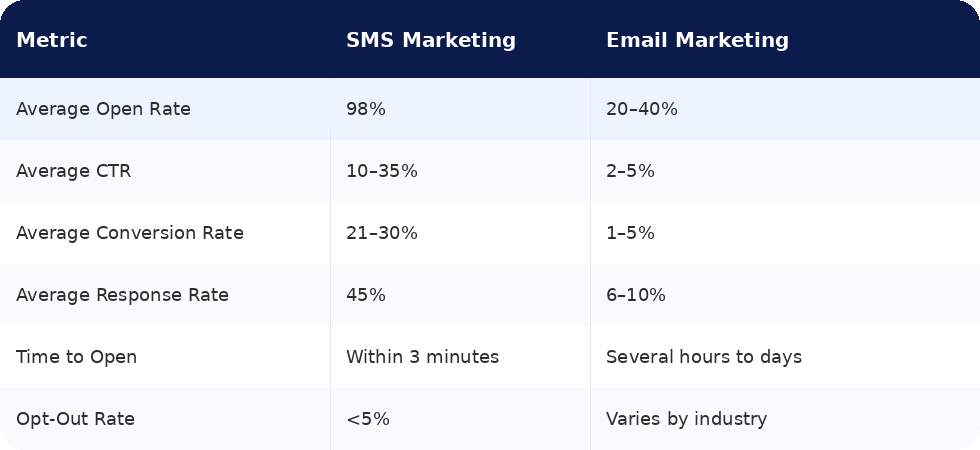
Open rate measures how many recipients view your SMS messages after delivery. SMS consistently outperforms most digital marketing channels, with average open rates often reaching 98%. High open rates give businesses a significant advantage because promotional offers, reminders, and notifications are more likely to be seen quickly. While SMS open rates are naturally strong, businesses can maximize engagement by sending relevant content, personalizing messages, and avoiding excessive messaging frequency.
Click-Through Rate (CTR)
Click-through rate measures the percentage of recipients who click a link within your text message. This metric helps determine how compelling your offer, call to action, or content is. A high CTR often indicates that the message resonates with your audience and successfully drives traffic to your website, landing page, or application. Using clear calls to action, personalized offers, and shortened trackable links can help improve click performance.
Conversion Rate
Conversion rate measures the percentage of recipients who complete a desired action after receiving a text message. While conversions often refer to purchases, they can also include newsletter signups, appointment bookings, survey responses, account registrations, or referral actions. This metric directly connects SMS marketing activity to business outcomes and revenue generation. Businesses can improve conversion rates through audience segmentation, personalized messaging, optimized landing pages, and timely offers.
Cost per Acquisition (CPA)
Cost per acquisition measures how much it costs to generate a customer, lead, or conversion through SMS marketing. It is calculated by dividing total campaign costs by the number of conversions generated. CPA provides valuable context when evaluating campaign profitability because a campaign with a high conversion rate may still be inefficient if acquisition costs are excessive. Reducing CPA often involves improving targeting, refining messaging, and optimizing subscriber acquisition strategies.
Cost per Subscriber
Cost per subscriber measures how much you spend to acquire and maintain each subscriber on your SMS list. This includes advertising costs, promotional campaigns, lead generation efforts, and list-building initiatives. Understanding subscriber acquisition costs helps businesses evaluate long-term customer value and determine whether list growth strategies are sustainable. Comparing cost per subscriber against average customer lifetime value can provide a clearer picture of overall SMS marketing profitability.
Opt-out Rate
Opt-out rate measures the percentage of subscribers who choose to stop receiving your messages. While some list attrition is normal, unusually high opt-out rates can indicate that messages are being sent too frequently, are poorly targeted, or fail to deliver value to recipients. Monitoring unsubscribe trends helps businesses identify potential issues before they affect campaign performance. Maintaining relevant content, proper segmentation, and reasonable sending frequency can help keep opt-out rates low.
SMS Marketing Performance Benchmarks
Top Tips to Maximize SMS Marketing ROI
With its relatively low cost and high success rate, it’s easy to see why more and more brands are choosing SMS marketing. And most SMS platforms like Dexatel make it easy to get rolling, so you can start successfully measuring and optimizing right off the bat. Here are tips to get you started.
Personalize Your SMS Marketing Efforts
Personalization is more than just addressing your recipient by name. Think about how the content and purpose of the message relates to each customer. If they have purchased a specific type of product before, then sending another offer that’s relevant to their interests and past purchases will be far more relatable and useful than a SMS blast. Although that can work too since you can segment your targets into large or small groups.
Optimize Your SMS Marketing
Test out different phrasings, calls to action, and other variations in your messages. You can create separate landing pages to see which SMS message recipients followed your links, or set up different reply keywords and see which messages get responses. It’s also important to use an SMS provider with worldwide availability and high platform uptime (Dexatel has 99.9%) to ensure that your messages actually get delivered.
Measure Opt-Out Rates
If your targets are opting out of your subscriber list, you may want to rethink your strategy and try out different tactics. A high opt-out rate can signify problems with wrong content, wrong audience, wrong timing, or just sending out too many messages. See what works and what doesn’t, and remember that you can create effective campaigns at each stage of your customer journey.
Pick a Great SMS Provider
To get the best text marketing ROI and bring the most benefit, partner with an SMS provider that can fully support your SMS campaigns from start to finish. Look for platforms with a strong SMS API that will support your tools and can easily integrate with existing customer operations. Choose a provider that comes with a strong support team that can meet both your business goals and your budget—start for free.
A/B Testing SMS Campaigns to Improve ROI
A/B testing is one of the most effective ways to improve SMS marketing ROI over time. Rather than relying on assumptions, businesses can test different message variations and use performance data to determine which version generates more clicks, conversions, and revenue.
Some of the most common variables to test include:
Call-to-action (CTA): Compare phrases such as "Shop Now" versus "Claim Your Discount."
Message length: Test shorter messages against more detailed versions.
Send time: Compare morning, afternoon, evening, weekday, and weekend campaigns.
Offer type: Test percentage discounts, fixed-dollar discounts, free shipping offers, or loyalty rewards.
Personalization: Compare generic messages against messages that include customer names, purchase history, or location-based content.
Urgency: Test messages with limited-time language against messages without urgency cues.
For example, an online retailer could test the following two SMS messages:
Version A:
"24 hours only: Save 15% on your next order. Shop now: [link]"
Version B:
"Paula, your exclusive 15% discount ends tonight. Claim your offer now: [link]"
The business would send each version to a similar audience segment and compare click-through rates, conversion rates, and revenue generated. If Version B produces a higher conversion rate, that insight can be applied to future campaigns. To generate reliable results, businesses should test one variable at a time and use sufficiently large audience samples before declaring a winner. Over time, even small improvements in conversion rates can significantly increase overall SMS marketing ROI.
Choosing the Right Time to Send SMS Campaigns for Better ROI
Timing can have a significant impact on SMS marketing ROI. Even a well-crafted message may underperform if it reaches recipients when they are busy, asleep, or unlikely to engage. While the ideal send time varies by audience and industry, many businesses see strong engagement during weekday mornings (9 AM–12 PM) and early evenings (5 PM–9 PM) when customers are more likely to check and act on messages.
Weekend performance can vary, but late Sunday mornings and early afternoons often perform well for retail promotions, event reminders, and eCommerce campaigns. However, timing should always be aligned with customer behavior and the nature of the message. For example, restaurants may benefit from sending lunch promotions shortly before meal times, while appointment reminders are often most effective 24–48 hours before a scheduled visit.
Businesses should also be aware of local regulations and customer expectations. In many markets, promotional messages should generally be sent during reasonable business hours, with many organizations avoiding communications before 8 AM or after 9 PM local time. The best approach is to test different sending windows, monitor engagement metrics, and identify the times that consistently generate the highest click-through rates, conversions, and overall ROI.

How to Track SMS Marketing Revenue Accurately
Calculating SMS marketing ROI requires more than simply measuring clicks and conversions. Businesses need a reliable way to attribute revenue directly to SMS campaigns so they can understand which messages, offers, and customer segments generate the best results. Using multiple tracking methods provides the most accurate picture of campaign performance.
UTM Parameters
UTM parameters allow businesses to track SMS traffic within analytics platforms such as Google Analytics. By adding tracking tags to links, marketers can see how many visitors, conversions, and sales originated from a specific SMS campaign. This makes it easier to compare SMS performance against channels such as email, paid search, and social media.
Unique Promo Codes
Assigning a unique discount code to each SMS campaign is one of the simplest attribution methods. When customers redeem the code during checkout, businesses can directly connect purchases and revenue to a specific message. This approach works particularly well for eCommerce promotions, flash sales, and loyalty campaigns.
Dedicated Landing Pages
Creating campaign-specific landing pages helps isolate SMS traffic from other marketing channels. For example, a retailer could direct SMS subscribers to a dedicated sale page that is not promoted elsewhere. Any conversions generated through that page can then be attributed directly to the SMS campaign.
Call Tracking Numbers
For businesses that generate leads by phone, dedicated call tracking numbers can help measure SMS-driven inquiries and sales. Each campaign uses a unique phone number, allowing businesses to track call volume, lead quality, and revenue generated from SMS marketing efforts. This method is especially valuable for healthcare providers, service businesses, real estate companies, and local businesses that rely heavily on phone-based conversions.
SMS Marketing ROI Examples by Industry
Healthcare: Reducing Appointment No-Shows
A healthcare clinic sends appointment reminder SMS messages to 5,000 patients each month. Before implementing SMS reminders, the clinic experiences a 15% no-show rate, resulting in approximately 750 missed appointments. After launching automated reminder campaigns, no-shows fall to 10%, recovering 250 appointments per month. If the average appointment value is $80, the clinic generates an additional $20,000 in monthly revenue while spending only a fraction of that amount on SMS messaging.
eCommerce: Increasing Promotional Sales
An online retailer launches an SMS promotion offering a 15% discount to 20,000 subscribers. The campaign costs $200 to send and generates 500 purchases with an average order value of $60. Total campaign revenue reaches $30,000, demonstrating how highly targeted SMS promotions can produce significant returns while maintaining relatively low messaging costs.
Retail: Driving Flash Sale Revenue
A retail brand uses SMS to promote a 24-hour flash sale to 10,000 loyalty program members. The campaign generates a 12% click-through rate and a 6% purchase rate, resulting in 600 sales. With an average transaction value of $50, the promotion generates $30,000 in revenue from a single campaign. Because SMS messages are typically read within minutes, retailers can use them to create urgency and drive immediate purchasing decisions.
Service Businesses: Increasing Booking Rates
A salon sends SMS reminders and limited-time promotional offers to existing customers who have not booked an appointment in the past 90 days. Of 2,000 recipients, 150 schedule a new appointment worth an average of $45. The campaign generates $6,750 in revenue while helping the business fill unused appointment slots and improve customer retention.
Start sending SMS that actually gets read
Reach customers instantly with reliable SMS delivery across 190+ countries. No credit card required — try Dexatel free for 30 days.
Frequently Asked Questions
What is a good ROI for SMS marketing?
A good SMS marketing ROI depends on your industry, audience, and campaign objectives, but many businesses consider a positive return of several hundred percent to be successful. Because SMS typically delivers high open rates and strong engagement, well-targeted campaigns often generate significantly higher returns than many traditional marketing channels. The most important benchmark is whether your SMS campaigns consistently generate more revenue than they cost to run.
How does SMS marketing ROI compare to email marketing?
SMS and email can both generate strong returns, but SMS often benefits from higher open rates, faster engagement, and stronger response rates. While email is effective for longer-form content and nurturing campaigns, SMS is particularly valuable for time-sensitive promotions, reminders, and transactional communications. Many businesses use both channels together, with SMS driving immediate action and email supporting broader customer engagement strategies.
How do I track SMS conversions?
Businesses commonly track SMS conversions using UTM parameters, unique promo codes, dedicated landing pages, and call tracking numbers. These methods make it possible to connect clicks, leads, purchases, and revenue directly to specific SMS campaigns. Combining multiple attribution methods often provides the most accurate view of campaign performance and ROI.
Which SMS marketing metrics should I monitor?
The most important SMS marketing metrics include delivery rate, open rate, click-through rate (CTR), conversion rate, cost per acquisition (CPA), cost per subscriber, and opt-out rate. Together, these metrics provide a comprehensive view of campaign performance, customer engagement, and profitability. Monitoring them regularly helps identify opportunities to improve future campaigns and maximize ROI.
How long does it take to see results from SMS marketing?
SMS campaigns often generate results much faster than many other marketing channels because text messages are typically read within minutes of delivery. Promotional campaigns can produce clicks, conversions, and sales on the same day they are sent, while long-term initiatives such as subscriber growth and customer retention may take longer to evaluate. Consistent measurement over time provides the clearest picture of overall SMS marketing ROI.


