


Creating an SMS Marketing Campaign in 2026: An Advanced SMS Campaign Guide


Published: Jun 8, 2026

In this day and age, the purpose of mobile phones extends far beyond just making and receiving calls. We also use our devices for other reasons like storing media, consuming online content, sharing information, and of course, texting. It’s only natural for this versatile technology to have an incredible influence on marketing—in the form of SMS campaigns.
As overwhelming amounts of evidence would suggest, an SMS marketing campaign is an effective way for a business to connect with its audience. And the data speaks for itself: studies show that the average mobile user spends at least five hours a day on their smartphone. Moreover, texting statistics reveal that 97% of Americans send or receive text messages at least once per day.
This points to the convenience and popularity of using SMS as a means of communication. Needless to say, targeting your customers via their favorite channel positively impacts your company’s customer retention rates.
Experts have discovered the huge potential of text message marketing as a fast, easy, and cost-effective marketing channel. A successful text campaign will have no trouble reaching your targeted audience and converting leads into paying customers.
What Is an SMS Marketing Campaign?
An SMS campaign is a planned series of text messages sent to a targeted audience to promote products, services, events, or customer engagement initiatives. Businesses use SMS campaigns to communicate directly with opted-in subscribers, delivering time-sensitive offers, announcements, reminders, and personalized content to mobile devices. Unlike email or social media marketing, SMS provides immediate visibility and typically achieves higher open and engagement rates. SMS marketing campaigns can be launched through dedicated messaging platforms that support audience segmentation, personalization, scheduling, automation, and performance tracking.
Run SMS campaigns that drive real results
Design, send, and track bulk messaging campaigns with ease. From promotions to drip sequences — all in one intuitive platform.
How SMS Marketing Campaigns Work
SMS marketing campaigns allow businesses to send promotional and transactional messages directly to customers through a messaging platform or API. Before launching a campaign, businesses typically collect subscriber consent through websites, mobile apps, sign-up forms, checkout pages, or loyalty programs. Contacts can then be organized into audience segments based on factors such as customer behavior, demographics, location, or previous engagement.
After building your audience, you can create campaign messages, personalize content, add links or offers, and schedule delivery for the most effective time. The platform handles message routing through carrier networks while providing insights into delivery status, clicks, and customer engagement. Because of its strong visibility and response rates, SMS is commonly used for promotions, product announcements, appointment reminders, abandoned cart recovery, customer retention initiatives, and loyalty programs.
For businesses looking to expand beyond SMS, Dexatel Campaigns also supports WhatsApp Business and Viber Business, making it possible to manage multi-channel campaigns and reach customers through their preferred communication channels.
SMS vs. Other Marketing Channels
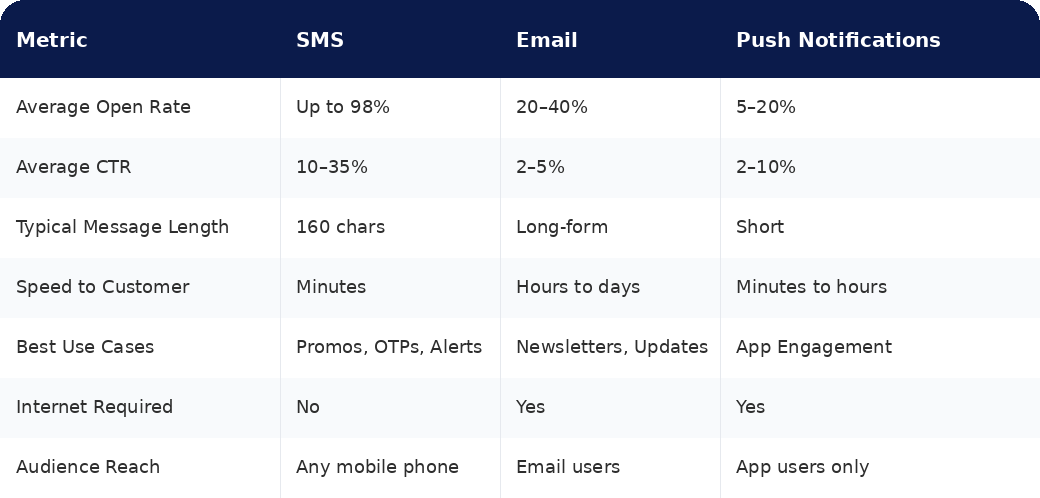
Create SMS Marketing Campaigns in Minutes
Create promotional campaigns, reminders, notifications, and customer engagement messages from a single platform. With audience management, scheduling, automation, and analytics built in, Dexatel helps businesses launch and scale SMS campaigns without complex setup.
Types of SMS Marketing Campaigns
There are various types of SMS marketing strategies that businesses can employ to engage with their target audience. But when it comes to context, two categories stand out: promotional SMS messages and transactional SMS messages.
1. Promotional SMS Messages
Promotional SMS is a popular type of marketing that businesses use to promote their products, services, offers, or events directly to their target audience. It’s a cost-effective and efficient way for businesses to reach a large audience instantly, create awareness about their products or services, and drive customer engagement and sales.
These types of texts are concise and to the point, typically limited to 160 characters per message. The content focuses on delivering a compelling offer, discount, or promotion that entices recipients to take action.
A strong and clear call to action is essential in promotional SMS messages. It prompts recipients to act immediately, such as making a purchase, visiting a website, or redeeming a coupon code.
Timing also plays a crucial role in promotional SMS. Sending messages at the right time when recipients are most likely to engage increases the effectiveness of the campaign. However, it's important to balance frequency to avoid overwhelming or annoying customers with excessive messages.
Promotional SMS messages can be targeted based on various criteria, such as demographic data, previous purchases, or customer preferences. This allows businesses to tailor their messages to specific segments of their audience, increasing relevance and engagement.
Adding a personal touch to promotional SMS, such as addressing recipients by name or tailoring offers based on their preferences, can enhance engagement and increase the likelihood of conversions.
You can track and analyze your promotional campaigns to measure their effectiveness. By monitoring metrics like open rates, click-through rates, and conversion rates, you can assess the success of their campaigns and make data-driven improvements.
2. Transactional Messages
Transactional messages are a type of SMS communication that businesses send to customers to provide important and time-sensitive information related to their transactions or interactions. They are crucial for building trust, providing transparency, and improving customer satisfaction. By promptly delivering important updates and information, businesses can enhance the overall customer experience and maintain a positive brand image.
These types of messages are triggered by specific customer actions or events like purchase confirmations, order updates, shipping notifications, account alerts, or password resets. Their primary purpose is to deliver critical information and enhance the customer's overall experience.
They typically contain concise and relevant information related to the specific transaction, such as order ID, item descriptions, payment summaries, delivery status, or account updates. The content is straightforward and focuses on providing valuable information rather than promotional offers.
Transactional messages are sent in real time or near real time to ensure timely communication with customers. For example, an order confirmation SMS often goes out immediately after a purchase is made, while a shipping notification is sent when the package is dispatched.
Oftentimes, they include a confirmation or verification element to ensure that customers are informed about the successful completion of their transaction. This instills confidence and provides reassurance to customers.
Businesses must comply with relevant regulations and privacy policies when sending transactional messages. While promotional messages usually require opt-in consent, transactional messages are typically considered essential communications related to a customer's interaction with the business.
To streamline the process, businesses often create pre-designed templates for various transactional message types. These templates ensure consistency in messaging, improve efficiency, and enable automated delivery of messages.
Why Launch an SMS Marketing Campaign?
Marketing via SMS offers a slew of opportunities for delivering your company’s message to your target audience. A well-planned SMS campaign can be an ideal means for notifying customers about upcoming events, promotions, product launches, and more. From a financial perspective, an SMS messaging campaign is a cost-effective communication method that offers great ROI potential.
For starters, you can use an SMS campaign management tool to send out bulk SMS messages to large volumes of customers while connecting with them on a personal level. Why break the bank by relying solely on less efficient and more costly methods, such as print media? As a marketing channel, a mobile campaign raises brand awareness, increases customer retention, and boosts sales, all while saving you a great deal of money.
Having said all that, why is SMS the preferred channel of marketers? SMS messages are known to have a 98% open rate—impressive in comparison to the 20% open rate of email marketing and the 1.2% click-through rate of social media. This only goes to show that launching a texting campaign is something to look into.
Key Features of Dexatel Campaigns
Dedicated Campaign Builders
Create and manage SMS as well as WhatsApp and Viber campaigns using channel-specific tools designed to support the unique capabilities of each messaging platform. This allows you to optimize content, formatting, and delivery strategies for every channel.
AI-Powered Message Generation
Generate campaign-ready message copy with the help of an integrated AI assistant. Whether you're creating promotional offers, customer notifications, or engagement campaigns, AI can help speed up content creation and reduce manual effort.
Integrated Link Tracking
Shorten URLs automatically and monitor how recipients interact with your campaigns. Built-in click tracking and delivery reporting provide valuable insights into engagement and campaign effectiveness.
Ready-to-Use Campaign Templates
Launch campaigns faster with a library of pre-built templates covering a wide range of industries, marketing goals, and customer communication scenarios. Templates can be customized to match your brand and campaign objectives.
Analytics and Performance Reporting
Measure campaign success through detailed analytics, including delivery rates, click-through rates, engagement metrics, and opt-out activity. These insights help you identify opportunities for optimization and improve future campaigns.
Fast API Integration
Connect Dexatel Campaigns to your existing applications, CRM systems, and workflows through a flexible REST API. Integration can be completed quickly, allowing you to automate messaging without disrupting existing processes.
Audience and Contact Management
Import, organize, and manage customer data from a centralized platform. Create targeted audience segments based on customer behavior, location, preferences, or engagement history to improve campaign relevance.
Advanced Campaign Scheduling
Schedule campaigns ahead of time and automate recurring sends to ensure messages reach customers at the most effective moments. Features such as time-zone-aware delivery help improve engagement across different regions.
Compliance and Regulatory Support
Simplify compliance management with built-in opt-out processing, suppression list management, and support for country-specific messaging requirements. This helps businesses maintain compliant communication practices while reducing administrative workload.
Workflow-Based Automation
Automate customer communication by triggering campaigns based on specific events, customer actions, or predefined workflows. Automated messaging helps businesses deliver timely and relevant interactions at scale.
Dynamic Personalization
Increase engagement by tailoring messages to individual recipients. Use customer attributes, behavioral data, custom fields, and audience insights to deliver more relevant and personalized campaign experiences.
Top 5 Benefits of SMS Marketing
As you’d expect, marketing via SMS comes with a bunch of benefits. We’ve compiled a list of the key advantages to break it down for you.
1. Fastest and Simple Way to Reach Customers Directly
Not only is text marketing widely recognized as the fastest and simplest way to reach customers directly, but it also provides businesses with a direct line of communication to engage with their target audience. With an average response time of just 90 seconds, SMS offers unparalleled speed and immediacy.
Unlike other marketing channels, SMS does not require an internet connection, ensuring instant message delivery even in areas with limited connectivity. Moreover, the simplicity of texting allows businesses to craft concise and attention-grabbing messages, ensuring that important information is delivered swiftly and effectively.
To put it simply, the advantages of SMS include:
- Instant text delivery
- Quick response time
- No internet dependency
- Concise and attention-grabbing
2. Highest Open Rate Compared to Other Marketing Channels
When it comes to open rates, SMS outshines other marketing channels, delivering unmatched results. With an open rate of over 98%, SMS messages have a significantly higher likelihood of being seen and read by recipients.
Unlike emails that often get lost in crowded inboxes or social media posts that may be easily overlooked, SMS messages are instantly delivered to the recipient's mobile device, prompting immediate attention. The simplicity and directness of SMS communication make it a preferred choice for businesses seeking high engagement and direct customer interaction.
SMS marketing messages:
- Are instantly delivered to recipients' mobile devices, ensuring prompt visibility and engagement
- Capture the recipient's attention directly, without competing with other distractions like social media feeds or email clutter
- Are more likely to be read and acknowledged, unlike emails that often get filtered as spam
- Are easily accessible and can be viewed by recipients on the go
3. Highest Conversion Rates
Needless to say, text message marketing stands out as a powerhouse, with higher conversion rates compared to other marketing channels since it has the ability to drive immediate action from recipients.
The direct and personalized nature of SMS communication, combined with the high open rates and quick response times, creates a sense of urgency and prompts customers to take the desired steps, whether it's making a purchase, redeeming an offer, or engaging with a call to action.
SMS texts boast an average of 29% conversion rate, often surpassing other marketing channels. They also achieve click-through rates of 10% or higher, indicating a strong level of recipient engagement and interest.
4. Cost-Effective Marketing Channel
Unlike traditional advertising methods or digital channels that often involve high costs, SMS campaigns are relatively affordable and deliver impressive results. The cost per SMS message is typically lower than other channels, and with high open rates and response rates, businesses can achieve a significant ROI.
Oftentimes, platforms provide SMS marketing automation capabilities, allowing businesses to streamline their campaigns, save time, and reduce manual labor costs. This cost-effectiveness, combined with the ability to generate immediate and measurable results, makes SMS a smart choice for businesses of all sizes.
In a nutshell, text message marketing boasts:
- Lower cost per message
- Minimal production costs
- Automation and scalability
- Reduced wastage
- No printing or postage costs
- Measurable results
5. Trackable with Real-Time Analytics
The advantage of being trackable with real-time analytics allows businesses to monitor the performance of their campaigns and make data-driven decisions. For example, businesses can track the delivery status of each SMS, ensuring they reach the intended recipients and identifying any potential delayed text message issues.
With real-time analytics, marketers can track the open rates of their messages, providing insights into the effectiveness of the content. By including links in texts, businesses can also examine click-through rates and measure recipient engagement with the provided links or calls to action.
SMS campaigns can be integrated with conversion tracking tools, allowing businesses to measure the number of recipients who complete desired actions after receiving an SMS. On top of that, measuring opt-out rates helps businesses understand the level of recipient engagement and refine their messaging strategies accordingly.
You also want to test your campaign and experiment with different message variations. This way, you can measure which performs better in terms of open rates, response rates, or conversions. With data on recipient behavior and preferences, businesses can perform segmentation analysis to identify target segments that respond well to specific types of messages, allowing for more targeted campaigns.
The main metrics to track include:
- Message delivery status
- Open rates
- Click-through rates
- Conversion tracking
- A/B testing
- Opt-out rates
- Segmentation analysis
What to Do Before Creating an SMS Campaign?
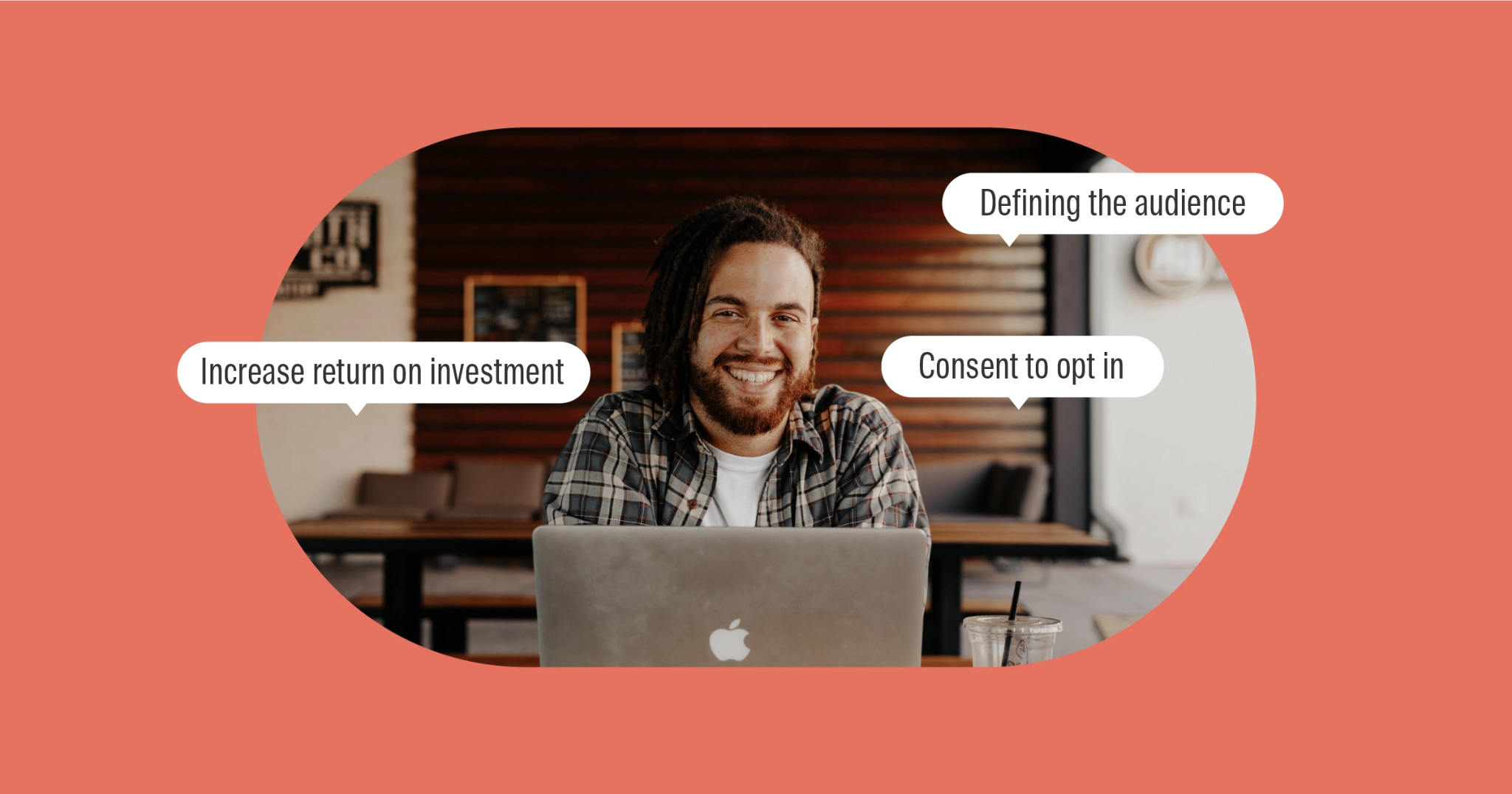
There’s no denying the benefits an SMS campaign can bring in, but only if you implement it the right way. That being said, you’ll need to have a solid SMS marketing strategy in place before even thinking about launching it. This involves defining your audience, setting objectives, and making sure to abide by local texting regulations.
Know Your Audience
A fundamental part of coming up with a text message marketing campaign involves knowing who your target audience is. By doing so, your messages will go out to those who are most likely to engage and possibly become your customers.
Figuring out who your target audience is involves creating a customer profile. You’ll want to define certain attributes such as pain points and buying behavior. Demographic information will also come in handy when creating SMS marketing campaigns.
Define Your Goals
Before you send your texting campaign on its way, it’s important to know what goals you have in mind. You’ll also want to set KPIs for the channel. Determine how you’ll meet those goals and how you’ll calculate the success of the campaigns.
You’ll want to have a clear idea of how SMS can align with your company’s mission and serve its bottom line. Essential metrics you need to take into account include conversion, click-through, and sub-growth rates, in addition to SMS marketing ROI.
Ask for Permission
No matter how urgent your message is, avoid texting your customers without their permission. The rule of thumb is that your customers should want to get messages from you. As a matter of fact, you are required by law to obtain your customers’ consent before sending them SMS messages.
Do not pursue customers who have no interest in your campaign. Instead, give them an opportunity to opt out. A common practice is to include an SMS opt-in form on your company’s website.
SMS Campaign Use Cases
New Product and Feature Announcements
Launching a new product, feature, service, or collection requires fast and direct communication with your audience. SMS campaigns allow businesses to share launch announcements, feature updates, software releases, and seasonal offerings with subscribers who have already opted in to receive brand communications.
Time-Sensitive Promotions and Discount Campaigns
Promotional campaigns often depend on reaching customers at the right moment. With SMS, businesses can instantly promote limited-time discounts, special offers, holiday deals, clearance events, and coupon campaigns, helping drive immediate engagement and faster purchase decisions.
Event Promotion and Attendance Reminders
Messaging channels are an effective way to keep attendees informed before and during an event. Businesses can use SMS marketing campaigns to send invitations, registration confirmations, reminders, schedule updates, and important announcements for webinars, conferences, product launches, live events, and other gatherings.
Lead Nurture Campaigns
Not every prospect is ready to make a purchase immediately. Lead nurture campaigns help businesses stay connected with potential customers by sending relevant content, reminders, educational resources, and promotional offers over time. This approach helps build trust and keeps the brand top of mind throughout the buying journey.
Abandoned Cart Reminders
Abandoned cart messages target shoppers who add products to their cart but leave before completing checkout. A timely SMS reminder can encourage customers to return and finish their purchase, often generating significantly higher recovery rates than email alone. Some businesses also include limited-time discounts or incentives to increase conversions.
Flash Sale Campaigns
SMS is particularly effective for flash sales because messages are typically read within minutes of delivery. Businesses can use text messages to announce limited-time promotions, exclusive discounts, and inventory clearance events. The immediacy of SMS helps create urgency and encourages faster purchasing decisions.
Giveaways and Contests
SMS campaigns can be used to promote giveaways, sweepstakes, and contests designed to increase engagement and grow subscriber lists. Businesses often encourage customers to enter by replying with a keyword, visiting a landing page, or completing a simple action. These campaigns can generate excitement while expanding audience reach.
Delivery and Order Tracking Updates
Transactional SMS messages help keep customers informed throughout the fulfillment process. Common use cases include order confirmations, shipping notifications, delivery updates, and pickup reminders. These messages improve customer experience while reducing support inquiries related to order status.
Text-to-Buy and Direct Shopping
Modern SMS marketing can support direct purchasing experiences by guiding customers to pre-filled carts, personalized product pages, or mobile checkout flows. Businesses can send targeted product recommendations, restock alerts, and exclusive offers that allow customers to move from message to purchase with minimal friction. This approach is particularly effective for eCommerce brands focused on increasing conversion rates and repeat purchases.
Automated and Drip Campaigns
Automated campaigns are triggered by specific customer actions or predefined workflows. Businesses often use drip campaigns to welcome new subscribers, onboard customers, recover abandoned carts, or nurture leads over time. Automation helps maintain consistent communication without requiring manual intervention.
Re-Engagement Campaigns
Re-engagement campaigns are designed to reconnect with inactive customers or subscribers who have stopped interacting with a brand. These campaigns may include special offers, personalized recommendations, win-back discounts, or reminders about unused accounts. The goal is to increase customer retention and reactivate dormant audiences.
Loyalty and Rewards Campaigns
Loyalty campaigns help strengthen long-term customer relationships by rewarding repeat purchases and engagement. Businesses use SMS to send loyalty point updates, exclusive member offers, VIP promotions, birthday rewards, and referral incentives. These campaigns focus on increasing customer lifetime value and encouraging repeat business.
SMS Marketing Examples from Leading Brands
Many of the world's most recognizable brands use SMS marketing to drive engagement, increase sales, and improve customer experiences. While campaign strategies vary by industry, the most successful examples share a common theme: timely, relevant messages that encourage customers to take action.
Starbucks: Personalized Loyalty Offers
Starbucks uses mobile messaging to deliver personalized offers, rewards updates, and loyalty program communications. By tailoring promotions to customer preferences and purchase behavior, the company has strengthened engagement within its rewards ecosystem and encouraged repeat purchases. Starbucks has reported significant growth in mobile-driven sales and customer participation through its mobile engagement initiatives.
Domino's: Promotions and Order Updates
Domino's combines promotional SMS campaigns with transactional messaging such as order confirmations and delivery updates. The brand has also used text messaging to distribute exclusive offers and coupons, with some SMS promotions achieving redemption rates of 20 to 25%. In addition to driving sales, delivery notifications help improve customer satisfaction by keeping customers informed throughout the order process.
IKEA: Product Launches and Customer Journeys
IKEA uses SMS to support product launches, promotional campaigns, and customer service interactions. One notable example is its Click & Collect messaging workflow, which keeps customers informed throughout the pickup process using a conversational series of text messages. This approach helps reduce friction while creating a more seamless customer experience.
Best Buy: Flash Sales and Limited-Time Promotions
Best Buy has used SMS campaigns to notify customers about flash sales, special promotions, and in-store events. The immediacy of SMS allows the retailer to create urgency around limited-time offers and drive traffic during promotional periods. These campaigns demonstrate how SMS can be used to generate rapid customer responses and increase short-term sales.
8 Text Marketing Campaign Ideas
82% of survey respondents admit to opening all text messages they receive. When a campaign delivers your business messages directly to your customers’ inboxes, chances are they will read them. You can take your first step with these SMS marketing ideas and use cases.
1. Let Your Customers Know About Your Best Offers
Informed customers are happy customers. Make sure to keep your customers up to date with relevant and engaging information such as offers, promotions, and new product launches. This is an excellent way to make your audience feel important and increase customer loyalty as a result.
For example, send short promotional text messages and include a special price to attract customers. Make sure to include a link to your website in case the recipient needs more information.
Example: "Weekend Sale: Get 25% off all orders over $75 through Sunday. Use code WEEKEND25 at checkout: shop.example.com"
2. Send Reminders in the Form of Text Messages
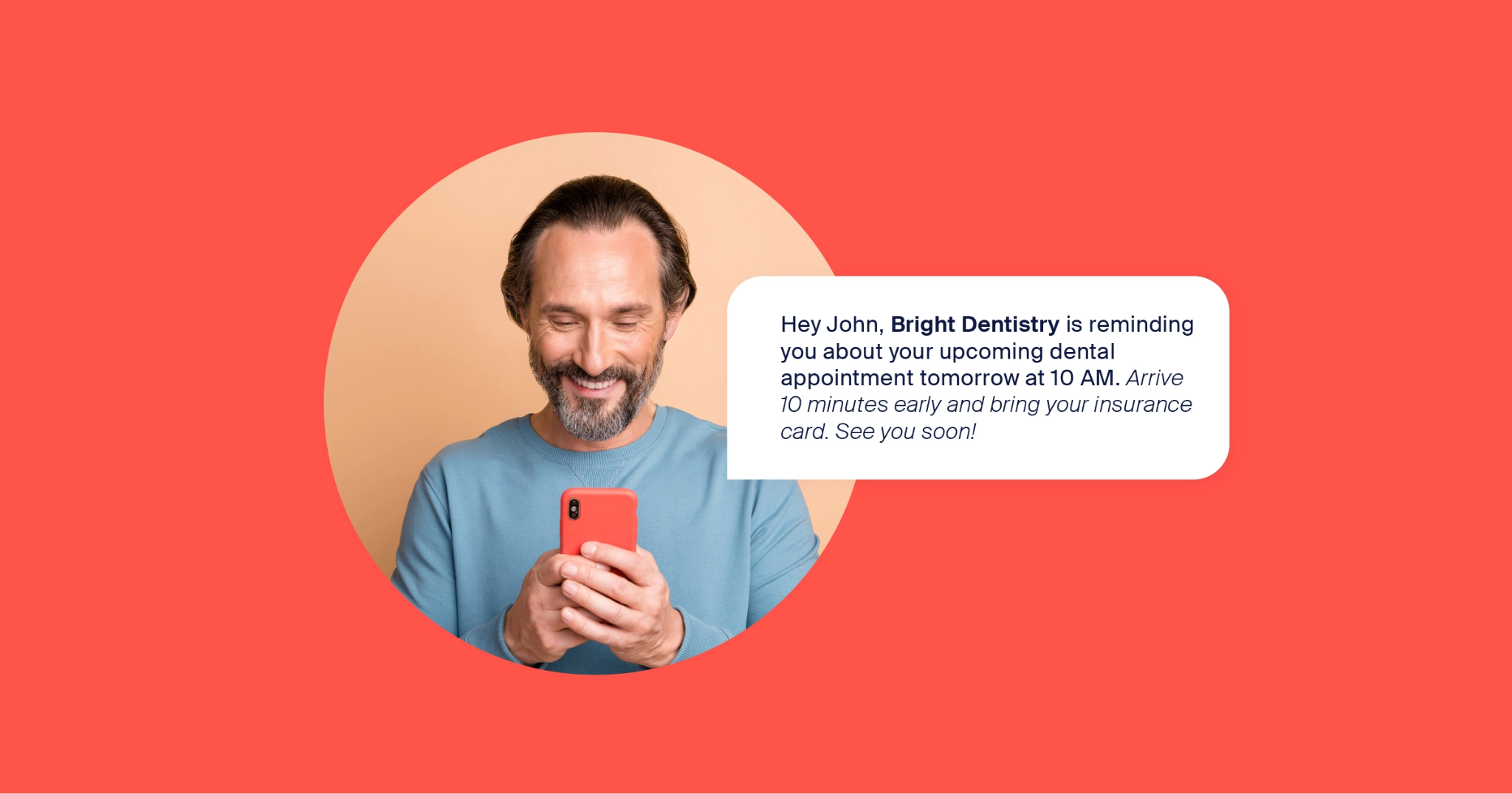
Stay in touch with your customers, reduce no-shows, and increase attendance rates with a simple text message reminder. Service-based companies rely heavily on appointments and reservations.
Whether you are a restaurant owner, doctor, lawyer, or consultant, text reminders can positively influence your conversion rates. In fact, alerting your customers of upcoming appointments or reservations can reduce no-show rates by over 23%.
Example: "Reminder: Your dinner appointment is tomorrow at 10:00 PM. Reply YES to confirm or call (555) 123-4567 to reschedule."
3. Send Timely Notifications
Keep your customers in the loop by sending timely notifications regarding an order, a booking, or any other form of activity. Most successful companies recognize the importance of sending notification messages. It is the driving force in attracting, retaining, and converting customers.
There are various scenarios in which you can relay automated SMS messages to customers. For instance, you can send an order confirmation text message to an online shopper or perhaps let a recipient know that their meal order is in process.
Example: "Your order #48291 has been shipped and is expected to arrive on June 15. Track your package here: example.com/track"
4. Announce Product Launches
A text message campaign can serve as a direct way to keep your subscribers up to date with new product or service launches. You can also offer early access to loyalty program members. Collecting relevant information about new leads can make this approach even more effective.
Build your product and marketing to attract the right audience by figuring out which segments are interested enough to opt in. It also pays to know why they are interested.
Example: "Introducing our newest wireless headphones. Shop before anyone else and enjoy 15% off during the first 48 hours: example.com/new"
5. Request Feedback
If done right, SMS surveys and feedback requests are known to generate more responses than email marketing. This means keeping them simple and not longer than two or three multiple-choice questions. It’s an excellent way to collect quantitative data that you can use to enhance the customer experience by pinpointing areas for improvement.
Example: "Thanks for your recent purchase! We'd love your feedback. Rate your experience in less than 30 seconds: example.com/survey"
6. Become Your Customers’ Trusted Guide in the Industry
Build trust with your customers and stand out as an industry expert by sending messages with periodic informative tips. This is especially relevant if your customer base is information-hungry. Become a trusted source of useful advice for your customers. For example, if you are a gym owner, you can send brief tips and tricks on muscle-gain meal plans.
Example: "Fitness Tip of the Week: Aim for 20–30g of protein within an hour after your workout to support muscle recovery and growth."
7. Generate a Pop Quiz SMS Campaign
SMS is a personal and informal channel, making it ideal for entertaining campaigns. Boost customer engagement with a trivia question marketing campaign. Ask them questions about your company, brand, specific products, or trending topics associated with your brand. Offer special prices or discounts for those who answer the question correctly first.
This type of campaign SMS not only creates favorable interaction with your customers, but it also boosts customer loyalty rates.
Example: "Trivia Time! What year was our company founded? Reply with your answer for a chance to win a $25 gift card. Winner announced tomorrow!"
8. Personalize Your SMS Marketing for Every Customer
When collecting customers’ phone numbers, you’ll most likely come across details like customer name, age, and gender. Use this data to your advantage and take a highly personal approach to each customer. Congratulate your customers’ birthdays with a message and give them a special discount for the occasion; a little attention goes a long way.
Example: "Happy Birthday, Amy! Enjoy 20% off your next purchase this month with code BDAY20. Thanks for being part of our community."
9. Run Sweepstakes Contests
SMS-based sweepstakes contests allow customers to participate by sending a keyword or entering their information via SMS. These can generate excitement, increase engagement, and build brand awareness. Text-to-win contests are popular in industries such as consumer goods, travel, sports, and entertainment.
Example: Hi Sam! Text 'SWEEPSTAKES' to this number for a shot at winning a dream vacation for two. Don't miss out on this incredible opportunity from Salute the Sky!
10. Let Shoppers Know When Products Are Back in Stock
Thanks to back-in-stock alerts, businesses can notify customers when a product they were interested in becomes available again. This type of SMS text advertising creates a sense of urgency and allows customers to make a timely purchase, specifically in industries like electronics and collectibles.
Example: Great news, Anna! Your favorite product is back in stock. Hurry and grab yours before they sell out again: bit.ly/p1we1
11. Textable Coupons
We’ve all received SMS coupons at some point. These are exclusive discount codes or offers that customers can redeem by showing the SMS text at the point of purchase. This can be used by various industries, including restaurants, retail stores, and entertainment venues, to drive foot traffic and encourage immediate purchases.
Example:Congratulations, James! Show this message at Flavoroso and enjoy a free appetizer with your meal. Valid for your next visit within the next 7 days.
Top Text Marketing Campaign Best Practices
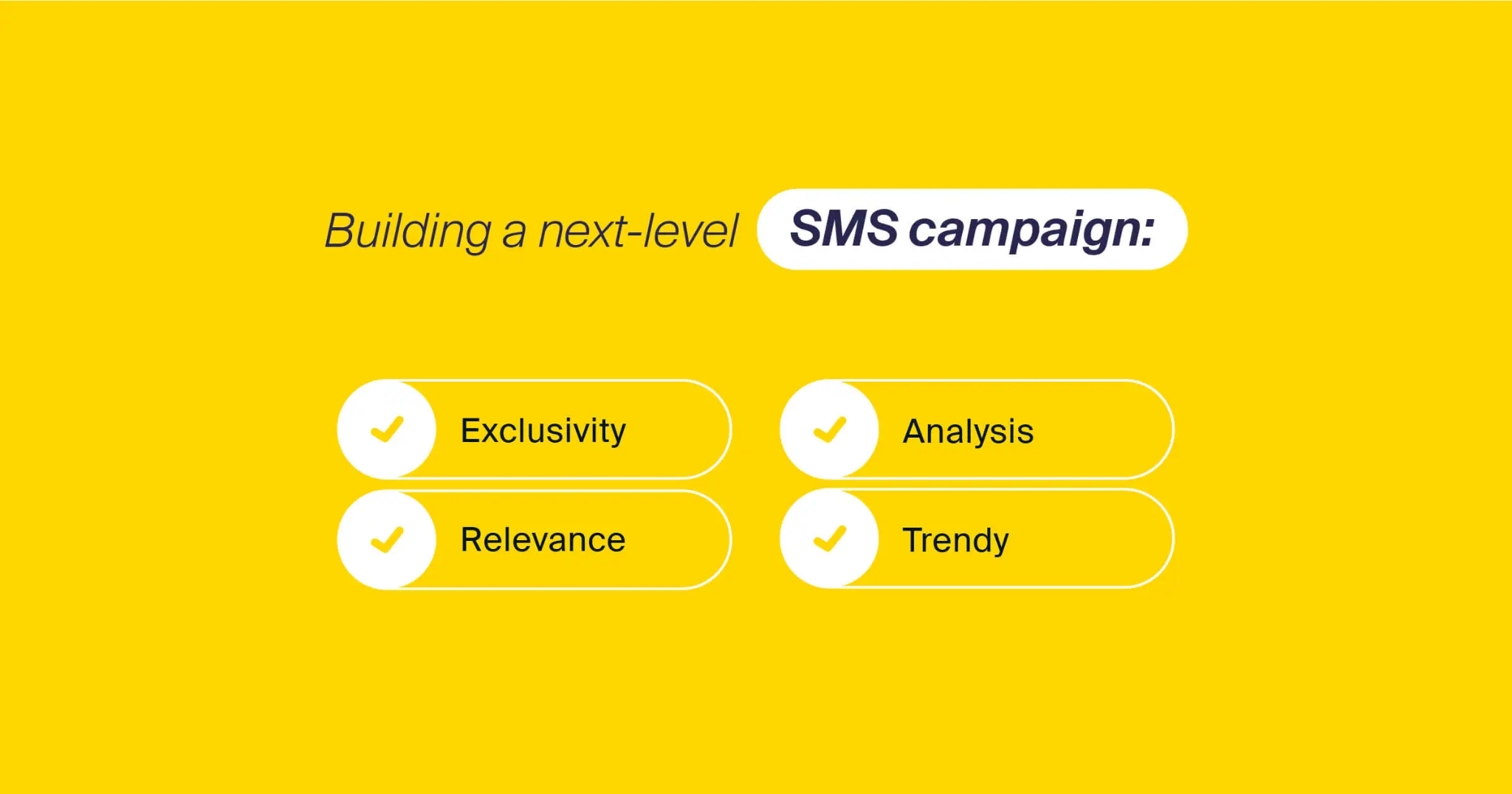
Both small and large enterprises make use of bulk SMS messaging to get their customers’ attention quickly and cost-effectively. But you’ll still need to take certain measures to ensure you’re not bothering your customers with untimely or irrelevant text messages. These SMS marketing best practices show how you can make the most of your campaigns.
Be Exclusive
Who doesn’t like to be part of something special? Provide that sense of exclusivity to your customers and allow them to experience the thrill of feeling special via SMS offers. Make your recipients feel valued, unique, and not like they’re just another name on your contact list.
Be Relevant
Ideally, you wouldn’t send the same text campaign to your new and existing customers. New customers, for instance, may prefer receiving promos while existing customers favor rewards from loyalty SMS programs.
Audience segmentation enables you to divide your customers into groups based on common traits and send relevant SMS messages to each group. This raises the efficiency of your SMS and ensures a high response rate.
The KISS Principle
Implement a KISS strategy for an effective marketing campaign. And no, there isn’t any physical contact involved in this strategy. KISS stands for “Keep it short and simple,” meaning you should express your message in a clear manner and tell the recipient what to do next. And since SMS messages have a 160-character limit, you already have a restriction for conveying your message.
Keep It Light and Fun
People associate text messages with informal conversations; they use SMS messaging to communicate with friends and family. You want your SMS campaign to maintain that lightness and fun nature of texting.
Apply a friendly tone and personalized approach to ensure better trust among customers. Specialists prefer to use texting abbreviations such as “fyi” and “aka” in their campaigns to make the interaction casual. This also helps prevent the text message from exceeding the character limit.
Timing Matters
When it comes to developing a successful SMS marketing strategy, timing is everything. Consider the time of the day that’s most appropriate to send SMS marketing messages. Ideally, aim to reach out on the weekdays from 11 a.m. to noon (during lunch hours) and from 5 p.m. to 7 p.m. (directly after work hours).
It’s also a good idea to define the optimal frequency of messages to send to your customers. Nothing drives away customers more than spamming them with endless waves of SMS text messages.
Measure Campaign Effectiveness
To maximize the potential of your SMS message campaign, you must understand the flaws and strengths of your marketing strategy. Analyze your customers’ feedback and gather statistics to see how your campaign is performing.
Low open rates indicate that something is wrong with your message. Perhaps you need to retarget your audience or try a different approach. Compare different metrics and shape your texts accordingly to drive the best results.
Using an SMS Campaign Software
A high-quality software such as the Dexatel platform allows you to power your text campaign and implement marketing automation. You can use it to automatically reach your potential customers as well as existing ones. Distinctive features of a good SMS marketing platform include:
Mass group texting
Automatic text replies
Text message scheduling
Comprehensive analytics
Built-in link shortening
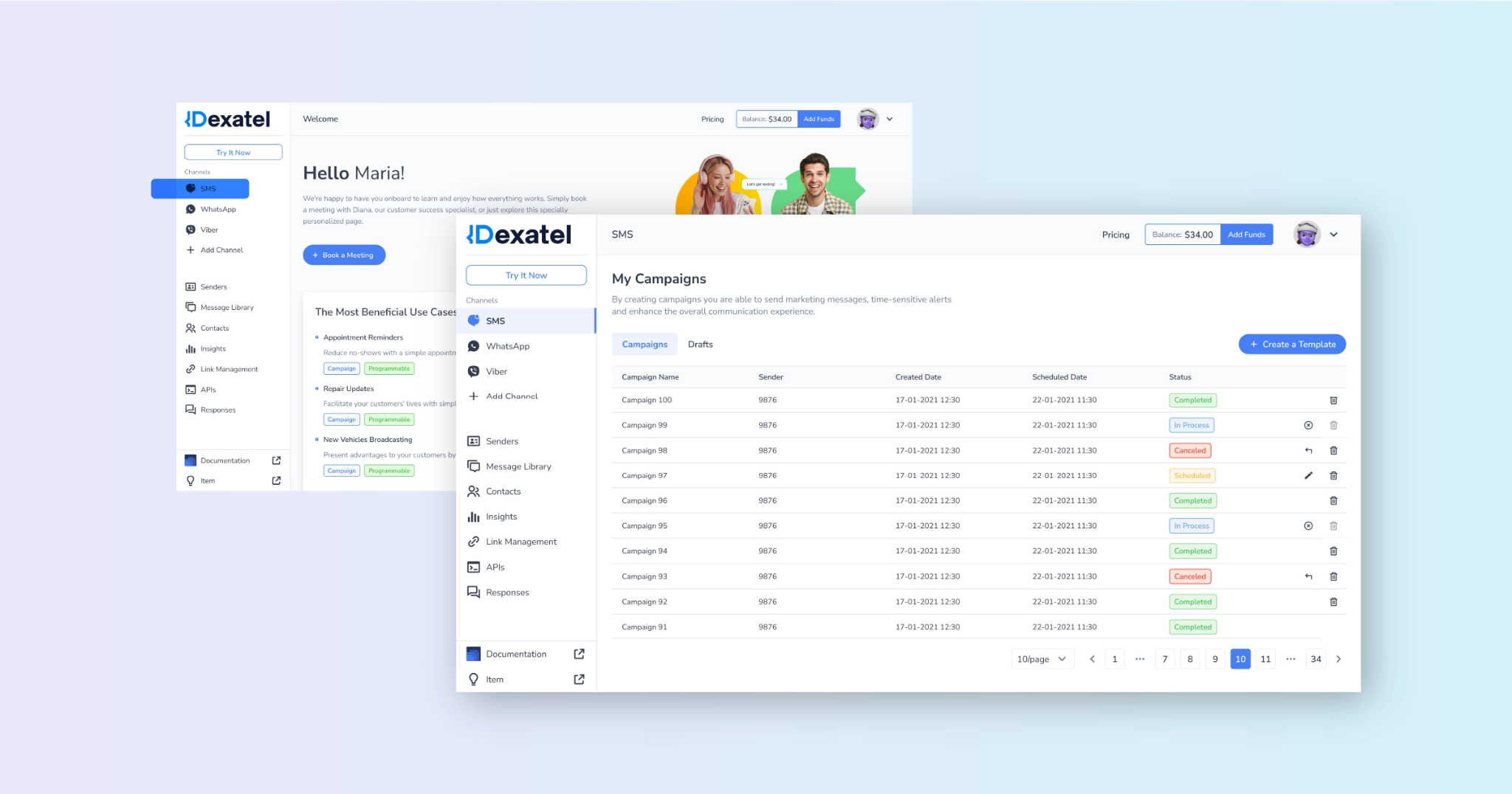
How To Create a Text Campaign With Dexatel
With Dexatel Campaigns, you can launch SMS, WhatsApp, and Viber campaigns from a single dashboard. The platform combines audience management, AI-powered content creation, campaign automation, scheduling, analytics, and reporting tools to help businesses communicate with customers at scale. Here's a walkthrough of the process:
Step 1: Choose Your Communication Channel
Start by selecting the channel you want to use for your campaign. Depending on your audience and goals, you can launch campaigns through SMS, WhatsApp, or Viber from the same platform.
Step 2: Create Your Campaign
Create a new campaign and define its objective, audience, and delivery settings. Organizing campaigns by purpose makes it easier to track performance and optimize future messaging efforts.
Step 3: Build Your Message
Compose your message manually, select a pre-built template, or use Dexatel's AI-powered messaging tools to generate campaign copy. Personalization fields can be added to tailor messages for individual recipients.
Step 4: Segment Your Audience
Select recipients from existing contact lists or create audience segments based on customer attributes, engagement history, location, behavior, or other criteria. Audience segmentation helps improve relevance and campaign performance.
Step 5: Schedule or Automate Delivery
Launch your campaign immediately, schedule it for a future date and time, or incorporate it into automated customer journeys. Businesses can create recurring campaigns and trigger messages based on customer actions and predefined workflows.
Step 6: Monitor Results in Real Time
Track delivery rates, click-through rates, engagement metrics, unsubscribe activity, and overall campaign performance through Dexatel's analytics dashboard. Real-time reporting helps marketers identify opportunities for optimization and measure campaign ROI more effectively.
Run SMS campaigns that drive real results
Design, send, and track bulk messaging campaigns with ease. From promotions to drip sequences — all in one intuitive platform.
How to Measure SMS Campaign Performance
Launching an SMS campaign is only the first step. To maximize results, businesses should continuously monitor campaign performance and identify opportunities for improvement. By tracking key SMS marketing metrics, you can better understand audience engagement, optimize future campaigns, and improve overall return on investment.
Delivery Rate
Delivery rate measures the percentage of messages successfully delivered to recipients. A high delivery rate typically indicates healthy contact lists, proper compliance practices, and reliable carrier connectivity. Most businesses aim for delivery rates above 95%, although results may vary depending on destination markets and list quality.
Click-Through Rate (CTR)
Click-through rate measures how many recipients clicked a link within your SMS message. CTR helps evaluate the effectiveness of your offer, call to action, audience targeting, and message content. SMS campaigns often achieve significantly higher CTRs than email campaigns, with many businesses targeting 5%–15% or higher depending on the use case.
Conversion Rate
Conversion rate measures the percentage of recipients who completed a desired action after receiving your message. This action could be a purchase, registration, booking, survey response, or any other campaign goal. Since conversions directly impact revenue, this is often one of the most important metrics for evaluating campaign success.
Opt-Out Rate
Opt-out rate tracks how many recipients unsubscribe after receiving a campaign. A consistently high opt-out rate may indicate excessive messaging frequency, poor audience targeting, or irrelevant content. Most successful SMS programs strive to keep opt-out rates as low as possible while maintaining engagement.
Revenue and Return on Investment (ROI)
ROI measures how much revenue a campaign generates compared to its cost. By comparing campaign revenue against messaging expenses, businesses can determine which campaigns, audience segments, and promotional offers deliver the strongest financial results. Monitoring ROI over time helps guide budget allocation and campaign strategy.
Audience Growth Rate
Subscriber growth is another useful indicator of long-term SMS marketing success. Tracking how quickly your opt-in list grows helps you understand whether your acquisition efforts, website forms, loyalty programs, and promotional campaigns are attracting new subscribers effectively.
Monitor Performance With Dexatel Analytics
Dexatel provides built-in analytics and reporting tools that allow businesses to monitor campaign performance in real time. Track delivery rates, click activity, audience engagement, unsubscribe trends, and campaign ROI from a centralized dashboard. These insights make it easier to optimize future campaigns, improve targeting, and maximize the value of your SMS marketing investment.
A/B Testing SMS Campaigns for Better Results
Even small changes to an SMS campaign can significantly impact engagement and conversion rates. A/B testing, also known as split testing, allows businesses to compare two versions of a campaign and determine which performs better based on real customer behavior. Rather than relying on assumptions, marketers can use data to optimize future campaigns and maximize ROI.
One of the most common elements to test is message copy. For example, you might compare a direct promotional message against one that emphasizes urgency or exclusivity. Calls to action (CTAs) are another important variable, as different wording can influence click-through and conversion rates. Businesses can also test send times to identify when subscribers are most likely to engage with messages, whether that's during business hours, evenings, or weekends.
Other useful variables include sender names, promotional offers, personalization levels, and message length. However, to obtain reliable results, it's important to test only one variable at a time and send each variation to similar audience segments. Once enough data has been collected, businesses can compare delivery rates, click-through rates, conversions, and opt-out rates to identify the highest-performing version.
Dexatel Campaigns supports A/B testing and campaign analytics, making it easier to experiment with different messaging strategies and continuously improve SMS marketing performance over time.
Best Times to Send SMS Marketing Campaigns
Timing plays a major role in SMS marketing performance. Because text messages are typically read within minutes of delivery, sending messages when recipients are most likely to engage can significantly improve click-through rates, conversions, and overall ROI.
While every audience behaves differently, many businesses see strong results during the following windows:
Weekday mornings: 10 AM–12 PM
Weekday evenings: 5 PM–8 PM
Sunday late mornings: 10 AM–12 PM
These periods often align with natural breaks in the day when people are more likely to check their phones and respond to marketing messages. Retail promotions, appointment reminders, event notifications, and limited-time offers frequently perform well during these engagement windows.
Businesses should generally avoid sending promotional SMS messages late at night, very early in the morning, or during times when recipients are unlikely to take action. Excessive messaging outside normal waking hours can lead to lower engagement rates, higher opt-out rates, and a poorer customer experience.
That said, there is no universal best time for every audience. A restaurant promoting lunch specials may see better results before midday, while an eCommerce brand could perform better during evening shopping hours. The most effective approach is to use A/B testing to compare different send times and identify the windows that consistently generate the highest engagement, conversion rates, and SMS marketing ROI for your specific audience.
How Automated SMS Campaigns Improve Marketing ROI
Not every SMS campaign needs to be sent manually. Many businesses increase engagement and revenue by using automated SMS workflows that send messages based on customer actions, timing, or predefined triggers. Because these messages are highly relevant to the recipient, they often achieve higher click-through and conversion rates than traditional bulk campaigns.
Common automated SMS campaigns include:
Welcome sequences: Automatically introduce new subscribers to your brand, products, or services after they join your SMS list.
Cart abandonment reminders: Re-engage shoppers who leave products in their cart before completing a purchase.
Post-purchase follow-ups: Send order confirmations, delivery updates, product recommendations, and review requests after a transaction.
Lead nurturing campaigns: Deliver educational content, offers, or reminders designed to move prospects further through the sales funnel.
Re-engagement campaigns: Reach inactive customers with targeted promotions or incentives to encourage repeat purchases.
For example, an eCommerce business might automatically send a cart abandonment reminder one hour after a customer leaves the checkout process, followed by a limited-time discount if the purchase remains incomplete. Similarly, a welcome series can introduce new subscribers to your products and encourage a first purchase without requiring any manual intervention.
Automated workflows help businesses deliver the right message at the right time while reducing operational effort. When combined with audience segmentation, personalization, and performance tracking, automated SMS campaigns can become one of the highest-performing components of an overall SMS marketing strategy. Businesses using the Dexatel Campaigns platform can build and manage these automated customer journeys from a centralized interface while tracking engagement and conversion performance in real time.
Combining SMS Marketing With Email and Other Channels
SMS is most effective when used as part of a broader omnichannel marketing strategy rather than as a standalone channel. While email remains valuable for newsletters, product updates, and long-form content, SMS excels at delivering time-sensitive messages that require immediate attention. Using both channels together allows businesses to engage customers at different stages of the customer journey while maximizing overall marketing performance.
For example, a retailer might send a promotional email announcing a weekend sale and then follow up with an SMS reminder a few hours before the promotion ends. Businesses can also use SMS to re-engage subscribers who did not open an email campaign, recover abandoned carts, or drive attendance for events and webinars.
Other channels such as WhatsApp, Viber, push notifications, and social media can further support customer communication efforts. By coordinating messaging across multiple channels, businesses can create more consistent customer experiences while increasing reach, engagement, and conversions. The most successful marketing strategies use each channel for its strengths, with SMS often serving as the high-visibility touchpoint that drives immediate action.
SMS Marketing Compliance and Regulatory Requirements
SMS marketing regulations exist to protect consumers from unwanted communications and ensure businesses handle customer data responsibly. Before sending promotional text messages, businesses should obtain clear and explicit consent from recipients through website forms, checkout pages, loyalty programs, mobile apps, or keyword-based opt-ins, while clearly explaining the type and frequency of messages subscribers will receive.
In the United States, SMS marketing is subject to regulations such as the Telephone Consumer Protection Act (TCPA), which requires appropriate consent before sending promotional messages and can impose substantial penalties for non-compliance. Businesses that collect or process customer phone numbers in Europe must also consider GDPR requirements, as phone numbers are classified as personal data and must be collected, stored, and used transparently and lawfully.
Equally important is providing subscribers with a simple and reliable way to opt out of future communications, typically through keywords such as STOP, UNSUBSCRIBE, or CANCEL, and ensuring those requests are honored promptly. Organizations should also maintain detailed records of customer consent, including signup timestamps and consent sources, to demonstrate compliance if questions arise. Failure to follow SMS marketing regulations can lead to fines, legal disputes, carrier filtering, blocked messages, reduced deliverability, and reputational damage.
To help businesses manage these requirements, Dexatel provides features such as opt-out management, audience controls, sender registration support, consent-based messaging workflows, and reporting tools that simplify compliance while supporting effective SMS marketing campaigns.
SMS, WhatsApp, and Viber Campaigns Compared
SMS campaigns are ideal for delivering critical updates that require immediate attention, such as OTPs, appointment reminders, delivery notifications, promotional offers, and time-sensitive alerts. Because SMS works on virtually any mobile phone without requiring internet access or a dedicated app, it offers exceptional reach and consistently high visibility. It's particularly effective for concise messages where speed and deliverability are the top priorities.
WhatsApp campaigns are the better choice for interactive customer communication, relationship building, and personalized marketing. Businesses can leverage rich media content, including images, videos, buttons, and interactive message templates, while maintaining two-way conversations through verified business accounts. This makes WhatsApp particularly useful for customer support, lead nurturing, and engagement-focused campaigns.
Viber campaigns come in handy for businesses looking to create branded, visually engaging experiences. With support for images, GIFs, stickers, call-to-action buttons, and customized sender branding, Viber enables businesses to deliver promotional content in a more interactive format. It can be especially effective for loyalty initiatives, customer engagement programs, and large-scale promotional campaigns in markets where Viber has a strong user base.
With Dexatel Campaigns, businesses can manage SMS, WhatsApp, and Viber messaging from a single platform. This unified approach simplifies audience management, campaign automation, delivery monitoring, analytics, and reporting across multiple communication channels.
Common SMS Marketing Challenges and How to Avoid Them
While SMS marketing can deliver excellent engagement and ROI, it is not without challenges. Understanding these limitations can help businesses build more effective campaigns and avoid common mistakes that reduce performance.
Message Fatigue and Subscriber Opt-outs
Because SMS is a highly personal channel, sending too many messages can quickly lead to subscriber frustration and increased opt-out rates. Businesses should focus on sending relevant, timely content rather than maximizing message volume. Audience segmentation and preference management can help ensure subscribers receive messages they actually want.
Messaging Costs at Scale
SMS is generally cost-effective, but costs can increase as subscriber lists grow and campaign volume expands. Businesses running international campaigns may also encounter varying carrier fees and country-specific pricing. Multimedia messaging and premium messaging routes can further increase costs compared to standard SMS.
Character Limitations
A standard SMS message is limited to 160 characters, requiring marketers to communicate clearly and concisely. While longer messages can be sent, they are often split into multiple message segments, which may increase costs and affect readability. Effective SMS campaigns prioritize clear calls to action and concise messaging.
Attribution and Performance Tracking
Measuring SMS performance can be more complex than simply tracking clicks. Businesses often need to combine multiple attribution methods—such as UTM parameters, promo codes, landing pages, and call tracking—to accurately connect SMS activity to revenue. Establishing a tracking framework before launching campaigns makes ROI measurement significantly easier.
Start Building More Effective Messaging Campaigns Today
Successful messaging campaigns combine the right audience, timing, content, and delivery channel to drive meaningful customer engagement. Whether you're promoting a new product, sending time-sensitive offers, managing event communications, or strengthening customer loyalty, SMS, WhatsApp, and Viber campaigns can help you reach customers quickly and effectively.
Launch your next messaging campaign with Dexatel and connect with customers through a user-friendly dashboard.
Run SMS campaigns that drive real results
Design, send, and track bulk messaging campaigns with ease. From promotions to drip sequences — all in one intuitive platform.
Frequently Asked Questions
What is an SMS marketing campaign?
An SMS marketing campaign is a coordinated effort to send promotional, informational, or transactional text messages to a group of opted-in subscribers. Businesses use SMS campaigns to share special offers, announce new products, send reminders, promote events, and engage customers directly on their mobile devices. Because text messages typically have high open rates, SMS remains one of the most effective customer communication channels.
What is an SMS marketing platform?
An SMS marketing platform is a tool that helps businesses create, send, automate, and analyze text message campaigns. Many platforms, such as Dexatel, also include audience segmentation, personalization, scheduling, and reporting features.
What is the best SMS platform?
The best SMS platform depends on your business size, budget, geographic reach, and feature requirements. Look for a provider that offers reliable delivery, automation tools, analytics, and scalable pricing.
What are the different types of SMS marketing campaigns?
SMS campaigns can serve a variety of business goals, including promotional offers, flash sales, product launches, event invitations, customer loyalty programs, abandoned cart reminders, and customer re-engagement campaigns. Some businesses also use SMS for transactional communications such as appointment reminders, order updates, and delivery notifications. The right campaign type depends on your objectives, audience, and stage of the customer journey.
How do I measure SMS campaign success?
Campaign performance is typically measured using metrics such as delivery rate, click-through rate, conversion rate, opt-out rate, and overall return on investment (ROI). Tracking these metrics helps businesses understand how recipients interact with messages and identify opportunities for improvement. Advanced analytics can also reveal which audiences, offers, and messaging strategies generate the strongest results.
What makes a good SMS marketing campaign?
Successful SMS campaigns deliver relevant messages to the right audience at the right time. Clear calls to action, concise messaging, personalization, audience segmentation, and appropriate sending frequency all contribute to stronger engagement and conversion rates. Businesses should also continuously test and optimize campaigns based on performance data to improve results over time.
How often should businesses send SMS marketing campaigns?
The ideal sending frequency depends on your industry, audience expectations, and campaign goals. Sending too few messages can reduce engagement, while sending too many may lead to subscriber fatigue and increased opt-outs. Most businesses find the best results by maintaining a consistent schedule and prioritizing message relevance over volume.
How quickly can I launch an SMS marketing campaign?
Most businesses can create and send their first SMS campaign within minutes using Dexatel's platform. Once your account is set up and your contact list is uploaded, you can build, schedule, and launch campaigns without requiring technical expertise.
Can I segment my audience before sending a campaign?
Yes. Audience segmentation allows you to target specific customer groups based on demographics, purchase history, location, engagement levels, or other criteria. This helps improve relevance, engagement, and overall campaign performance.
Can I automate SMS campaigns?
Absolutely. You can automate messages based on customer actions, dates, events, or predefined workflows. Automation helps businesses maintain consistent communication while reducing manual effort.
Can I run SMS, WhatsApp, and Viber campaigns from one platform?
Yes. Dexatel Campaigns allows businesses to manage SMS, WhatsApp, and Viber campaigns from a single interface. This makes it easier to coordinate messaging, segment audiences, automate workflows, and track performance across channels.
Do I need a long-term contract to get started?
No. Dexatel offers flexible pricing options that allow businesses to start sending campaigns without committing to long-term contracts. This makes it easier to test campaigns, scale gradually, and control communication costs.
How do I start SMS marketing?
Start by choosing an SMS marketing platform, building an opt-in subscriber list, and defining your campaign goals. Make sure you obtain consent before sending messages and follow all applicable regulations.
Is SMS marketing legal?
Yes, SMS marketing is legal when you obtain proper consent from recipients and comply with local regulations. Requirements vary by country, so businesses should follow the rules that apply to their target markets.
Why is SMS marketing effective?
SMS messages are delivered directly to a user's mobile device and are typically read within minutes. This makes SMS an effective channel for promotions, reminders, alerts, and time-sensitive communications.


