How to Send a Mass Text


Published: Apr 3, 2026
Updated: Oct 29, 2026
To send a mass text, upload your contact list to a mass texting platform, register your sending number, write your message, and schedule it. Use merge tags to personalize each text with details like the recipient’s first name.
Each recipient gets a private SMS instead of joining a group conversation. Replies come back to you, and other recipients never see them.
Three things matter before you send: consent from your contacts, your sending number, and the platform you use. This guide covers each one, explains what mass texting costs, and shows what you can do from your phone alone.
What is a mass text message?
A mass text is one message sent to many people, with each person receiving it individually. You’ll also see it called bulk SMS, a text blast, or SMS broadcasting.
Mass texts sent through a platform are A2P messaging, short for application-to-person. Software delivers the messages, even though a person writes and schedules them. Carriers treat this traffic differently from ordinary texts between two people, with their own registration rules and filtering.
A mass text is not a group chat. Each recipient sees your message and nothing about anyone else on the list.
Mass text vs. group text: privacy and replies
A group text puts everyone in one shared conversation, so every participant sees every other number and every reply. A mass text sends a separate message to each person.
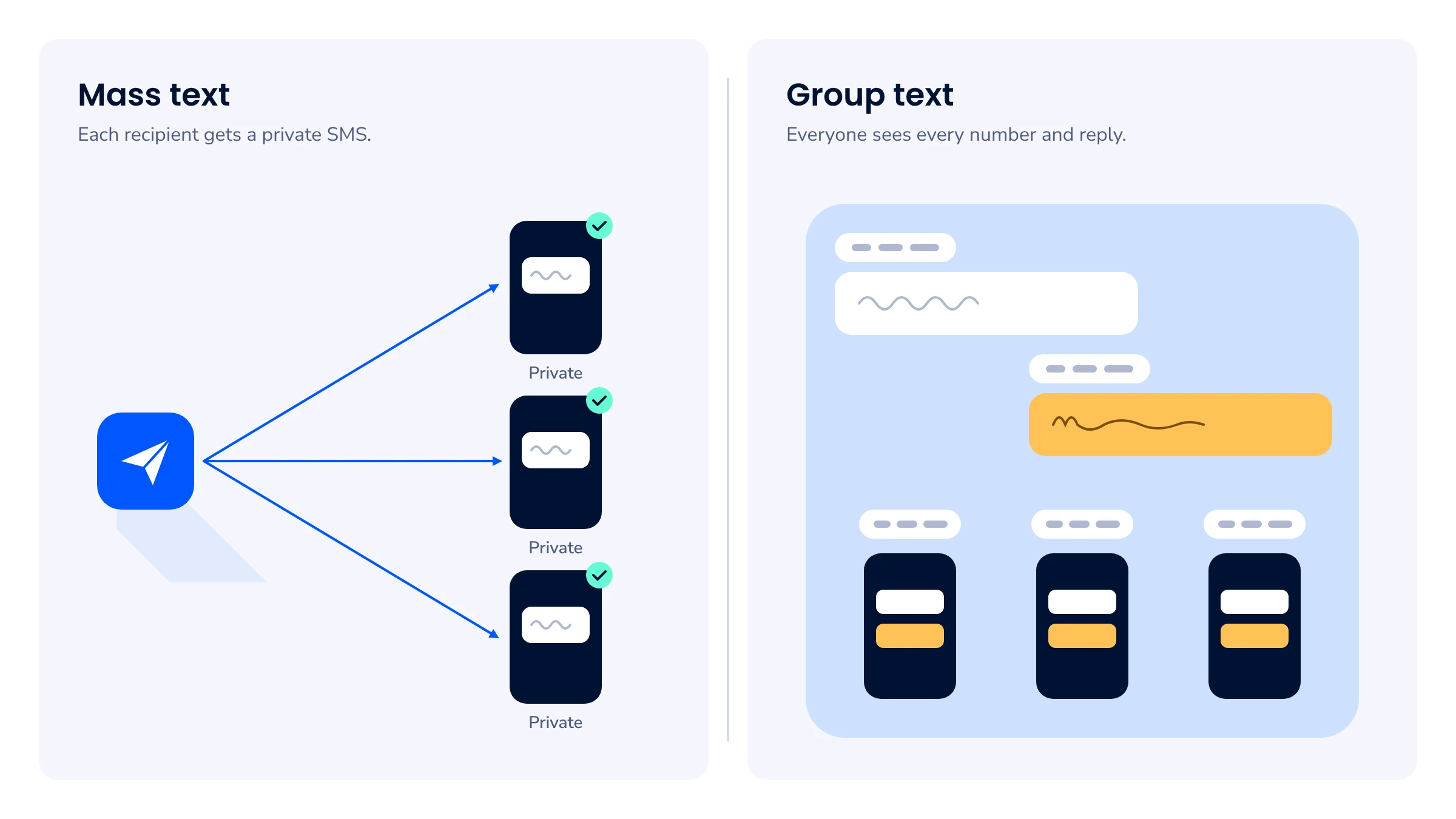
That difference matters for customer messages. A group thread exposes customers’ phone numbers to each other, and one “wrong number” reply notifies everyone on the list. With mass texting, replies stay private. If your platform and sending number support two-way messaging, each response becomes its own conversation that a team member can handle.
Decide before you send whether the message is a broadcast or an invitation to reply:
- One-way broadcasts work for updates that don’t need an answer, like an outage notice or a delivery confirmation. Give people another way to reach you if they need help.
- Two-way messaging works for promotions or payment reminders, where customers may have questions. If you invite replies, make sure someone is watching the inbox.
On a phone, you can avoid a group thread by sending separate messages or by adjusting group messaging settings, though this works best for small lists. A mass texting platform handles it automatically by delivering each SMS on its own.
How to send a mass text in 6 steps
1. Get permission and organize your contacts
Permission has to match the message. Someone who gave you a number for delivery updates hasn’t agreed to receive promotions.
For marketing texts, collect a clear opt-in. A signup form should use an unchecked box and wording that names your business and says what subscribers will receive. Our guide to collecting SMS opt-ins walks through the setup.
Save the phone number, the timestamp, the signup source, and the disclosure the person saw. If someone questions a message later, that record is your evidence.
Organize your list into three segments:
- Message preferences: Keep promotional subscribers separate from people who only signed up for service updates.
- Location: Country and time zone determine your sending hours and your costs.
- Recent activity: Separate active customers from contacts who haven’t engaged in a long time.
Also consider whether your messages will reach the main inbox. iOS can send texts from unknown senders to a separate folder with muted notifications. During signup, explain how subscribers can save your number, so your messages are more likely to be seen.
2. Choose a mass texting platform
A phone can handle a small list, but its messaging app doesn’t keep consent records, process opt-outs automatically, or report on delivery. A mass texting platform does those jobs.
Check these five capabilities:
- Two-way messaging: Receive replies and respond to them.
- A shared inbox: Let your sales or support team see and answer conversations.
- Scheduling: Plan sends and check how the platform handles time zones.
- Contact management and segmentation: Import CSV files, organize audiences, and track opt-out status.
- Integrations: Connect the platform to your CRM so opt-outs stay consistent everywhere.
Integrations matter more than they seem. If someone unsubscribes in one system and the change doesn’t reach the others, that contact can be texted again. Check how each integration syncs opt-outs. An SMS API can also trigger texts from events such as an order update.
Dexatel’s mass text messaging platform includes these features. It comes with free trial credits and no credit card required, so you can test delivery before importing your full list. You can review the available integrations as well.
3. Register your sending number
US carriers require business texts from local numbers to be registered. Unregistered traffic can be blocked or throttled, even when recipients have opted in, so don’t leave registration until the day you plan to send.
Registration has two parts:
- Brand registration identifies your business.
- Campaign registration describes the messages you’ll send, with sample texts and opt-in details.
Carriers use the brand’s vetting level to set how many messages you can send in a given period. Toll-free numbers and short codes follow different approval processes. For more detail, read our guide to A2P 10DLC.
4. Write the message
Give each message one purpose and one next step. Open with your business name so people know who is texting, state the reason right away, and end with the action and the opt-out line.
Merge tags pull details like a first name or an order number from each contact’s record. Set a fallback for missing data so nobody receives “Hi ,”. Marketing texts also need opt-out wording, such as “Reply STOP to unsubscribe,” and your platform has to process those replies.
5. Schedule, test, and send
Send only during permitted hours in each recipient’s time zone. The federal rule for covered telephone solicitations bars them before 8 a.m. or after 9 p.m. local time at the recipient’s location, under 47 CFR § 64.1200. Check state rules as well.
For example, a message sent at 8:30 p.m. Pacific reaches East Coast contacts at 11:30 p.m. Eastern, which is outside the window. Scheduling by time zone is a compliance step, not just a convenience. An area code doesn’t always show where someone lives, so use the best location data you have.
Before you launch, send a test and check that:
- Your business name and message read clearly.
- Merge tags and fallbacks display correctly.
- Links open the right page.
- Opt-out replies work.
- Your audience, exclusions, and time zones are set correctly.
6. Review the results
Track four numbers:
| Metric | What it tells you |
|---|---|
| Delivery rate | How many messages were delivered. A drop can point to carrier filtering or invalid numbers. |
| Response rate | How many people replied, especially when the message asked for a reply. |
| Click-through rate | How many people clicked a tracked link. |
| Opt-out rate | How many people unsubscribed. A rising number means you’re messaging too often or sending content people didn’t expect. |
Use these results to adjust your audience, content, and frequency. Dexatel’s campaign reporting shows all four in one place.
Which number should you send from?
There are four main options. Your choice depends on volume, whether you need replies, and the countries you’re reaching.
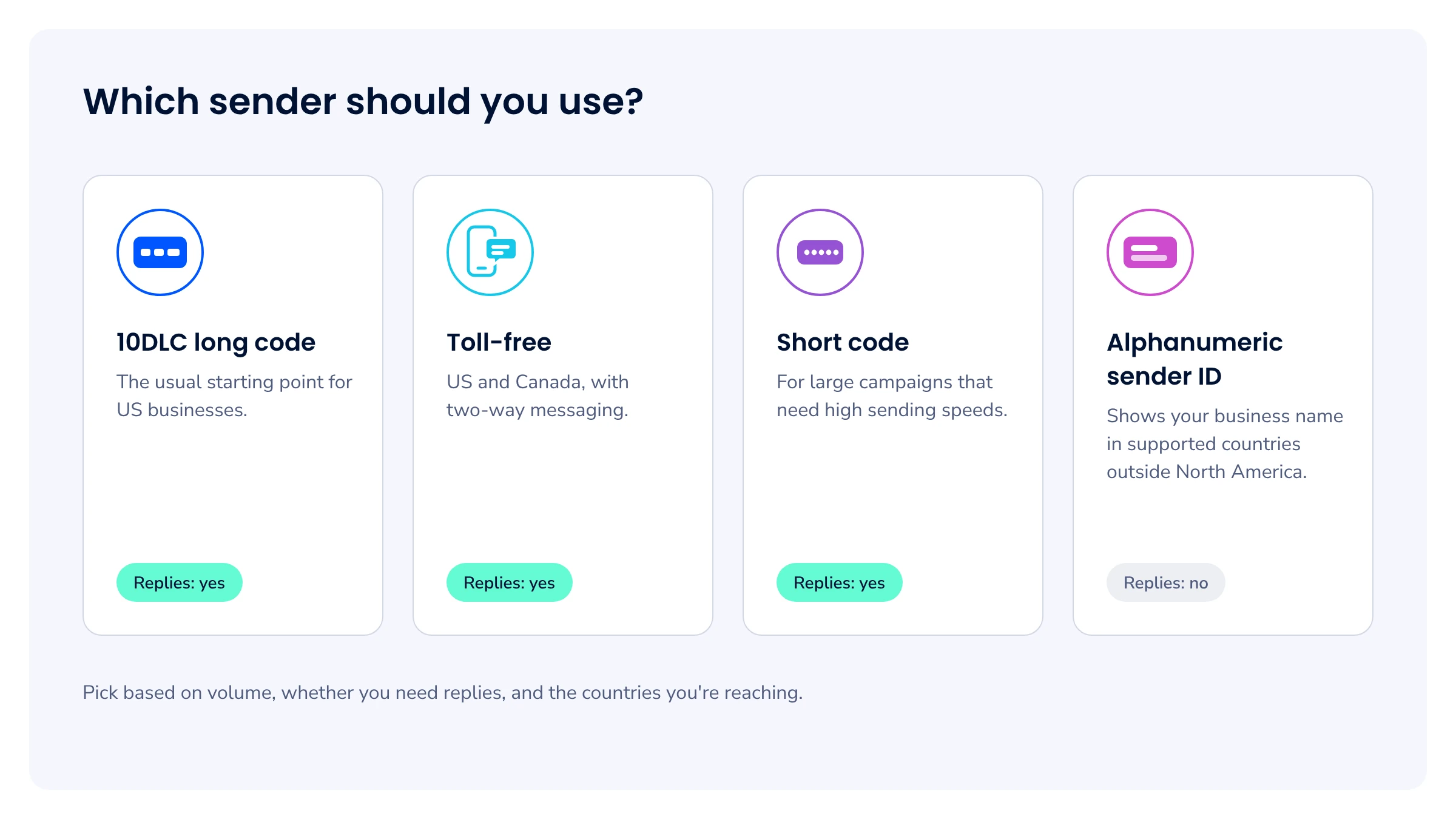
| Sender type | Best for | Supports replies? | Dexatel fees |
|---|---|---|---|
| 10DLC long code | Moderate-volume US business texting | Yes | $4 one-time brand registration; $10 per month per campaign |
| Toll-free number | Business messaging in the US and Canada | Yes | $2 one-time setup; $2 per month |
| Short code | Large campaigns that need high sending speeds | Yes | $1,000 per month (random); $2,000 per month (vanity) |
| Alphanumeric sender ID | Showing your business name in supported countries | No | Registration varies by country |
Fees from Dexatel’s SMS pricing page. Message charges are separate.
Most US businesses start with a 10DLC long code. It handles campaigns and one-to-one conversations from a local number at a low registration cost. A dedicated short code makes sense when speed is the limit, such as an alert system that has to reach thousands of subscribers within minutes. Our comparison of long codes and short codes covers the trade-offs. Toll-free texting is another option for US and Canadian campaigns.
An alphanumeric sender ID shows your business name instead of a number in many countries outside North America. Recipients can’t reply to it, and some countries require the sender ID to be registered in advance. Check each destination before you plan a launch. A branded sender ID helps recipients recognize your messages, so give them another way to reach you.
Is mass texting legal?
Yes, when you have consent, honor opt-outs, and meet the rules that apply to your messages. In the US, three layers matter: federal law, state law, and carrier policies.
Get consent before you send
Marketing texts require prior express written consent under the federal Telephone Consumer Protection Act (TCPA). A pre-checked box doesn’t count, and neither does a number collected for a different purpose. The disclosure should name the sender, say that message and data rates may apply, and explain how to stop.
A signup form can use wording like this:
“By checking this box, I agree to receive recurring automated marketing texts from [Company] at the number provided. Consent is not a condition of purchase. Message and data rates may apply. Reply STOP to unsubscribe or HELP for help.”
Adapt this to your program, and link to your terms and privacy policy. Wording alone doesn’t prove consent. Keep a record of the action the person took, the disclosure they saw, their number, and the timestamp.
Transactional texts, such as order confirmations, follow a different standard, but the practical advice is the same: keep records, and don’t use a service message to send a promotion.
The stakes are high. TCPA damages run $500 per violation, rising to $1,500 when a court finds the violation was willful or knowing, under 47 U.S.C. § 227. Courts generally count each text as its own violation, so one non-compliant send to thousands of people can add up quickly.
Make opting out easy
Recipients can revoke consent by any reasonable method, and common reply keywords include STOP, QUIT, END, REVOKE, OPT OUT, CANCEL, and UNSUBSCRIBE. Honor revocations promptly, and within the FCC’s deadline of no more than 10 business days. Use automatic opt-out handling so each request is applied across your systems.
The FCC adopted new revocation rules on September 30, 2026 (FCC 26-67). Under the order, a business that designates a specific opt-out method, such as a reply keyword, doesn’t have to process revocations sent through other methods. For informational messages, such as appointment reminders or order updates, a person can opt out of one category without giving up the others. Revoking marketing messages still covers all future marketing from that sender. The rules take effect 30 days after publication in the Federal Register, and the FCC is asking whether the 10-business-day deadline should be shortened, so check for updates before you finalize your process.
The FCC has also delayed the requirement to honor revocations across all message types until January 31, 2027. Building a single “revoke all” option now is still the safer choice.
Check state rules
Several states add their own requirements, so check them before you message residents there. Texas is a good example. Senate Bill 140, effective September 1, 2025, brought text messages under the state’s telephone solicitation rules. Businesses that send marketing texts may need to register with the Texas Secretary of State, pay a $200 fee, and post a $10,000 bond. After a 2025 settlement, the Secretary of State’s guidance says businesses that text with prior consent don’t need to complete that registration. The exemption depends on real, documented consent, so keep your records. Read our overview of text messaging privacy laws for more detail.
Stay out of carrier filters
Carriers filter aggressively to block fraud, and legitimate campaigns can get caught in the net. You can lower the risk by:
- Registering your sender through A2P 10DLC for US local numbers.
- Sending only to people who opted in, and removing invalid or opted-out numbers.
- Identifying your business in every message.
- Using a branded link or trackable short link instead of a public shortener such as bit.ly.
- Avoiding content carriers restrict, including sexual content, hate speech, alcohol, firearms, and tobacco.
Outside the United States
Rules change by country. In the European Union and the United Kingdom, consent must be freely given and documented. In India, commercial SMS through domestic routes generally requires DLT registration of your business, sender header, and message templates before you can send. Other markets have their own sender ID rules.
Build registration time into your launch schedule. Our SMS compliance guide covers each market in more detail.
Sending a mass text from your phone
You can text several people from an iPhone or Android without extra software. For a small internal group, that may be enough.
On iPhone
Messages doesn’t have a dedicated mass-text option. Whether replies come back to you individually depends on your iMessage, RCS, and SMS settings and on how your carrier handles group messages. Before relying on it, send a test to two of your own contacts and check where their replies appear. If you can’t confirm the behavior, send a separate message to each person in its own conversation.
Messages can’t personalize texts or report on delivery, so a message that never arrives fails quietly.
On Android
Google Messages includes a mass text setting. Open your profile icon, go to Messages settings, then Advanced, then Group messaging, and choose the mass text option. Google describes it as sending an SMS to all recipients and receiving individual replies. Start a new conversation, add your recipients, and write your message. Check that the conversation uses SMS rather than an RCS group chat. Google doesn’t publish a recipient limit for this mode, so check your carrier’s restrictions before a large send. Google’s support page has the full steps.
When to switch to a platform
A phone app is missing several things a campaign needs:
- Consent records: The app doesn’t store who opted in, when, and for which messages.
- Opt-out handling: A STOP reply sits in your inbox until someone acts on it.
- Campaign reporting: Phone apps don’t show campaign-wide delivery and response data.
- Sender registration: The app doesn’t handle A2P registration for you.
For recurring customer messages, a bulk SMS platform handles these tasks and still lets you manage campaigns from a phone or browser.
How to write a clear mass text
Keep each message to one purpose and one action. A text that tries to do three things usually gets ignored.
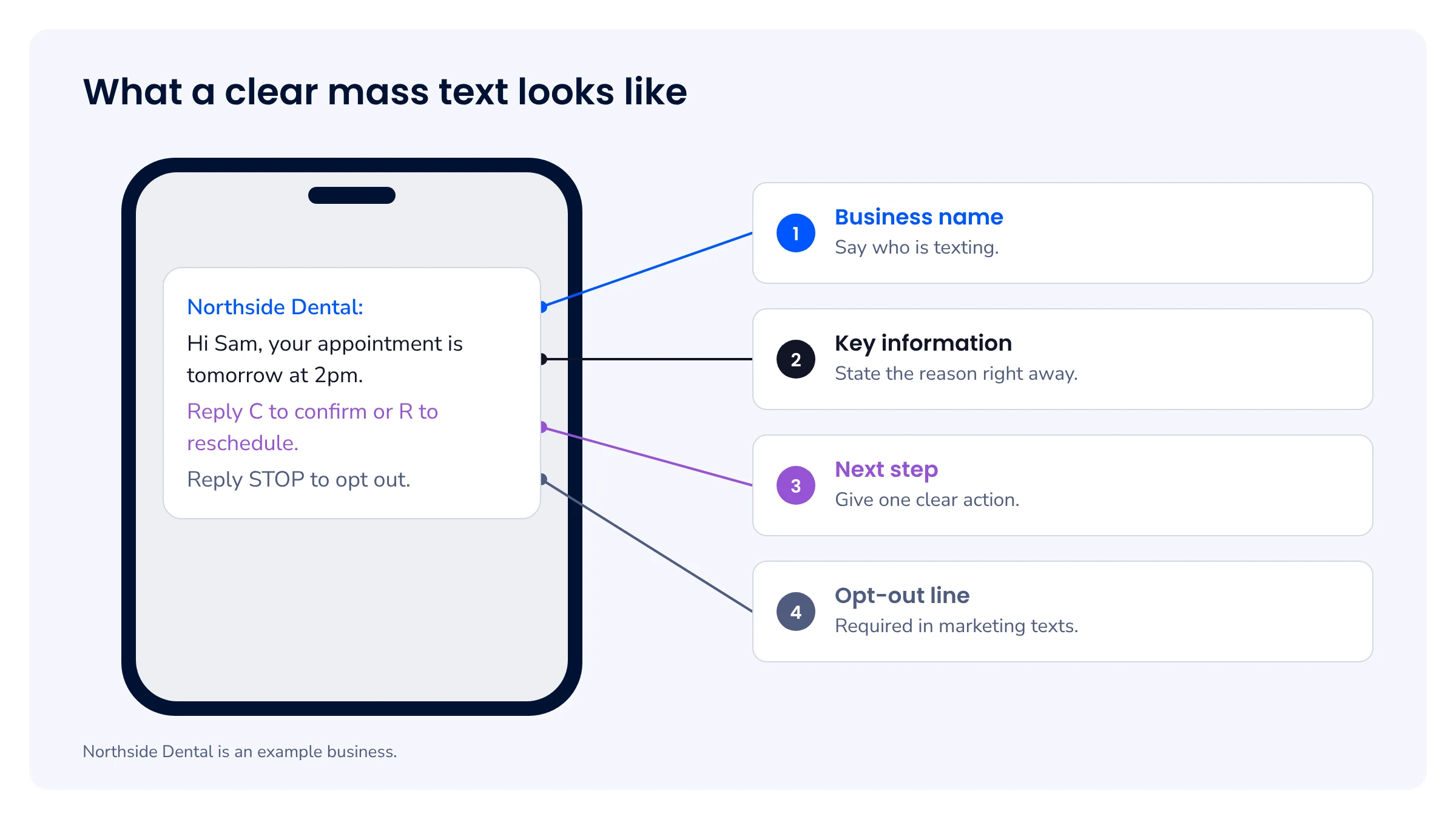
A simple structure works well: business name, key information, next step, opt-out line.
Northside Dental: Hi Sam, your appointment is tomorrow at 2pm. Reply C to confirm or R to reschedule. Reply STOP to opt out.
Five templates you can copy
Replace the merge tags with your details, then check the rendered message before sending. Names, dates, and links change the length.
Appointment reminder
{{company}}: Hi {{first_name}}, your appointment is tomorrow at {{time}}. Reply C to confirm or R to reschedule. Reply STOP to opt out.
Order or delivery update
{{company}}: Hi {{first_name}}, order {{order_id}} ships today. Expected delivery: {{date}}. Track it: {{link}}. Reply STOP to opt out.
Promotion
{{company}}: Hi {{first_name}}, get 20% off through Sunday with code SAVE20. Shop: {{link}}. Reply STOP to opt out.
Payment reminder
{{company}}: Hi {{first_name}}, invoice {{invoice_id}} is due {{date}}. Pay or ask for more time: {{link}}. Reply STOP to opt out.
Service alert
{{company}} alert: Service in {{area}} is down. Estimated restoration: {{time}}. Updates: {{link}}. Reply STOP to opt out.
Include reply instructions only if your number supports replies and someone monitors them. For more examples, see our SMS template library.
Why 160 characters isn’t always 160
A standard SMS segment holds 160 characters when the message uses the GSM-7 alphabet, which covers standard Latin letters, numbers, and common punctuation. Once a message includes characters outside that set, such as an emoji or some accented letters, the segment drops to 70 characters.
Longer messages split into concatenated segments, and each segment carries less text because the phone needs room to reassemble the parts. A curly apostrophe copied from a word processor can switch the whole message to the shorter limit. A 150-character message with one curly apostrophe can become three segments, and you pay for three.
To avoid surprises, write in a plain text field, check the segment counter in your platform after personalization, and use emoji only when they earn their cost. A trackable short link keeps links short and reports clicks.
What does mass texting cost?
You pay per message, and the rate depends on the destination. Dexatel’s published rates are:
| Destination | Price per SMS |
|---|---|
| United States | $0.0229 |
| United Kingdom | $0.0495 |
| Germany | $0.0825 |
Rates from Dexatel’s SMS pricing page.
SMS is pay-as-you-go, with no setup fee, no monthly minimum, and no contract. The price shown is the price charged, with nothing added at checkout. Higher volumes lower the per-message rate, and you can talk to sales about volume pricing.
At the US rate, texting 100 people costs $2.29, and texting 10,000 people costs $229, assuming each message fits in one segment. A message that runs to two segments doubles the cost for each recipient. Sender fees are charged separately, as listed in the table above.
Mass text or mass email?
The right channel depends on how urgent the message is and how much detail it needs.
| What to compare | Mass text | Mass email |
|---|---|---|
| Cost | Charged per SMS, plus sender fees | Usually much lower per recipient |
| Length | Short, about 160 characters per segment | Room for detail, images, and attachments |
| Speed to read | Usually within minutes | Hours or days |
| Replies | Individual conversations | Often goes to an unmonitored address |
| US rules | TCPA, state rules, and carrier registration | CAN-SPAM, with no registration |
Use text for time-sensitive messages, like an appointment tomorrow, a payment due today, or an outage happening now. Use email for anything the reader can act on later. Commercial email still needs accurate sender information, a valid postal address, and a working opt-out method. The FTC’s CAN-SPAM guide explains the requirements.
Many teams use both. Send the full details by email, then text a short reminder to people who haven’t acted yet. Make the text understandable without the email, and respect each channel’s consent rules.
Can you send mass texts for free?
Not at real volume. Carriers charge for delivery, so any service promising unlimited free bulk SMS is covering that cost somewhere.
You can try Dexatel’s mass texting service with free trial credits and no credit card required. Use the trial to confirm that messages deliver, that personalization and links display correctly, and that your opt-in and opt-out flows work.
When SMS isn’t the right channel
SMS reaches almost every phone without an app, which makes it the default for alerts and verification. But if your customers mostly talk in a messaging app, texting may not reach them.
WhatsApp: Business messaging runs through the WhatsApp Business API, not the consumer app. Broadcast lists in the consumer app are capped at 256 recipients and only reach people who have saved your number. The API doesn’t have those limits, but business-initiated messages require approved templates, and each template is billed. Our comparison of WhatsApp options explains which one fits your use case.
Viber and Telegram:Viber Business Messages support richer content than SMS and work well where your customers already use Viber. Telegram channels suit updates to people who subscribe to you, which is different from texting a list you collected.
RCS: RCS adds branding, images, and buttons on supported phones. Coverage depends on the device, the carrier, and the business messaging rollout. Where RCS isn’t available, set up SMS fallback so the message still arrives, written so it makes sense without images or buttons.
How businesses use mass texting
- Reminders: Appointments, deliveries, and payments. These usually get strong replies because recipients expect them.
- Alerts: Outages, safety notices, and urgent service changes. Explain what happened, who is affected, and what to do.
- Promotions: Offers and launches, sent only to people who agreed to marketing texts.
- Confirmations: Orders, bookings, and account changes.
- Internal notices: Shift changes, closures, and urgent updates for staff.
Frequently asked questions
How do I text 100 people at once?
Upload an opted-in list of 100 contacts to a mass texting platform using a CSV file or CRM integration. Choose your sender, write your message, and send or schedule it. Each person receives a separate text. At Dexatel’s US rate, a one-segment message to 100 people costs $2.29 before sender fees.
How many messages can I send per day?
It depends on your number type, registration, and carrier. For US 10DLC messaging, carriers set limits based on brand vetting, and some apply daily caps while others limit messages per minute. Check your assigned limits before a large campaign, and ask your platform how it handles messages above the limit.
Can I send mass texts for free?
Only in limited amounts. Dexatel offers free trial credits with no credit card required, which is enough to test delivery, formatting, and your opt-in process before you commit a full list.
Do I need A2P 10DLC registration to send a mass text?
Yes, if you send from a US local ten-digit number to US recipients through a platform. Carriers require registration for this traffic, even when recipients have opted in. Toll-free numbers and short codes follow separate approval processes.
Can I send a mass text from a computer?
Yes. A browser-based mass texting platform lets you import contacts, write messages, schedule campaigns, and track delivery. Most businesses run campaigns this way, because managing a large list on a phone is impractical.
Will recipients see each other’s phone numbers?
No, when you send through a mass texting platform. Each person receives a separate message and can’t see the list or other replies. On a phone, check that your messages go out as separate texts and not a shared group thread before you send to more than a few people.
Start with a small test
A mass text campaign works when three things are in place: a list that opted in and can prove it, a registered sender, and a platform that handles opt-outs automatically. Miss one of them and the campaign can fail quietly.
Start with a small test to a list you already have consent for. Check delivery first, since that shows whether your setup works. Then look at replies and opt-outs.
You can start for free with trial credits and no credit card required, or review SMS pricing by country before you commit.